
Sanitary rupture disc
Hygienic pressure protection for sterile processes: aseptic STRIKO discs, cleaning, vacuum and the documents your validation needs.
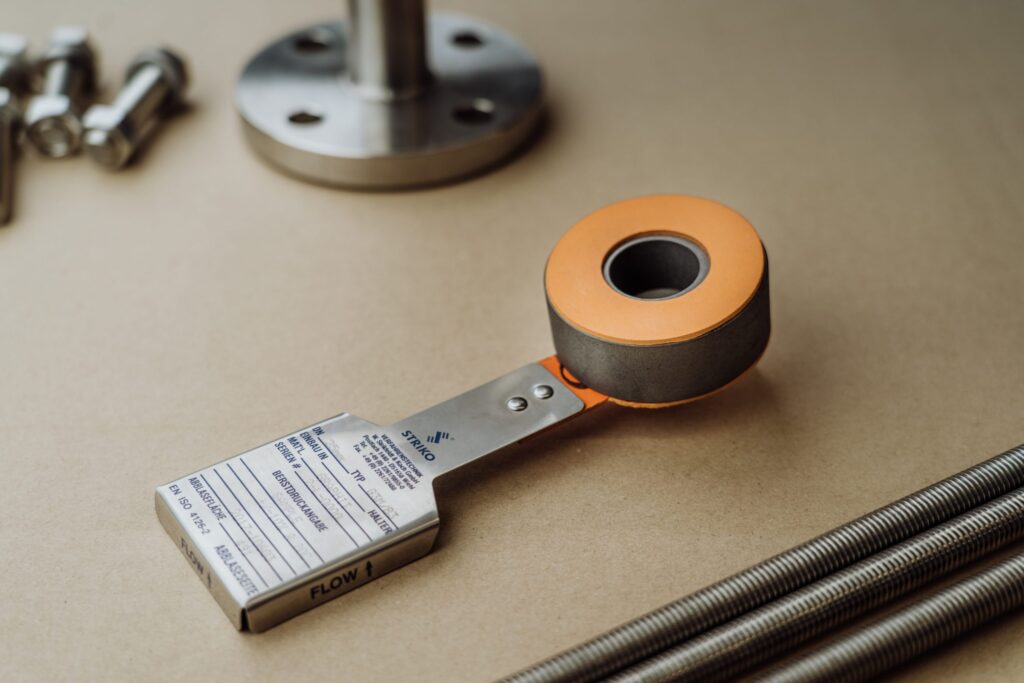
Sanitary rupture disc: protection that must also stay clean
A sanitary rupture disc has to do two jobs that pull in different directions. On the one hand it is a safety device, a calibrated membrane that opens at a set pressure and protects a vessel from overpressure. On the other hand it is a product contact surface in a process where cleanliness is not negotiable. A disc that relieves pressure perfectly but harbours residue in a crevice is not acceptable in a pharmaceutical suite or a food line. A disc that is spotless but bursts at the wrong pressure is not acceptable anywhere.
Think of a bioreactor in a biotech plant. Every batch starts with cleaning, then sterilisation, then filling, then a long period of cultivation in which contamination would mean losing the entire batch. The rupture disc on top of that vessel sees all of those stages. It has to withstand hot cleaning solutions and steam, it must not trap product in dead zones, and it must remain a reliable relief device for the moment something goes wrong. That is what a sanitary design is about.
At Dutch Valve Vision we supply the STRIKO aseptic metal rupture discs that are made for exactly these conditions. As the exclusive agent of STRIKO Verfahrenstechnik GmbH for the Netherlands, Belgium and Luxembourg, we advise pharmaceutical, biotech and food producers on disc selection, holders, detection and documentation. This page explains what makes a rupture disc sanitary, how cleaning and sterilisation affect the choice, and which documents support your validation.
What makes a sanitary rupture disc different
The relief principle is the same as for any metal disc. The disc remains 100% leak tight in normal operation, and at the set burst pressure it opens within milliseconds to protect the equipment. What changes is everything around that principle.
Hygienic rupture discs are designed for sterile processes and have highly polished surfaces that support cleaning and CIP procedures. A polished surface gives product residues and microorganisms fewer places to adhere, and it allows cleaning solutions to do their work in a predictable way. Geometry matters as much as finish. Crevices, gaps and pockets in which liquid can stand are the enemy of any hygienic design, because they are hard to clean and hard to verify.
The disc also has to be compatible with the product and with the cleaning chemistry. Our standard metal disc is made of 316 stainless steel, with Hastelloy and titanium as options where the medium or cleaning agents require them. Material choice is always based on chemical compatibility, operating temperature and mechanical load, and in hygienic service the cleaning agents count as part of the medium.
Finally, a sanitary rupture disc has to deliver reproducible performance. In regulated production, the relief device on a validated vessel should behave the same way after every replacement. That puts extra weight on the holder, on the installation procedure and on the documentation, which we come back to below.
Sanitary rupture disc versus a standard industrial disc
It is tempting to think that any stainless steel disc will do in a food or pharma plant, as long as the material is right. The difference shows up over time. A standard industrial disc is optimised for relief performance and corrosion resistance, and the surface finish and geometry follow from that. A sanitary rupture disc is optimised for relief performance and cleanability at the same time. Polished surfaces and a design without dead zones mean that the disc can be cleaned with the rest of the vessel instead of becoming the one spot where residue collects.
The consequences of choosing wrongly are rarely visible on day one. They appear as a failed swab test, a contamination investigation or a cleaning validation that cannot be closed. At that point, replacing the disc is the easy part. Explaining why the position was specified with an industrial disc in the first place is harder. That is why we recommend treating a sanitary rupture disc as a hygienic component from the design stage onwards.

STRIKO aseptic metal rupture discs through Dutch Valve Vision
STRIKO has been active in rupture discs since 1974 and works to a clear philosophy: test, evaluate and recalibrate. Within its programme, the aseptic metal rupture discs are specifically suited to the pharmaceutical and food industries, and they are our answer when a customer asks for a sanitary rupture disc. STRIKO discs are designed to protect installations against both overpressure and vacuum, and in hygienic processes both conditions occur regularly.
For our customers, the value of working through Dutch Valve Vision lies in the combination of the manufacturer’s range with local support from our office in Monster. We help translate your process description and your hygiene requirements into a disc specification, we match the holder, and we make sure the documentation package fits what your quality department expects. Because we supply according to both DIN and ANSI standards, a European plant and a line built to an international specification can be served in the same way.
Cleaning, sterilisation and the vacuum that follows
Hygienic processes put a rupture disc through conditions that many industrial discs never see. Cleaning in place means that hot alkaline and acidic solutions circulate through the equipment, often several times a week. Steam sterilisation exposes the disc to high temperatures and saturated steam. Each cycle is a combination of chemical, thermal and mechanical load.
The part that is easy to overlook is what happens afterwards. When a vessel that has just been steamed is closed and starts to cool, the steam condenses and the pressure inside drops, sometimes far below atmospheric. The result is a vacuum that pushes on the disc from the other side. A disc that was only designed for overpressure can be deformed or damaged in that moment, and a damaged disc no longer bursts at its rated pressure. It sounds like a small detail, but in batch processes it happens after every single cleaning and sterilisation cycle.
That is why vacuum resistance belongs in every sanitary rupture disc specification. For metal discs, vacuum-suitable and double disc executions are available, and vacuum support holders prevent the disc from flipping over or being damaged under reverse pressure. In batch plants with frequent cleaning they are a necessity rather than an option.
Temperature deserves attention for another reason. The burst pressure of a disc is linked to temperature, and at higher temperatures the effective burst pressure can decrease, depending on material and design. A disc that sees production at moderate temperature and sterilisation at a much higher temperature has to be specified for both, so that it neither bursts during a routine sterilisation cycle nor fails to protect the vessel during an upset.
A sanitary rupture disc is a hygienic pressure relief device for pharmaceutical, biotech and food processes, with highly polished surfaces that support cleaning and CIP procedures. Dutch Valve Vision supplies STRIKO aseptic metal rupture discs for these industries, with holders of hygienic design and documentation that supports validation, including EN 10204 3.1 material certificates and traceability.
Where a sanitary rupture disc protects the process
In pharmaceutical production, sanitary discs protect process vessels, reactors and storage tanks in sterile areas, where both product safety and operator safety count. In biotech, bioreactors and fermenters are typical positions, with long cultivation times in which an unplanned opening or a contamination source would be costly. In food and beverage production, discs protect tanks and process equipment that are cleaned intensively and where the same hygiene thinking applies.
What these applications share is a dual requirement. The disc has to fit into a validated, cleanable system, and it has to remain an uncompromising safety device. A position that looks acceptable from a hygiene point of view but has not been checked for vacuum, temperature and cleaning chemistry is only half specified.
Replacement planning is different in these industries as well. In a validated plant, changing a component often falls under change control, and even a like-for-like replacement of a sanitary rupture disc has to be documented. Production schedules are tight, and the window between two batches is not the moment to discover that the spare disc on the shelf is a different execution. Keeping identical spare discs, with the same documentation as the installed ones, turns a replacement into a routine task rather than a deviation.
Dutch Valve Vision serves the pharmaceutical, biotech and food industries alongside chemistry, energy and offshore. For hygienic mixing tasks in food processes, the STRIKO range also includes the EREstat static mixer, designed for hygienic processes, so the same partner can support more than one position in your line.
Documentation that supports validation
In regulated production, a component is only as good as the paper trail behind it. Qualification and validation require evidence that the equipment installed is the equipment specified, made from the specified materials and able to perform as intended. For a sanitary rupture disc and its holder, that evidence has to be available when the line is qualified and again every time a disc is replaced.
Our holders for pharmaceutical and biotech applications combine a hygienic design with reproducible performance and documentation for validation processes. Each holder ships with EN 10204 3.1 material certificates, pressure calculations and inspection reports, and every component is traceable. They are designed in line with ASME Section VIII, EN ISO 4126 and PED 2014/68/EU. Metal discs fall under PED, ISO 4126 and CE marking.
Our own organisation works under an ISO 9001 quality management system certified by KIWA. That means controlled processes, full traceability and complete documentation. If your quality department has specific documentation requirements, for example about surface finish records or material declarations, tell us at the enquiry stage and we will check what can be supplied with the disc.
Holder, detection and installation in hygienic lines
The holder of a sanitary rupture disc has to meet the same standards as the disc itself. It positions the disc correctly, seals it under operating pressure and applies a reproducible load, independent of variations in installation. Clear flow and installation markings help crews fit a replacement disc the right way round, which is particularly valuable when replacements happen under time pressure between batches. Holders are designed for long-term reuse, so after a burst only the disc is replaced.
Burst detection adds another layer of control. A sensor registers the moment the disc opens, through an electrical loop or a magnetic field, and sends a signal to the PLC, SCADA or DCS. In a sterile process, an opened disc is not only a safety event but also a potential breach of the sterile boundary, so knowing about it immediately protects both the operator and the batch. Detection is used in food and beverage as well as pharmaceutical production.
Installation follows the same discipline as any rupture disc, with extra care for cleanliness. Keep discs in their packaging until fitting, check the size and burst pressure against the position, make sure the connection faces are clean and aligned, and respect the flow direction. A disc with any visible damage must not be installed, because even small defects can affect the burst pressure.
After installation, the position becomes part of the cleaning circuit. Check that the cleaning and sterilisation procedure for the vessel actually reaches the disc surface, and that the disc is included in the inspection routine. Periodic visual inspection of the process side, where accessible, shows early signs of attack from product or cleaning agents long before they could affect the burst behaviour of the sanitary rupture disc.
Specifying a sanitary rupture disc with Dutch Valve Vision
A good specification starts with the process, not the catalogue. We ask for the product medium and the cleaning and sterilisation media, the operating pressure including peaks, the required burst pressure, the temperatures during production and during sterilisation, the lowest pressure the vessel can reach after cleaning, and the connection type and size. Tell us about your hygiene and documentation requirements, and if you would like burst detection.
With that information we select the STRIKO aseptic disc, the matching holder and any detection, and we make sure the documentation fits your validation. Email sales@dutchvalvevision.com or call +31 (0)70-2210560 between 09:00 and 17:00 on weekdays.
What we need for the right selection
- Medium and composition
- Operating pressure and pressure peaks
- Required burst pressure
- Temperature, normal and in the relief scenario
- Connection and installation space

Frequently asked questions about sanitary rupture disc
Hygienic pressure protection for sterile processes: aseptic STRIKO discs, cleaning, vacuum and the documents your validation needs.
What is a sanitary rupture disc?
A sanitary rupture disc is a pressure relief device designed for hygienic processes. It is used in pharmaceutical, biotech and food production. Like any rupture disc, it is leak tight until it bursts at a set pressure. What sets it apart are its highly polished surfaces. Those surfaces support cleaning and CIP procedures. The design avoids places where product or cleaning liquid can remain. Material choice takes both the product and the cleaning agents into account. We supply STRIKO aseptic metal discs for these applications.
Why does a sanitary rupture disc need vacuum resistance?
Hygienic processes often include steam sterilisation. When a steamed vessel cools down, the steam condenses and the pressure drops. That can create a vacuum below atmospheric pressure. The vacuum pushes on the disc from the outside. A disc designed only for overpressure can be damaged by that reverse load. Once deformed, it can no longer be trusted to burst at its rated pressure. Vacuum-suitable discs and vacuum support holders prevent that. We include vacuum conditions in every sanitary specification.
Which materials are used for aseptic rupture discs?
The standard material for our metal discs is 316 stainless steel. Hastelloy and titanium are available as options. The choice depends on the product, the cleaning agents and the temperatures. In hygienic service the cleaning chemistry counts as part of the medium. A material that resists the product but not the cleaning solution is not suitable. Temperature during sterilisation also influences the choice. Holders are available in 316/316L stainless steel and other alloys. We match disc and holder materials to your full process cycle.
What documentation comes with a sanitary rupture disc?
Holders are supplied with material certificates according to EN 10204 3.1. Pressure calculations and inspection reports are included. Every component is traceable. Holders are designed in line with ASME Section VIII, EN ISO 4126 and PED 2014/68/EU. Metal discs fall under PED, ISO 4126 and CE marking. Our quality management system carries ISO 9001 certification from KIWA. If your validation requires additional documents, tell us at the enquiry stage. We then check what can be supplied with the disc.
Does temperature during sterilisation affect the burst pressure?
Yes, the burst pressure of a rupture disc is linked to temperature. At higher temperatures the effective burst pressure can decrease. How much depends on the material and the design. A disc that sees moderate production temperatures and high sterilisation temperatures must suit both. It must not burst during a routine sterilisation cycle. It must also still protect the vessel during an upset. That is why we ask for temperatures in every phase of the process. The burst pressure is then chosen with the full cycle in mind.
Can a sanitary rupture disc be fitted with burst detection?
Yes, burst detection can be added to discs in hygienic service. The sensor works with an electrical loop or a magnetic field. It signals the moment the disc opens. The signal can go to a PLC, SCADA or DCS system. In a sterile process an opened disc may also breach the sterile boundary. Immediate detection therefore protects both the operator and the batch. In hazardous areas the sensor must be ATEX certified. We specify detection together with the disc and holder.
Where are sanitary rupture discs typically installed?
Typical positions are process vessels and reactors in pharmaceutical plants. Bioreactors and fermenters in biotech are another common application. Storage tanks in sterile areas are also protected with sanitary discs. In food and beverage production, discs protect tanks and process equipment. All of these positions are cleaned regularly and often sterilised. That combination calls for a hygienic design and vacuum resistance. Reliable relief remains the first requirement in every case. We help you assess each position in your line.
What information do you need to quote a sanitary rupture disc?
We need the product medium and the cleaning and sterilisation media. Operating pressure including peaks and the required burst pressure are essential. We ask for temperatures during production and during sterilisation. The lowest pressure the vessel can reach after cleaning tells us about vacuum. Connection type and size complete the mechanical picture. Please share your hygiene and documentation requirements as well. Tell us if you would like burst detection. With that we propose a STRIKO aseptic disc, holder and documentation package.
Specify your sanitary rupture disc
Send us the product and cleaning media, pressures, temperatures during production and sterilisation, vacuum conditions and connection details. We propose a matching aseptic disc and holder.
+31 (0)70-2210560 · sales@dutchvalvevision.com
Vlotlaan 641, 2681 TZ Monster · Mon-Fri 09:00-17:00