
Static mixer with injection port
How to combine dosing and mixing in one pipe section, where the injection point belongs and how fast the added component becomes homogeneous.
- Exclusive STRIKO agent Benelux
- ISO 9001 · KIWA
- Engineering support from Monster (NL)
Four steps that repeat in every mixing element.
Split
Mixing elements divide the flow into smaller partial streams.
Redirect
The partial streams are redirected, creating shear.
Recombine
The streams merge again, element after element.
Homogeneous
No moving parts, energy taken from the pressure drop.
A static mixer with injection port combines a dosing point and fixed mixing elements in one pipe section, so the added component is distributed across the flow immediately after it enters. The position and direction of the injection point largely decide how quickly homogeneity is reached. Dutch Valve Vision supplies STRIKO static mixers and advises on dosing position, valves and integration.
- Dosing and mixing in one section
- No moving parts, energy from flow
- Integration with valves and instrumentation
- Exclusive STRIKO agent for the Benelux
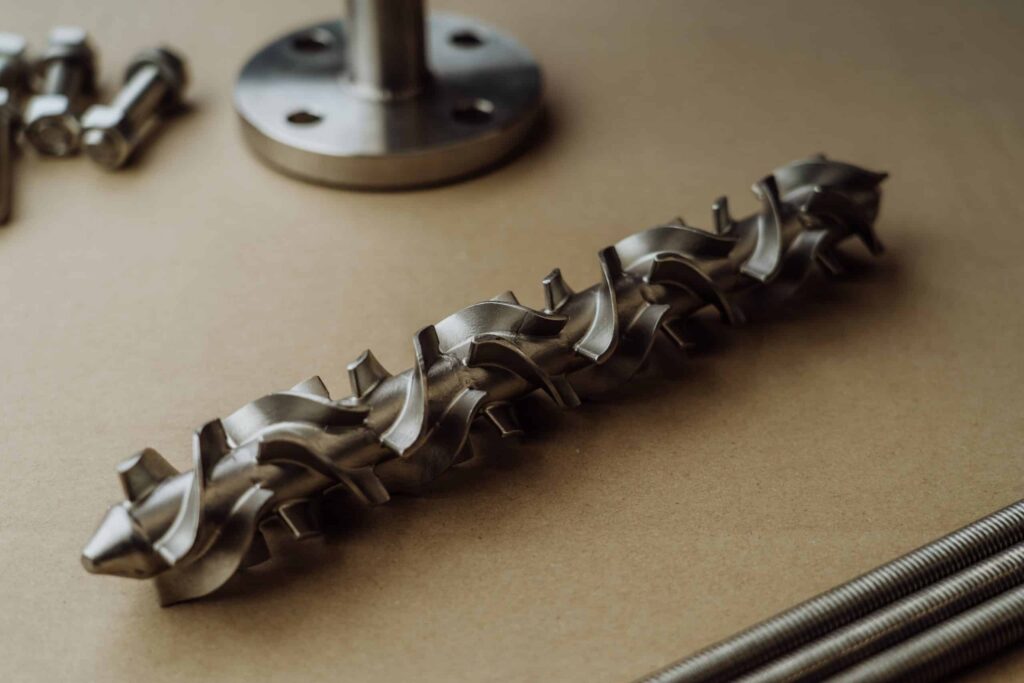
What a static mixer with injection port actually does
A static mixer with injection port brings two jobs together that are usually designed separately: adding a component to a process stream and mixing it in. The injection point introduces the additive, and the fixed elements directly behind it split, redirect and recombine the flow until the additive is spread evenly across the whole cross section. There is no motor and no moving part. The energy for mixing comes from the pressure drop of the main flow.
Why does that combination matter so much? Because the moment directly after dosing is the moment where things go wrong. A chemical injected into a pipe does not spread by itself. In a viscous product it can travel as a separate thread for a long distance. In a thin liquid it may disperse eventually, but only after the flow has passed several bends, valves and perhaps a measuring instrument that reports a value based on a stream that is not yet mixed. The shorter the distance between injection and homogeneity, the more predictable the process becomes.
At Dutch Valve Vision we see this in many forms. A water treatment line where a coagulant must reach every part of the flow before flocculation starts. A chemical process where a reactant must be distributed before it reaches a reactor. A food line where a flavour or colour is added to a base product just before filling. In each case the question is the same: how do we get from a single injection point to a uniform mixture in the shortest possible length of pipe? A static mixer with injection port is the most direct answer.
We are the exclusive agent of STRIKO Verfahrenstechnik GmbH for the Netherlands, Belgium and Luxembourg. STRIKO static mixers are configurable in diameter, length and internal elements and offer custom options for specific process requirements. This article explains how dosing and mixing work together, where the injection point belongs and what we need from you to design the combination.
Dosing and mixing in one pipe section
In a conventional layout, the dosing point and the mixer are two separate items on the drawing. The dosing connection is often a simple nozzle placed wherever it was convenient during construction, and the mixer, if there is one, sits somewhere downstream. Between them lies a length of pipe where the added component has time to settle along the wall or form a layer. By the time it reaches the elements, it is no longer a well defined starting point for mixing.
Combining the two in one design removes that uncertainty. The injection point is placed where the elements can take hold of the added stream straight away. Whether the injection point is integrated into the mixer section itself or placed in a short piece directly upstream is a design choice that we make together with you, depending on the process, the pipework and the maintenance approach.
The practical benefits are easy to recognise. The mixing length after dosing becomes shorter and more predictable. Overdosing of some parts of the flow and underdosing of others is reduced. The dosed chemical is used more efficiently, because it reaches all of the product instead of only part of it. And the space needed for the dosing and mixing step shrinks to a single section of pipe.
There is also a quality control benefit. When dosing and mixing are designed as one unit, the location where the mixture is homogeneous is known. That is the location where a sampling point or an inline analyser gives a reliable reading, and that reading can be fed back to the dosing control with confidence.
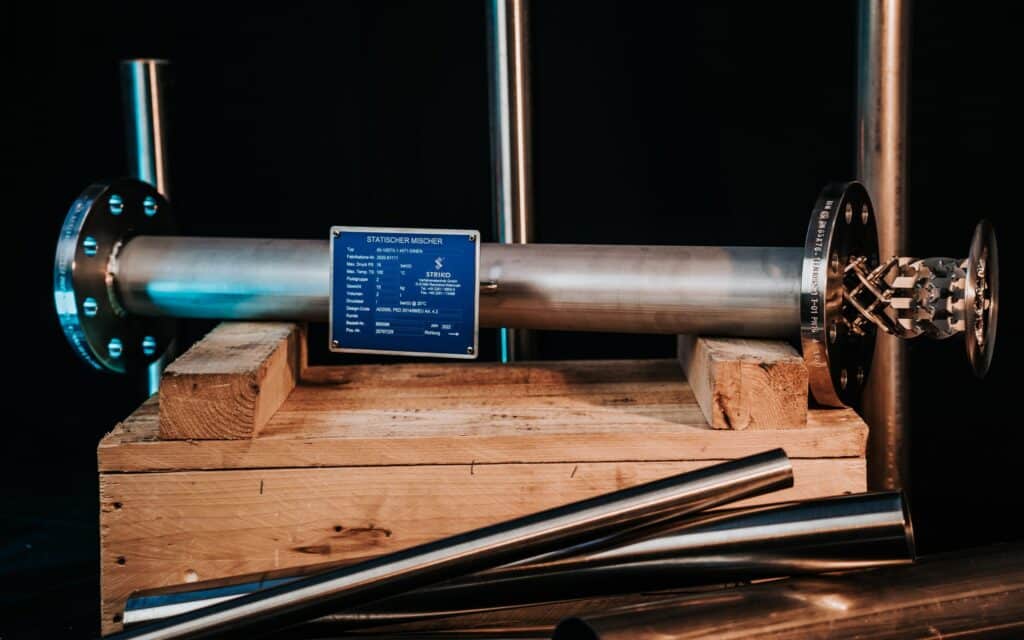
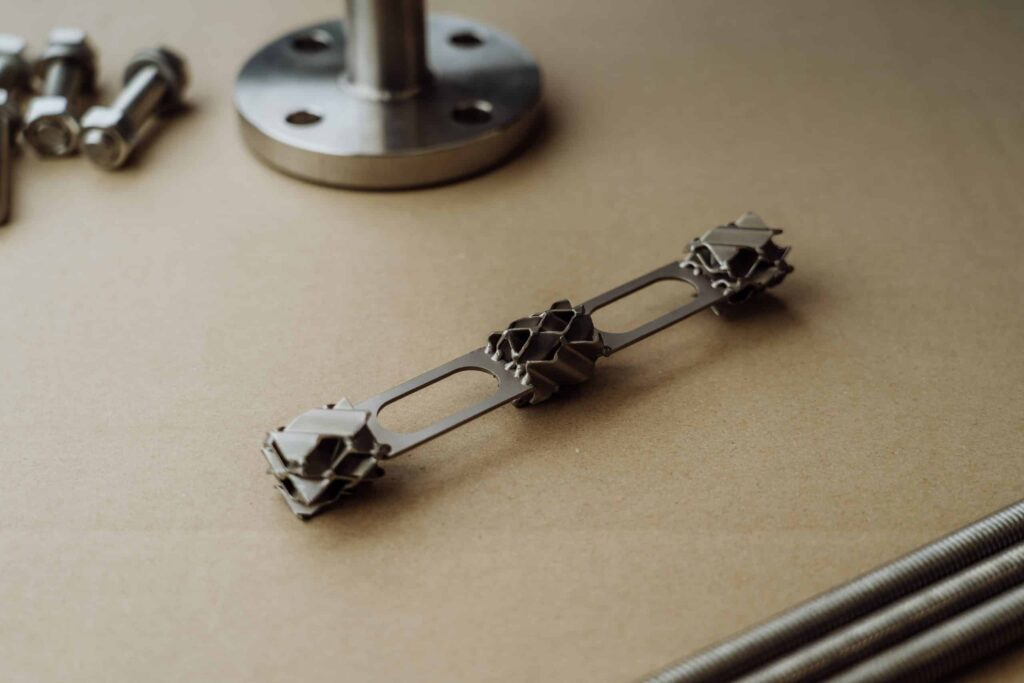
Where to inject: position and direction of the injection point
The position of the injection point relative to the elements is the single most important design decision in a static mixer with injection port. Three aspects determine the outcome.
Distance to the first element
The added component should reach the first element quickly. A long straight run between injection and mixing gives it time to stratify, especially in laminar flow with viscous products. A short distance means the elements start working on the additive while it is still concentrated in a small region, and the repeated splitting and recombining spreads it through the bulk from that point onward.
Centre of the pipe or the wall
A connection at the pipe wall introduces the additive into the slowest moving part of the flow, close to the wall. From there, it has the longest route to the centre. An injection nozzle that brings the additive towards the centre of the pipe gives the elements a better starting position. For small dosing ratios, where a tiny stream must be spread through a large flow, this makes a noticeable difference.
Direction relative to the flow
The direction in which the additive leaves the nozzle also matters. Injection in the direction of flow tends to give a smooth introduction, while injection against or across the flow creates local turbulence. Which approach suits a given case depends on viscosities, velocities and the dosing ratio. This is a matter of engineering judgement for the specific process rather than a single rule.
In turbulent service, where the main flow is thin and fast, the elements mix quickly and the exact injection geometry is somewhat less critical. In laminar service, with viscous products, the position and direction of the injection point can decide whether the mixture is homogeneous at the outlet or still streaky. STRIKO specialises in mixers for (highly) viscous media, which is exactly where these details matter most.
Selection starts with four data points
With these we choose series, diameter and number of elements.
Viscosity
Of the main stream and of the added component.
Flow rates
Main flow and dosing, also at part load.
Temperature and pressure
Determine material and allowable pressure drop.
Mixing quality
How homogeneous the product must be downstream.
Homogeneity right after dosing
A static mixer with injection port is judged by one outcome: how uniform the mixture is at the outlet. That homogeneity matters for different reasons in different processes.
In pH control, a probe placed downstream of an unmixed dosing point measures a value that depends on where in the pipe the probe happens to sit. The control system then reacts to that value, doses more or less, and the loop starts to oscillate. With the additive fully mixed before the probe, the measurement represents the whole flow, and the control loop can do its job calmly.
In chemical reactions, local over-concentration of a reactant can lead to side reactions, hot spots or inconsistent product. Distributing the reactant evenly before the reaction zone supports yield and consistent quality. In continuous chemical processes, static mixers accelerate and stabilise reactions by guaranteeing a homogeneous mixture.
In petrochemistry and oil and gas, homogeneous flow is the precondition for representative sampling. When an additive or a second stream has been injected upstream, the sample only means something if it is taken where the mixture is uniform.
How quickly homogeneity is reached depends on the dosing ratio, the viscosities, the flow regime and the number and type of elements. A thin additive in a turbulent water stream mixes quickly. A small amount of a thick additive in a viscous product requires more elements and careful injection design. That is why we ask for the dosing ratio across the whole operating range, not only at design flow.
Specification ready? We will prepare a targeted quote.
Send us medium, pressure, temperature and connection. Our specialists come back with a matching proposal.
Typical duties for a static mixer with injection port
Water and waste water treatment is the classic field for combined dosing and mixing. Neutralising agents, coagulants or air are distributed evenly for effective treatment and pH control. Dosing and mixing in one section is the natural layout here.
In food and pharma, static mixers support emulsification, the dosing of additives and temperature regulation of delicate products. The EREstat series is designed for food processing and hygienic processes, and STRIKO mixers support inline sterilisation and steam cleaning.
Gas injection is a special case. When a gas is introduced into a liquid, the aim is often to dissolve it or to create a fine dispersion. Customised STRIKO designs are used for gas-in-liquid dissolving processes, and the STV series is optimised for gases. For viscous products, the STX series is the relevant starting point, while Helical is the universal mixer for many general duties.
Materials at the injection point
The injection point is where the added chemical is at its most concentrated. The first elements behind it see that concentration before any dilution has taken place. Material selection should therefore consider the additive at full strength, not only the diluted mixture further downstream.
The material options for STRIKO static mixers cover stainless steel (SS316, 1.4404, 1.4571), carbon steel, the plastics PVC, PE and PVDF, and special coatings or linings for aggressive media. Materials can be adapted to project-specific requirements. In chemical dosing lines, plastic construction is often the logical choice. In hot or high pressure lines, stainless steel usually takes over.
The dosing line: valves and control around the static mixer with injection port
The mixer can only distribute what it receives, so the dosing line deserves as much attention as the mixing section. A check valve in the dosing line prevents back flow of the process medium into the dosing system when the dosing pump stops. Flow measurement on both the main stream and the dosing stream allows the control system to keep the ratio stable. A control valve or a variable speed dosing pump adjusts the addition.
Dutch Valve Vision is a specialist in special valves for special services, and we advise on the integration of static mixers with valves, measuring instrumentation and process automation. That perspective helps to design the dosing point, the valves and the mixer as one coherent system rather than as separate purchases.
Common mistakes when dosing and mixing are designed separately
Most problems with dosing points are not caused by poor equipment but by decisions taken at different moments by different people. The piping designer places a nozzle where there is room. The process engineer later specifies a mixer somewhere downstream. The instrument engineer puts the analyser wherever the cable tray passes. Each decision makes sense on its own, and together they produce a line that never quite reaches a stable reading.
A few patterns come back regularly. The first is a dosing nozzle placed just after a control valve or a pump, on the assumption that the turbulence there will do the mixing. It helps a little, but it is not a controlled mixing step, and its effect changes with the valve position and the flow. The second is an analyser placed too close to the dosing point, reading a value that depends on where the additive happens to be in the pipe at that moment. The third is a dosing line that was sized for the design flow and becomes unstable at the low end of the range, delivering the additive in pulses rather than as a steady stream.
Designing a static mixer with injection port as one unit avoids most of these issues at the start. The injection geometry, the element configuration and the measurement location are chosen together, on the basis of the same process data. When the operating range is wide, the design is checked at both ends of it. That approach costs a little more thought during engineering and saves a lot of adjustment during commissioning.
Commissioning itself follows a simple sequence. First a pressure test and leak detection on the installed section and its connections. Then a run with the actual media, with samples or readings taken at the measuring point for mixing quality. If the result deviates from expectations, the cause is usually found in the dosing ratio, the injection position or flow conditions that differ from the data used during design. We support installation, validation and optimisation, so that the section performs as intended from the first production run.
Specifying a static mixer with injection port with Dutch Valve Vision
To design a static mixer with injection port, we need data on both streams. For the main flow, that means viscosity, volume flow at minimum and maximum load, temperature and pressure. For the dosing stream, it means the additive, its concentration and viscosity, and the dosing ratio across the operating range. The required mixing quality at the outlet, the available pressure drop, the pipe size and connections, and a sketch or P&ID of the line complete the picture.
Quality at Dutch Valve Vision is managed under an ISO 9001 system certified by KIWA, from our base in Monster, the Netherlands. You can reach us at sales@dutchvalvevision.com or on +31 (0)70-2210560, Monday to Friday between 09:00 and 17:00.
Frequently asked questions about static mixer with injection port
What is a static mixer with injection port?
It is a static mixer combined with a dosing point, so an additive is introduced and mixed in one pipe section. The injection point adds the component to the main flow. The fixed elements directly behind it split, redirect and recombine the flow. As a result the additive is distributed across the whole cross section within a short length. There are no moving parts, and the mixing energy comes from the pressure drop of the main flow. The combination shortens the distance between dosing and homogeneity. It also makes the location of a reliable measurement point predictable. We design the injection position and the mixer together for each application.
How far upstream of the elements should the chemical be injected?
In general, the injection point should be close to the first element. A long straight run gives the additive time to settle along the wall or form a separate layer. This effect is strongest in laminar flow with viscous products. In turbulent service with thin liquids, the distance is somewhat less critical. The dosing ratio also plays a role, because small ratios are harder to distribute. The exact distance depends on the process and on the pipework available. We determine it as part of the mixer design. A sketch of the existing line helps us give concrete advice.
Should the injection nozzle reach into the centre of the pipe?
In many cases that gives a better result than a connection at the wall. Near the wall the flow is slowest, and an additive introduced there has the longest route to the centre. A nozzle that brings the additive towards the centre gives the elements a better starting point. This matters most for small dosing ratios and for viscous products. In fast turbulent flow the elements compensate more easily for a wall injection. The direction of injection relative to the flow also influences the result. There is no single rule that suits every process. We assess the injection geometry for your specific conditions.
How quickly is the injected component homogeneous?
That depends on the dosing ratio, the viscosities, the flow regime and the number and type of elements. A thin additive in a turbulent water stream mixes within a short length. A small amount of a thick additive in a viscous product needs more elements. The position and direction of the injection point also affect the result. For reliable measurement, the probe or sampling point should be placed where homogeneity is reached. Validation with measuring points for mixing quality confirms the result after installation. Simulations of flow and homogeneity can support the design. We include the expected mixing length in our advice.
Can gas be injected with a static mixer?
Yes, gas injection into a liquid is a known application of static mixing. The aim is often to dissolve the gas or to create a fine dispersion. Customised STRIKO designs are used for gas-in-liquid dissolving processes. The STV series is optimised for gases. In water treatment, air is one of the media that static mixers distribute evenly. Gas injection has its own design considerations, such as the pressure of the liquid and the orientation of the section. We need the gas, the liquid and the flow conditions to advise properly. Please mention in your request that a gas phase is involved.
Which material should the injection point be made of?
The injection point and the first elements see the additive at full concentration. Material selection must therefore consider the undiluted chemical, not only the final mixture. Options include stainless steel in grades such as SS316, 1.4404 and 1.4571, carbon steel and plastics such as PVC, PE and PVDF. Special coatings or linings are available for aggressive media. In many chemical dosing lines, plastic construction is the logical choice. In hot or high pressure service, stainless steel usually takes over. Materials can be adapted to project-specific requirements. Send us the full composition of both streams so we can advise.
Is a check valve needed on the dosing line?
In most installations a check valve on the dosing line is good practice. When the dosing pump stops, the pressure in the main line could otherwise push process medium back into the dosing system. That can contaminate the dosing chemical or damage the dosing equipment. The check valve should be compatible with the dosing chemical and suitable for the pressure. Flow measurement and a control valve or variable speed pump complete the dosing line. Dutch Valve Vision specialises in special valves and advises on integration with valves and instrumentation. That way the mixer and the dosing line are designed as one system. Mention your dosing equipment in your request so we can take it into account.
What information does Dutch Valve Vision need?
We need the viscosity, flow, temperature and pressure of the main stream at minimum and maximum load. For the dosing stream we need the additive, its concentration, viscosity and the dosing ratio across the operating range. From the required outlet mixing quality we derive how intensive the mixing has to be. The available pressure drop, pipe size and connections define the mechanical side. The chemical composition of both streams determines the material. A sketch or P&ID showing the planned injection position is very helpful. With these data we select the STRIKO series and design the section. Mail the complete set to sales@dutchvalvevision.com and we will respond as soon as we can.
Plan your dosing point and mixer together
Send us the main flow and dosing flow (minimum and maximum), viscosities, temperature, pressure, chemical composition and a sketch of the line. We will advise on the mixer and injection position.
- +31 (0)70-2210560
- sales@dutchvalvevision.com
- Vlotlaan 641, 2681 TZ Monster, the Netherlands
- Mon-Fri 09:00-17:00