
Static mixer water treatment
How static mixers distribute coagulants, neutralising agents and air in drinking water, process water and waste water lines.
- Exclusive STRIKO agent Benelux
- ISO 9001 · KIWA
- Engineering support from Monster (NL)
Four steps that repeat in every mixing element.
Split
Mixing elements divide the flow into smaller partial streams.
Redirect
The partial streams are redirected, creating shear.
Recombine
The streams merge again, element after element.
Homogeneous
No moving parts, energy taken from the pressure drop.
In water treatment, a static mixer installed directly after the dosing point spreads coagulants, neutralising agents or air evenly across the full pipe section, using the energy of the flow itself and no moving parts. Dutch Valve Vision supplies STRIKO static mixers for water treatment in stainless steel, PVC, PE and PVDF, with support for sizing and integration.
- Exclusive STRIKO agent for the Benelux
- Materials include PVC, PE and PVDF
- No moving parts, low maintenance
- Validated with pressure test and measuring points
Static mixer water treatment: a dose only works once it is mixed
Static mixer water treatment starts from a simple observation: a chemical that is dosed into a pipe does not spread across that pipe on its own. A dosing pump can deliver a coagulant or a caustic solution with great precision, yet directly after the injection point that chemical travels as a concentrated streak along one side of the flow. Part of the water gets far too much, part of it gets almost nothing. Downstream, the treatment result depends on how quickly that streak is turned into a uniform concentration.
That is exactly what a static mixer does. Inside a pipe section sits a series of geometrically designed mixing elements that split the flow, redirect it and bring it back together, over and over. After a number of elements, the dosed chemical is distributed across the entire cross section. The energy for this comes from the flow itself, as a pressure drop across the mixer. There is no motor, no shaft seal and no gearbox.
At Dutch Valve Vision we supply static mixers from STRIKO Verfahrenstechnik, for whom we are the exclusive agent in the Netherlands, Belgium and Luxembourg. STRIKO mixers are used in water treatment among other sectors, and the same mixing principle applies whether the water is heading for a tap, a boiler or a discharge point. What changes from one plant to the next is the chemistry, the flow pattern and the choice of material. This page walks through those differences for drinking water, process water and waste water.
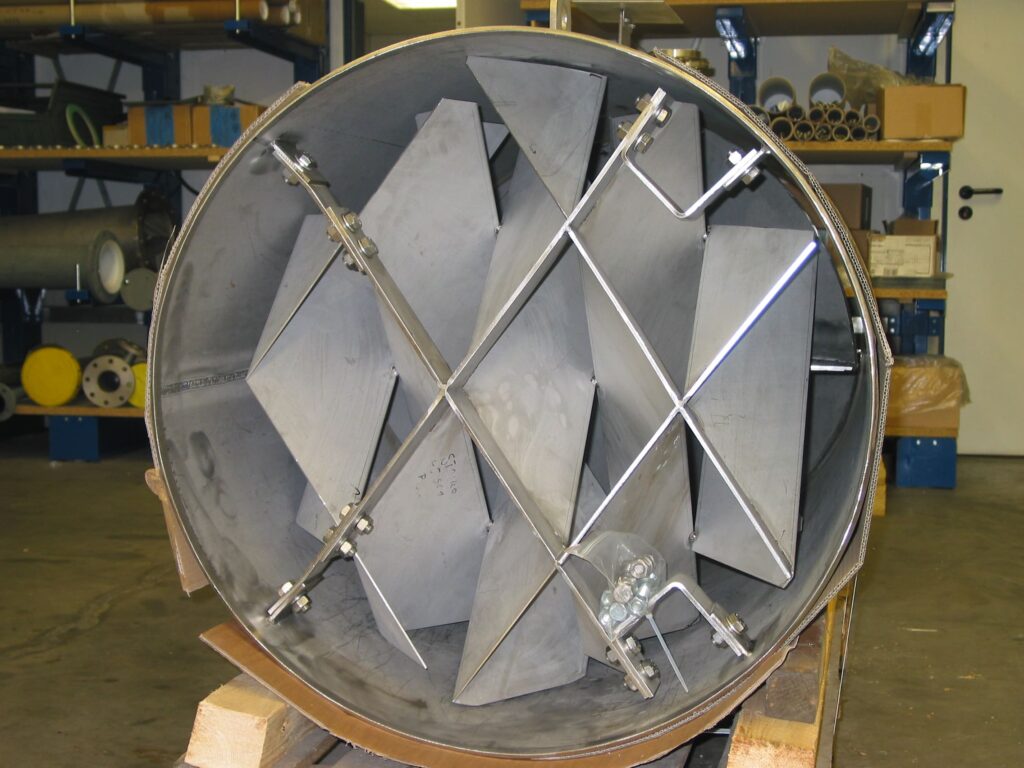
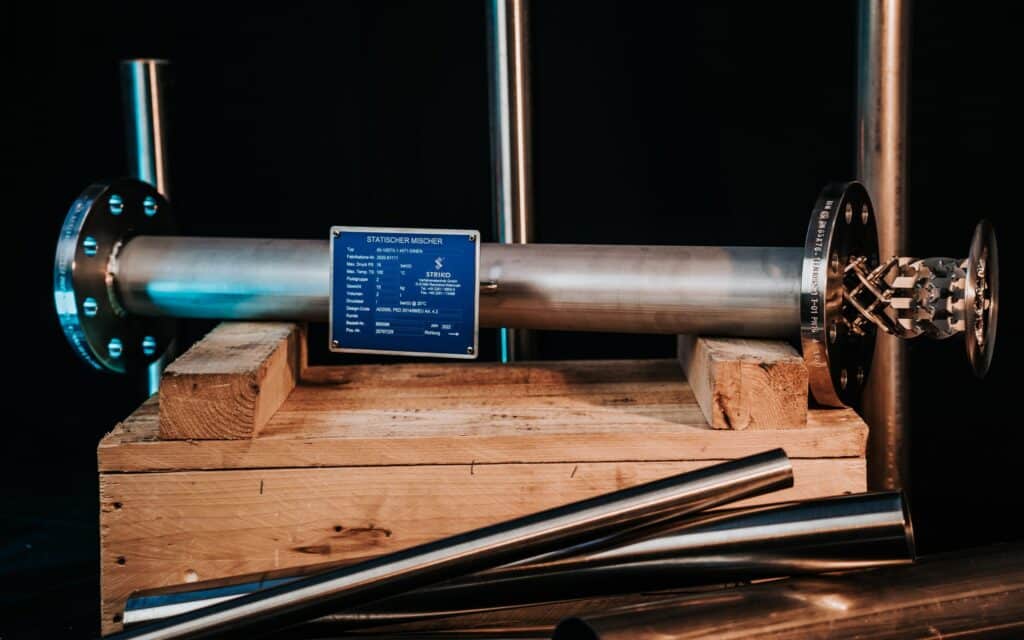
How a static mixer behaves in a water line
Most water lines run in the turbulent regime. Water has a low viscosity, and at typical pipe velocities the flow is already chaotic before it reaches the mixer. You might think that turbulence alone would take care of mixing. In practice, the natural turbulence in a straight pipe needs a long distance to even out a concentrated dose, often far longer than the space between the dosing point and the next process step or measuring point.
A static mixer shortens that distance dramatically. The elements force the dosed stream into the core of the flow, divide it into ever finer portions and create additional eddies that accelerate the final distribution. In laminar flow, which is more common with viscous media, mixing relies mainly on the repeated splitting of the stream. In water, it is the combination of splitting and extra turbulence that does the work, which is why a relatively short mixer is often enough.
The trade off is pressure drop. Every static mixer consumes some of the available pressure to create its mixing effect. In a new design that pressure drop is simply included in the pump calculation. In an existing line, it is worth checking whether the pumps have the margin. For most water applications this is not a problem, but it is a question we always ask before recommending a mixer.
The number of elements and the length of the mixer follow from the mixing task. A small dose into a large main needs a different configuration from two streams of comparable size, and a chemical with a much higher density or viscosity than water behaves differently from a watery solution. In static mixer water treatment the answer is rarely one standard length for every line. It is a sizing exercise in which the flow range, the dose ratio, the available pressure drop and the required homogeneity are weighed against each other. The good news is that once a mixer is correctly sized, it keeps delivering the same result for as long as the process conditions stay within the range it was designed for.
Drinking water: coagulants and pH correction
In drinking water production, a coagulant is often added to raw water to make fine suspended particles clump together so they can be removed in the next stages. The coagulant dose is small compared to the volume of water, and the chemical needs to be distributed quickly and evenly. Local overdosing in one part of the stream and underdosing in another gives poorer floc formation than the same amount of coagulant spread uniformly. A static mixer directly after the coagulant dosing point is therefore a common part of static mixer water treatment in drinking water plants.
pH correction is the second classic duty. Drinking water may need its acidity adjusted at several points in the treatment train, and the pH meter that controls the dosing needs to see a representative sample. Place that meter too close to an unmixed dosing point and it reads whatever layer of the flow happens to pass the probe. The control loop then chases a value that does not exist across the rest of the pipe, and the dosing starts to oscillate. With a static mixer between dosing point and meter, the meter sees homogeneous water and the controller can settle down.
Picture an operator at a treatment works who notices that the dosing pump for caustic keeps ramping up and down every few minutes, while the pH further downstream seems stable. Nothing is wrong with the pump or the meter. The meter simply sits in a zone where the caustic has not yet been mixed in. That kind of situation is typical, and it is often solved with a mixer rather than with more control technology. In static mixer water treatment for drinking water, the mixer is therefore as much a measurement tool as a treatment tool.
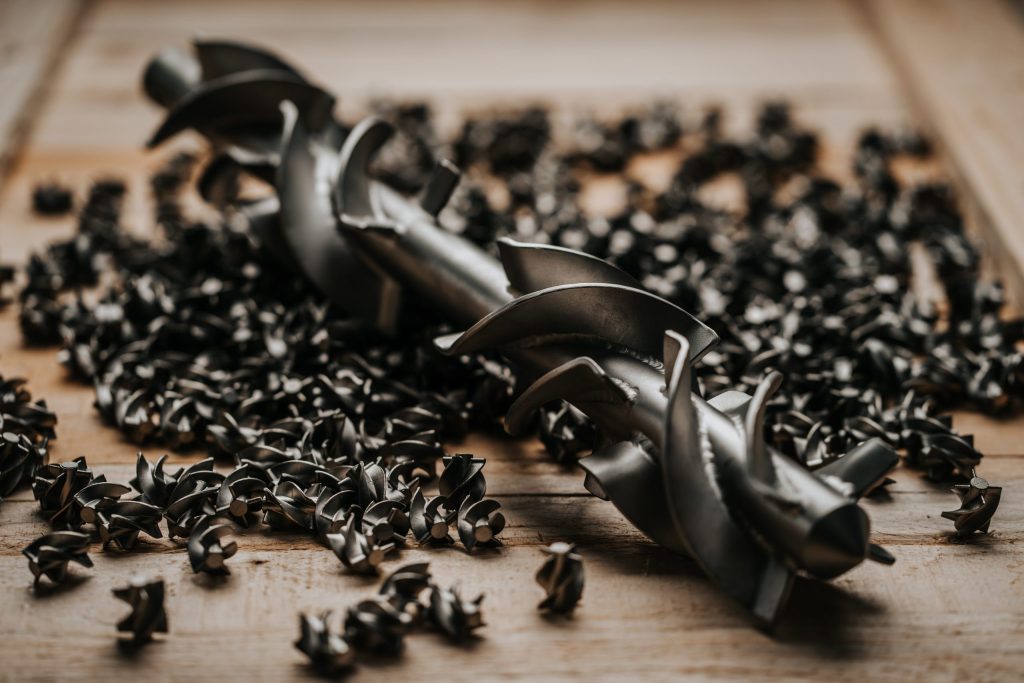
Selection starts with four data points
With these we choose series, diameter and number of elements.
Viscosity
Of the main stream and of the added component.
Flow rates
Main flow and dosing, also at part load.
Temperature and pressure
Determine material and allowable pressure drop.
Mixing quality
How homogeneous the product must be downstream.
Process water: conditioning and blending streams
Process water covers a wide range of uses, from cooling water circuits and boiler feed water to rinse water in production. What these applications have in common is that the water is conditioned with chemicals or blended from several sources before use. A static mixer makes sure that a conditioning chemical is evenly distributed before the water reaches heat exchangers, boilers or production equipment.
Blending is a less obvious but equally relevant use. When two water streams of different quality or temperature are combined, for example a softened stream and a raw stream, the result should be uniform before it enters the process. Without a mixer, the two streams can run side by side in the same pipe for a surprising distance. Static mixer water treatment in this setting is less about chemistry and more about getting a constant quality at the point of use. Think of a production line that uses water at a fixed temperature for rinsing. If a warm and a cold stream are joined just upstream of the line and not properly mixed, the temperature at the outlet can drift with every small change in the ratio between the two. A mixer in the combined line removes that drift.
A practical point for process water is that it often runs close to production equipment where space is limited. A static mixer is compact and fits into existing pipework as a pipe section, which makes it easy to add during a modification without rebuilding the line.
Specification ready? We will prepare a targeted quote.
Send us medium, pressure, temperature and connection. Our specialists come back with a matching proposal.
Waste water: neutralisation, air and variable flows
Waste water brings its own challenges. The composition changes over the day, flows can rise sharply after rainfall or during production peaks, and the water may contain solids. In industrial waste water, neutralisation is one of the most common treatment steps. Acid or caustic is dosed until the pH is within the limits for discharge or further treatment. Because pH responds strongly to small differences in concentration, homogeneity matters even more here than in drinking water.
Coagulants and other treatment chemicals are also dosed in waste water, and air can be introduced to support treatment processes. In each case the goal is the same: an even distribution across the pipe before the water moves on. STRIKO static mixers are used for exactly this type of dosing and homogenisation in water and waste water.
Variable flow is the point that deserves most attention in waste water. A mixer sized only for the average flow may perform well most of the day but less well at the extremes. At low flow the mixing becomes gentler, at high flow the pressure drop rises. That is why we always ask for the full range, from minimum to maximum, when we select a static mixer for waste water. For static mixer water treatment on an industrial site, it also helps to know how the dosing control follows the flow, because the mixer and the controller have to work together to keep the ratio right. Solids are the other consideration. Where the water carries particles, the mixer should be easy to dismantle for cleaning or inspection, which static mixers generally are.
Choosing materials for static mixer water treatment
The material of a static mixer depends on the water, the dosed chemicals, the temperature, corrosive conditions and the process requirements. For static mixer water treatment, plastics play a large role. PVC, PE and PVDF are widely used because they resist many of the chemicals dosed in water treatment and do not corrode like carbon steel. Stainless steel such as SS316, 1.4404 or 1.4571 is an option where temperature, pressure or hygiene demands point in that direction. Carbon steel and special coatings or linings complete the range.
A detail that is often overlooked is the location of the highest chemical load. Directly after the injection point, the dosed chemical is at its most concentrated. The mixer elements see that concentrated chemical before anything else does. A material that copes perfectly well with the diluted water further downstream can still be under strain at that spot. We therefore look at both the water and the dosed chemical when we advise on material. Materials can be adapted to project specific requirements.
Sizing and validating a static mixer for water treatment
Selection starts with process data. The key parameters are the flow of the main water stream, the flow of the dosed chemical, the viscosity of both, the temperature and pressure, and the mixing quality you need. The ratio between main flow and dose matters a great deal. A few litres of coagulant per hour into a large water main is a different mixing task from combining two water streams of similar size. Available pressure drop and the space between dosing point and next measuring point complete the picture.
With that information we select the mixer type, the diameter, the length and the internal elements for your static mixer water treatment duty. After installation, the mixer should be validated. Validation covers a pressure test and leak detection, measuring points for mixing quality and, where useful, simulations of flow velocities and homogeneity. For a treatment plant that has to demonstrate compliance with discharge or quality requirements, a representative sampling point after the mixer is also the basis for reliable reporting.
How Dutch Valve Vision supports static mixer water treatment projects
We are clear about our role. We supply the static mixer and the valves around it, and we support selection, sizing and integration. We do not build complete dosing skids with pumps, tanks and control panels. Those come from your installer or the party building the treatment system, and we are happy to coordinate with them so that the mixer fits the rest of the installation.
On the valve side, we supply standard industrial valves from stock for water treatment, including ball valves, check valves and butterfly valves, in DIN, EN and PN versions as well as ASME, API and Class versions. Where centrifugal pumps need protection against low flow, we are also the official and exclusive Benelux agent for Schroeder automatic recirculation valves, which are used in water treatment among other sectors. Our expertise covers selection and sizing of static mixers, integration with valves, instrumentation and process automation, and support with installation, validation and optimisation. Dutch Valve Vision works under an ISO 9001 certified quality management system, certified by KIWA.
You can reach us at sales@dutchvalvevision.com or +31 (0)70-2210560, Monday to Friday from 09:00 to 17:00, at our office in Monster in the Netherlands.
Frequently asked questions about static mixer water treatment
Why use a static mixer in water treatment?
A dosing pump adds a chemical to the water but does not distribute it across the pipe. Without a mixer, the dosed chemical travels as a concentrated streak for a considerable distance. Part of the water then receives too much and part receives too little. A static mixer splits, redirects and recombines the flow until the concentration is uniform. That makes the treatment more effective with the same amount of chemical. It also gives measuring instruments a representative sample. A static mixer has no moving parts and uses the energy of the flow itself. That combination makes it a low maintenance choice for water plants.
Which chemicals are typically mixed with a static mixer in water treatment?
In drinking water and waste water, coagulants are one of the most common applications. Neutralising agents such as acids and caustic solutions are another. Static mixers are also used to introduce air and to support pH control. In process water, conditioning chemicals are dosed and mixed before the water reaches equipment. Blending two water streams of different quality is a further use. Each chemical places its own demands on the material of the mixer. Some are strongly acidic, others strongly alkaline or oxidising. We therefore always ask for the composition of both the water and the dosed chemical.
Which material should I choose for a water treatment static mixer?
The choice depends on the water, the dosed chemical, the temperature and the pressure. PVC, PE and PVDF are widely used in water treatment because they resist many dosing chemicals. Stainless steel such as SS316, 1.4404 or 1.4571 suits higher temperatures, higher pressures or hygienic requirements. Carbon steel can be used where corrosion is not a concern. Special coatings or linings are available for aggressive media. Keep in mind that the chemical is most concentrated just after the injection point. The material has to cope with that concentration and not only with the diluted water. We advise on material based on the composition you send us.
Where should the dosing point be relative to the mixer?
In most cases the dosing point belongs directly upstream of the static mixer. The mixing elements then pick up the chemical immediately. If the dosing point is far upstream, the chemical can creep along the pipe wall or settle before it reaches the mixer. The mixer then has to undo a separation that has already developed. The measuring point for pH or concentration should normally sit after the mixer. That way the controller sees homogeneous water and the dosing remains stable. The exact distances depend on pipe diameter, flow and the ratio between main flow and dose. Send us a sketch of your line and we will review it with you.
How much maintenance does a static mixer need in a water plant?
A static mixer has no moving parts, so there is virtually no mechanical wear. There is no motor, bearing or shaft seal to service. In clean water applications the mixer can run for long periods without attention. Where the water carries solids or where deposits can form, periodic inspection is sensible. Static mixers can be dismantled easily for cleaning or inspection. Isolation valves on both sides make that work straightforward. The inspection interval depends on the water quality and the dosed chemicals. We are happy to advise on a sensible approach for your plant.
Can a static mixer handle varying flows in waste water?
Yes, but the full flow range must be considered during selection. At low flow the mixing becomes gentler because the flow is calmer. At high flow the pressure drop across the mixer increases. A mixer sized only for the average flow may underperform at the extremes. That is why we always ask for minimum and maximum flows. With that information we choose the elements and length that work across the whole range. The dosing control should also follow the flow so that the ratio remains correct. Together, mixer and dosing control deliver a stable result under changing conditions.
Does Dutch Valve Vision supply complete dosing systems for water treatment?
No, we do not build complete dosing systems with pumps, tanks and control panels. We supply the static mixer and the valves in and around the dosing line. As exclusive STRIKO agent for the Benelux, we have a full range of static mixers available. Valves are available in DIN and ASME versions, including standard valves from stock. We also support selection, sizing, integration and validation. The pumps, storage and controls come from your installer or system builder. We coordinate with that party so that all parts fit together. That way you get a specialist for each part of the system.
What information do you need to size a static mixer for my water line?
Start with the flow of the main water stream, ideally with minimum and maximum. Then give us the flow of the dosed chemical and its concentration. Add the temperature and the pressure in the line. Tell us which chemical is dosed and what the water composition is. State the mixing quality you need and the pressure drop you can accept. The pipe diameter and the space between dosing point and measuring point are also useful. A sketch or P&ID of the line completes the picture. Send it all to sales@dutchvalvevision.com and we will get back to you as soon as possible.
Get a static mixer sized for your water line
Send us the main flow and dosing flow with minimum and maximum, the water quality, the dosed chemical, pressure, temperature and the required mixing quality. We will advise a suitable static mixer and material.
- +31 (0)70-2210560
- sales@dutchvalvevision.com
- Vlotlaan 641, 2681 TZ Monster, the Netherlands
- Mon-Fri 09:00-17:00