
Rupture disc types
An overview of every rupture disc family we supply, what each one is built for and how to narrow the choice.

The main rupture disc types are flat and multi-layer metal discs, domed forward acting and reverse acting metal discs, graphite discs, aseptic discs for pharma and food, extruder discs, discs for tank containers, vacuum and double discs and compact burst plugs. The right type follows from the medium, the pressure profile, the temperature and the hygiene requirements. Dutch Valve Vision supplies them as exclusive STRIKO agent for the Benelux.
- Rupture disc types at a glance: why one design never fits every plant
- Metal rupture disc types by shape: flat, multi-layer and domed
- Forward acting and reverse acting: two rupture disc types for domed metal
- Graphite rupture discs: the answer when corrosion is the enemy
- Rupture disc types built around one application
- Sorting rupture disc types by pressure profile: vacuum, low and high pressure
- Burst plugs: the most compact of the rupture disc types
- From rupture disc types to one specification
Unsure about the right choice?
Share your process data with our specialists. We check the numbers with you and give reasoned advice.
Rupture disc types at a glance: why one design never fits every plant
Rupture disc types differ far more than most buyers expect when they first open a catalogue, and those differences decide whether a disc lasts for years or fails early. On paper every disc does the same job. It holds the pressure, stays leak tight and opens at a set burst pressure to protect a vessel or a pipe. In practice the medium, the temperature, the pressure profile and the hygiene requirements pull the design in very different directions. A reactor full of a corrosive acid needs something else than a sterile fermenter, and an extruder barrel has little in common with a tank container on the motorway. That is why we at Dutch Valve Vision never start with a type. We start with the process and let it point to the right family.
This page is a map of the rupture disc types we supply as exclusive agent of STRIKO Verfahrenstechnik GmbH in the Netherlands, Belgium and Luxembourg, together with the graphite and metal designs in our range. For each family you will read what it is, where it fits and what to watch out for. Every family also has its own page on our website if you want to go deeper. How a disc physically opens is covered on our page about the working principle, so here the focus is on choosing between designs.
A practical way to sort rupture disc types is along four axes. The first is material, mostly metal or graphite. The second is shape, flat or domed. The third is the direction in which the process pressure loads a domed disc, forward or reverse. The fourth is the application, from aseptic lines to extruders and tank containers. A real disc combines a position on each of those axes, and that combination is what eventually ends up in your specification.
Metal rupture disc types by shape: flat, multi-layer and domed
Metal is the default material in most process plants, and our standard metal disc is made of 316 stainless steel. Where the medium or the temperature asks for more, Hastelloy and titanium are available as options. The material is matched to three things: chemical compatibility with the medium, the working temperature and the mechanical load. Within metal, shape is the first real fork in the road.
Flat and multi-layer discs
Flat metal discs are the basic version for general process applications, and STRIKO lists its flat metal rupture discs for standard duties. A multi-layer construction adds strength and reliability at higher pressures, because the layers share the work of carrying the load and sealing the process. Picture a storage vessel with a clean, non-aggressive medium and a steady pressure. A flat disc is often exactly what that position needs, and there is no reason to make it more complicated than that.
Domed discs with an X or C scored dome
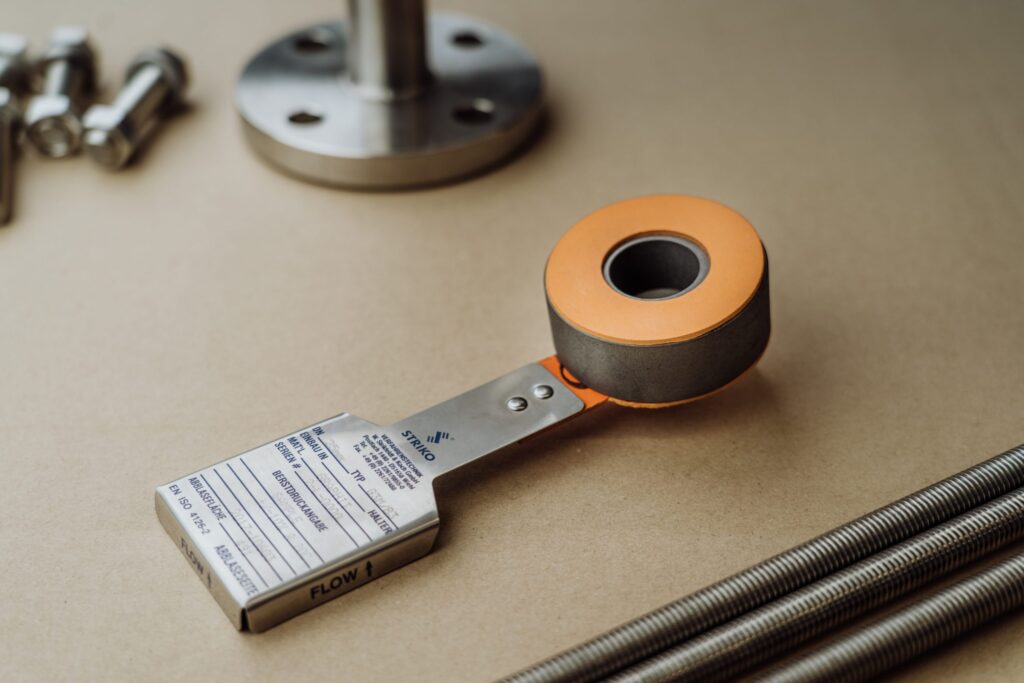
Domed metal discs suit applications with large pressure differences or where a controlled bursting action is required. X or C scoring in the dome creates a defined opening pattern, so you know in advance how the disc will open. That predictability matters when the discharge line is short or when downstream equipment should not be hit by loose parts. Domed designs are also where the split between forward and reverse acting comes in, which brings us to the next pair of rupture disc types.
Forward acting and reverse acting: two rupture disc types for domed metal
The side of the dome that faces the process divides domed metal discs into two families. Both are proven, both are widely used and they suit different pressure profiles. The choice between them is one of the questions engineers put to us most often.
Forward acting discs
In a forward acting disc the process pressure acts on the concave side of the dome. It is the classic design, and STRIKO builds its forward acting metal discs for high pressure environments. Forward acting holders are known for high accuracy of the burst pressure, they suit gas and liquid service and they make inspection and replacement easy. The point to keep an eye on is the operating ratio. A forward acting disc that runs close to its burst pressure day after day, or that sees heavy pressure cycling, works harder and can fatigue sooner.
Reverse acting discs
In a reverse acting disc, also called reverse buckling, the pressure acts on the convex side of the dome. STRIKO positions its reverse acting metal discs on durability and efficiency. Holders for reverse buckling discs are built to cope better with pressure cycles, to perform well at high temperatures and to reduce the risk of fatigue. Think of a batch unit that is pressurised and depressurised several times per shift, with the load on the disc rising and falling every time. That is the kind of duty where reverse acting earns its place.
In our experience the pressure profile settles this question, not a general preference. We ask how often the pressure cycles, how close normal operation runs to the burst pressure and how hot the disc gets in service. Steady conditions with a strong need for burst accuracy lean towards forward acting, while frequent cycling and high temperatures lean towards reverse acting. Our separate pages on forward acting and reverse acting rupture discs go into each option in more detail.
Graphite rupture discs: the answer when corrosion is the enemy
Graphite changes the material axis completely. It is naturally resistant to many acids, bases and highly aggressive media without any additional coating, which makes it the logical choice where stainless steel or other metal discs would degrade quickly. When a graphite disc bursts it opens across its full diameter, so the pressure is relieved fast and in a controlled way. It is suitable for gases, vapours and liquids.
We supply graphite rupture discs from DN25 to DN400, with the burst pressure set to the customer’s specification. They can be installed directly between ANSI or DIN flanges or in a holder. Options include a TFE coating, burst detection and vacuum support. Because graphite discs can often be clamped between standard flanges without a separate holder, installation tends to be simpler. Typical positions are reactor vessels, lines carrying acids and alkaline solutions and storage installations in the chemical industry, as well as processes with bleach and lye in pulp and paper. Of all rupture disc types, graphite is the family we look at first when corrosion is the main threat to the disc.
Standard metal disc in 316 stainless
Graphite discs from DN25 to DN400
Aseptic discs for pharma and food
Exclusive STRIKO agent for the Benelux
Rupture disc types built around one application
Some designs are defined less by material or shape than by the place where they work. The STRIKO programme includes three of these application specific rupture disc types, and each one brings its own set of demands.
Aseptic and sanitary discs
STRIKO aseptic metal rupture discs are made for the pharmaceutical and food industries. Hygienic discs are designed for sterile processes and have highly polished surfaces that support cleaning and CIP procedures. Imagine a fermenter in a biotech plant that is cleaned and sterilised between every batch. A disc with crevices or rough surfaces would become a hiding place for product residue, so the surface finish matters as much as the burst pressure. For pharma and biotech, holders combine hygienic design and reproducible performance with documentation for validation processes.
Extruder discs
Extruder rupture discs are built for the demanding conditions of polymer processing. In an extruder, a blockage or an unexpected change in viscosity can make the pressure climb very quickly. The disc opens in a controlled way and protects the screw, the barrel and the seals. Temperature plays a big part here, because the effective burst pressure can drop at higher temperatures. That is why we always ask for the temperature in the critical scenario and not only the normal operating temperature.
Discs for tank containers
STRIKO also supplies rupture discs for tank containers, as safety solutions for transport tanks. A tank container travels between sites, climates and loading cycles, so the disc meets conditions that a fixed installation never sees. For operators of such tanks, the disc is one of the components that keeps the container safe on the road and at the terminal.
Sorting rupture disc types by pressure profile: vacuum, low and high pressure
Another useful lens is the pressure profile of the system rather than the disc itself. Three situations deserve extra attention, because each of them rules certain designs in or out.
Vacuum and alternating pressure
A vessel that is emptied, or that cools down after steam cleaning, can end up under vacuum. A disc designed only for overpressure can then be pulled the wrong way and damaged. For systems that must handle both overpressure and underpressure, vacuum suitable discs and double discs are available. Vacuum support holders stop the disc from flipping over or being damaged, and they are essential in batch processes and cleaning cycles.
Low burst pressures
Low burst pressures are technically demanding, because a small absolute deviation quickly becomes a large relative one. The tolerance around the set burst pressure is determined by material properties and the manufacturing process, and at low pressures that tolerance deserves careful attention. Flat and multi-layer constructions and graphite are the designs that usually come into the discussion for these positions, always checked against the actual process data.
High pressure
At the other end of the scale, STRIKO forward acting metal discs are designed for high pressure environments, and a multi-layer construction adds strength under higher pressures. The holder and a consistent bolt load become more important as the pressure rises. A poorly designed holder can lead to premature failure, leakage or a wrong burst pressure, whatever disc sits inside it.
Burst plugs: the most compact of the rupture disc types
Burst plugs are the compact member of the family, and STRIKO offers them as a compact and reliable form of overpressure protection. A burst plug is a non-reclosing relief component, usually mounted with a threaded connection in a line, an extruder, a pump or a pressure vessel. Inside sits a calibrated bursting element that gives way once the set limit is exceeded. Burst plugs have no moving parts, are gas and liquid tight during normal operation, open fully when they respond and are always replaced after activation. They fit where installation space is limited and are used in extrusion and polymer processing, in chemistry and in hydrogen and ammonia applications. As with extruder discs, the burst pressure of a plug depends on temperature, so the scenario temperature has to be part of the selection.
From rupture disc types to one specification
A list of rupture disc types only helps if it leads to a decision, and that is the part we take off your hands. Dutch Valve Vision, based in Monster in the Netherlands, is the exclusive agent of STRIKO for the Benelux. STRIKO has been active in rupture discs since 1974 and follows a philosophy of testing, evaluating and recalibrating.
To see how the four axes come together, take a batch reactor with an aggressive medium, a pressure that rises and falls with every batch and a cleaning cycle that pulls a vacuum afterwards. Corrosion points towards graphite or a special alloy, the cycling points towards reverse acting if a metal dome is chosen, and the cleaning cycle calls for vacuum support. None of the rupture disc types on this page answers all three questions alone. The answer is a combination of material, design and holder, checked against the scenario temperature and the operating ratio. That is the kind of puzzle we solve every time a request comes in, and it is why we ask for more than just a pipe size and a pressure.
To narrow the choice we need the medium and its composition, the operating pressure including peaks, the required burst pressure, the temperature in normal operation and in the relief scenario, and the connection and installation space. With those data we can tell you which family fits, which material and which holder, and whether burst detection adds value. On the regulatory side, our metal discs are covered by PED, ISO 4126 and EN 14491 for explosion safety, and they carry CE marking. Our holders are designed in line with ASME Section VIII, EN ISO 4126 and PED 2014/68/EU, and they come with material certificates to EN 10204 3.1, pressure calculations, inspection reports and traceability per component. Our own quality management system is ISO 9001 certified by KIWA.
Replacing a disc that has just opened, or comparing rupture disc types for a new unit? Send your data to sales@dutchvalvevision.com or call +31 (0)70-2210560, Monday to Friday from 09:00 to 17:00, and we will come back with a concrete proposal.
Specification ready? We will prepare a targeted quote.
Send us medium, pressure, temperature and connection. Our specialists come back with a matching proposal.
Frequently asked questions about rupture disc types
Question not listed? Our specialists are happy to help.
How many rupture disc types are there?
There is no single fixed number, because it depends on how you sort them. We usually look at four axes: material, shape, the direction in which pressure loads the dome and the application. On the material axis the main choice is metal or graphite. On shape you choose between flat, multi-layer and domed designs with X or C scoring. Domed metal discs are either forward acting or reverse acting. Then there are application specific designs such as aseptic discs, extruder discs and discs for tank containers. Vacuum suitable discs, double discs and compact burst plugs complete the picture. A real disc combines a position on each axis, and that combination is what ends up in your specification.
Which rupture disc type is best for corrosive media?
For strongly corrosive media, graphite is usually the first family we look at. Graphite is naturally resistant to many acids, bases and aggressive media without extra coatings. That makes it suitable where stainless steel or other metal discs would degrade quickly. We supply graphite discs from DN25 to DN400, for mounting between ANSI or DIN flanges or in a holder. An optional TFE coating is available as a surface treatment. Metal remains an option too, with Hastelloy and titanium alongside standard 316 stainless steel. The final choice depends on the exact medium, the temperature and the mechanical load. Send us the composition of the medium and we will advise which material fits.
What is the difference between flat and domed rupture discs?
A flat disc is the basic version for general process applications, while a domed disc has a curved membrane. Flat discs, often in a multi-layer construction, suit standard positions with steady conditions. The multi-layer build adds strength and reliability at higher pressures. Domed discs are chosen for large pressure differences or where a controlled bursting action is needed. An X or C scored dome creates a defined opening pattern. Domed metal discs are also where forward and reverse acting designs come in. Both shapes can be supplied in 316 stainless steel, with Hastelloy and titanium as options. Which one fits depends on your pressure profile, medium and installation.
Which rupture disc type suits pharmaceutical and food processes?
For pharmaceutical, biotech and food processes, aseptic metal rupture discs from STRIKO are the natural choice. They are designed for hygienic, sterile processes. Hygienic discs have highly polished surfaces that support cleaning and CIP procedures. Smooth surfaces leave fewer places for product residue to collect between batches. Holders for these sectors combine hygienic design with reproducible performance. Documentation for validation processes can be supplied with them. Vacuum can be an issue in these plants as well, for example when a vessel cools down after steam cleaning. We take cleaning cycles and possible vacuum into account when we advise on disc and holder.
When should I choose reverse acting instead of forward acting?
Reverse acting is often the better choice when the process pressure cycles frequently. Reverse buckling holders offer higher resistance to pressure cycles and a lower risk of fatigue. They also perform better at high temperatures. Forward acting discs are the classic design and are known for high burst pressure accuracy in gas and liquid service. STRIKO builds its forward acting metal discs for high pressure environments. A forward acting disc that runs close to its burst pressure, or that sees heavy cycling, can fatigue sooner. The operating ratio between normal pressure and burst pressure is therefore a key input. We compare both options against your actual pressure profile before we advise.
Do all rupture disc types need a holder?
Not all rupture disc types need a separate holder. Metal discs can be installed directly between flanges in systems with straight pipe sections. Graphite discs can often be clamped between standard ANSI or DIN flanges as well. For pulsating pressure, cyclic loading or positions where process integrity is critical, a holder is the better route. A holder positions the disc correctly, applies a controlled load and seals it under operating pressure. It also makes it easier to integrate burst detection or leak detection ports. We supply forward acting holders, reverse buckling holders and vacuum support holders. The holder is reusable, and only the disc is replaced after it has opened.
Is a burst plug a type of rupture disc?
A burst plug works on the same basic idea, but in a much more compact form. It is a non-reclosing relief component that is usually mounted with a threaded connection. Inside the plug sits a calibrated bursting element that gives way once the set limit is exceeded. Burst plugs are fitted in lines, extruders, pumps and pressure vessels where installation space is limited. They are gas and liquid tight during normal operation and must always be replaced after activation. Temperature has a strong influence on the effective burst pressure of a plug. STRIKO burst plugs are available in different material combinations, such as stainless steel and special alloys. We supply them as part of our role as exclusive STRIKO agent for the Benelux.
Which data do you need to recommend a rupture disc type?
We need a clear picture of the process before we can recommend one of the rupture disc types. Start with the medium and its composition. Add the operating pressure including peaks and the required burst pressure. We also need the temperature, both in normal operation and in the relief scenario. The connection and the available installation space complete the basic set. For a replacement, the existing tag data or specification is a good starting point. With this information we select the family, the material, the holder and optional burst detection. Send your data to sales@dutchvalvevision.com or call +31 (0)70-2210560.
Not sure which type fits your process?
Send us the medium, operating pressure including peaks, burst pressure, temperature and connection. We will tell you which rupture disc type and holder match.
- +31 (0)70-2210560
- sales@dutchvalvevision.com
- Vlotlaan 641, 2681 TZ Monster, the Netherlands
- Mon-Fri 09:00-17:00