
Reverse acting rupture disc
How reverse buckling discs cope with pressure cycles and heat, what the holder must do and what we need to select yours.
- Exclusive STRIKO agent Benelux
- ISO 9001 · KIWA
- Engineering support from Monster (NL)

Pressure acts on the convex side
Higher resistance to pressure cycles
Better performance at high temperatures
Exclusive STRIKO agent for the Benelux
Why engineers specify a reverse acting rupture disc
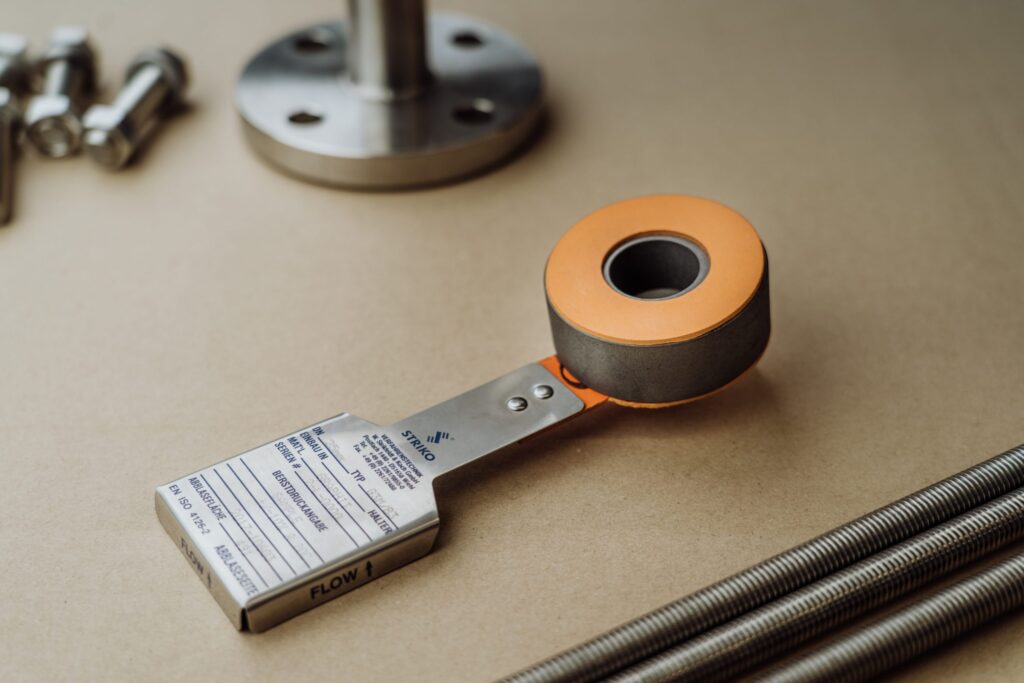
A reverse acting rupture disc is the design we recommend most often when a process runs close to its limits and changes pressure all day long. The name says what it does. The process pressure pushes on the convex side of the dome instead of the hollow side, so the membrane is squeezed rather than stretched. That single change in direction has a big effect on how long the disc lasts and on how close to the burst pressure you can operate. It is also why the same product is often called a reverse buckling disc.
Imagine a reactor that is pressurised and vented several times per shift, or a compressor discharge line where pulsations never quite disappear. A classic forward acting disc in that position is stretched a little further with every peak and relaxes again when the pressure drops. Over time the material tires, and one day the disc opens at a pressure that should have been harmless. Nobody wants that call from the control room. A reverse acting rupture disc handles the same situation very differently, because the dome is loaded in compression and the metal is not pulled towards its tensile limit on every cycle.
At Dutch Valve Vision we supply reverse acting metal rupture discs from STRIKO Verfahrenstechnik GmbH, the German manufacturer for which we are the exclusive agent in the Netherlands, Belgium and Luxembourg. STRIKO positions its reverse acting metal discs as the choice for durability and efficiency, and that matches what we see in practice. On this page we explain how the design behaves, where it outperforms other types, what it asks from the holder and the fitter, and what we need from you to select the right one.
How a reverse acting rupture disc works under load
Start with a domed metal membrane clamped in a holder. In a forward acting design the process sits on the concave side, like air inside a balloon. In a reverse acting rupture disc the dome points towards the process instead. The pressure presses on the crown and tries to push it flat.
As long as the pressure stays below the set point, the dome carries the load as a compressed shell. It is stable, it is leak tight and nothing moves. When the pressure reaches the burst pressure, the dome can no longer hold its shape. It becomes unstable, snaps through and reverses direction in a fraction of a second. After that reversal the disc opens along lines designed into it, the medium escapes and the pressure in the protected equipment drops.
What makes this interesting from an engineering point of view is that the burst pressure is governed by the buckling behaviour of the dome, not only by the tensile strength of the metal. Shape, thickness and material together decide the moment of reversal. That is how this type combines a durable membrane with a precisely defined set point. It is also why the dome itself has to be treated with care, which we come back to further down.
One more point is worth knowing. The energy that drives the reversal and the opening comes from the medium. In gas or vapour service there is plenty of stored energy to reverse and open the dome fully. In a system completely filled with liquid, far less energy is available, and some reverse acting designs need a closer look before they are specified for that duty. We always check the service conditions with the manufacturer rather than assume.
Pressure cycles, fatigue and a higher operating ratio
Fatigue is the main reason customers come to us for this design. Every pressure cycle is a load cycle for the disc. In tension, repeated cycles slowly weaken the material. In compression, the same cycles do far less harm. Our reverse buckling holders are designed around exactly that behaviour: higher resistance to pressure cycles and a lower risk of fatigue.
That resistance shows up in the operating ratio, the relation between the maximum operating pressure and the burst pressure. The operating ratio directly affects service life and reliability. A disc that is sensitive to fatigue needs a generous gap between the pressure at which the plant normally runs and the pressure at which the disc opens. A reverse acting rupture disc tolerates a higher operating ratio, so the plant can run closer to its design limits without premature openings.
Why does that matter commercially? Because the gap costs money. If a disc forces you to keep a wide margin, you either lower the operating pressure and give up capacity, or you raise the design pressure of the vessel and pay for heavier equipment. A higher operating ratio lets engineers make full use of the equipment they already have. Add a longer service life, fewer unexpected openings and fewer unplanned stops, and it becomes clear why this is so often the commercially most attractive type in our range.
Consider a batch plant where every batch means pressurising, reacting, venting and cleaning. Over a year that adds up to a large number of cycles on the same disc. The maintenance planner in that plant does not want to replace discs on suspicion. They want a disc that stays predictable from one turnaround to the next, and that is the situation reverse buckling was developed for.
That said, reverse buckling is not automatically the answer for every position. On a line with a steady pressure far below the set point, the fatigue advantage hardly comes into play, and a forward acting disc with its high burst accuracy may be the simpler choice. The same applies where vacuum or back pressure would push on the dome from the other side, because then the holder and any vacuum support need to be designed with that load in mind. We would rather talk you out of a design that brings no benefit than sell a disc that does not fit the process. The pressure trend of your unit, the number of cycles per year and the temperature in the relief case usually tell us within one conversation which direction makes sense.
A reverse acting rupture disc has the process pressure on the convex side of the dome, so the membrane is loaded in compression and snaps through at the set pressure before it opens. This gives higher resistance to pressure cycles, better performance at high temperatures and a lower fatigue risk than a forward acting disc. Dutch Valve Vision supplies STRIKO reverse acting discs with matching reverse buckling holders.
Heat and the reverse acting rupture disc
Temperature changes everything about a rupture disc. The burst pressure is not a fixed number that lives apart from its environment, because at higher temperatures the effective burst pressure can fall, depending on material and design. Reverse buckling designs are known for better performance at high temperatures, which makes a reverse acting rupture disc a logical candidate for hot process lines, steam systems and reactors with exothermic reactions.
That does not mean temperature can be ignored. It means it has to be specified properly. We ask for two temperatures: the normal operating temperature and the temperature during the relief scenario. The second one is what counts, because the disc has to open at the right pressure in the situation it was installed for. An engineer who sizes the disc on the normal operating temperature, while the runaway scenario is much hotter, is designing for the wrong moment.
Material choice follows the same logic. Our standard metal discs are made of 316 stainless steel, with Hastelloy and titanium as options for more aggressive media or more demanding conditions. The choice depends on chemical compatibility with the medium, the working temperature and the mechanical load. For the holder the options run from carbon steel and 316/316L stainless steel to duplex, super duplex, Inconel and Hastelloy, with Inconel and Hastelloy typically chosen for high temperatures and aggressive media.
What we need for the right selection
- Medium and composition
- Operating pressure and pressure peaks
- Required burst pressure
- Temperature, normal and in the relief scenario
- Connection and installation space
Designs in the STRIKO range
Every application needs its own rupture disc. These are the designs we supply most often.
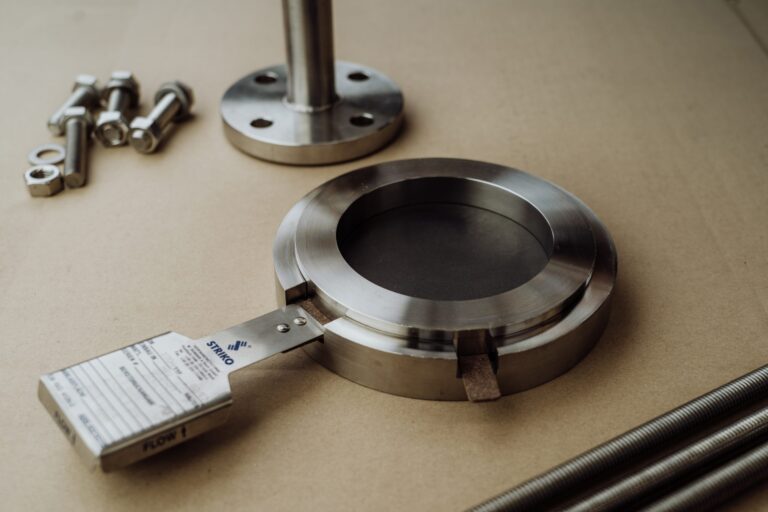
Graphite rupture disc
Corrosion resistant without coating, DN25 to DN400, between ANSI or DIN flanges.

Rupture disc holder
Correct positioning, reproducible loading and a reliable seal.
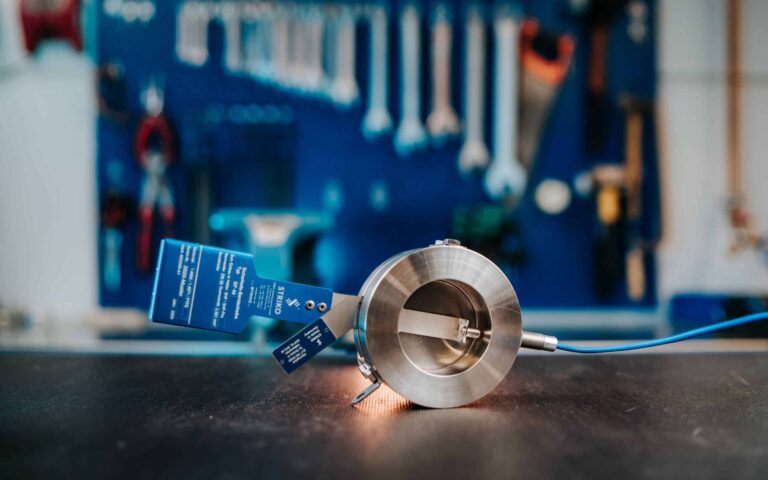
Burst indicator
Signals an opened disc directly to PLC, SCADA or DCS.
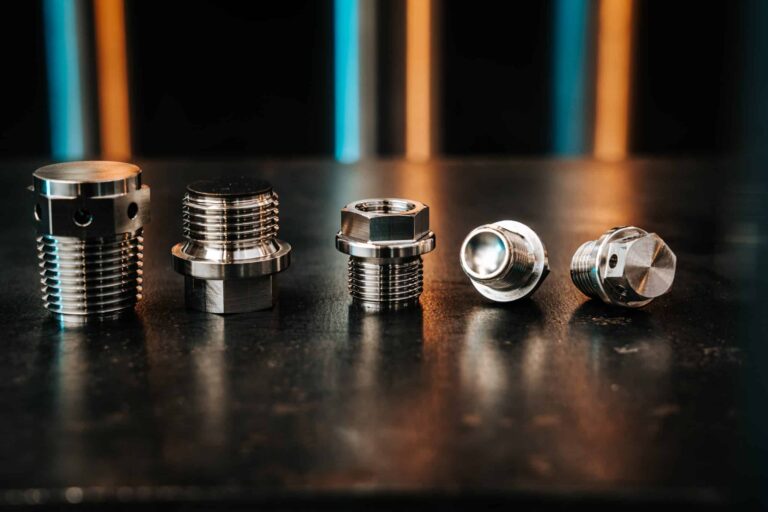
Extruder rupture disc
Built for the pressure peaks of plastics processing.
The holder decides whether the disc performs
A reverse acting rupture disc is only as reliable as the holder it sits in. The dome has to be positioned exactly, loaded reproducibly and sealed without leakage. A poorly designed holder can cause premature failure, leakage, a wrong burst pressure or even a complete system failure. That is why we treat the holder as a safety component in its own right and not as an accessory.
Our reverse buckling holders are built with tight tolerances to avoid stress concentrations. The clamping load on the disc must be reproducible, regardless of small variations during assembly. Sealing faces are machined with controlled roughness, metal or soft seals are chosen to suit the medium, and leak detection ports can be integrated where required. Clear flow and installation markings help the fitter get the orientation right, and a consistent bolt load keeps the clamping conditions identical every time a disc is replaced.
The holder is also the natural place for burst detection. A sensor based on an electrical loop that breaks, or on a magnetic field that changes when the disc moves, sends a signal to your PLC, DCS or SCADA system as soon as the disc opens. Fail-safe designs also report a defect in the sensor itself, and in hazardous areas ATEX certification of the sensor is required.
Documentation completes the picture. Our holders are designed in line with ASME Section VIII, EN ISO 4126 and PED 2014/68/EU, and ATEX where applicable. They come with material certificates to EN 10204 3.1, pressure calculations, inspection reports and traceability per component. The holder is designed for long term reuse, so after an opening only the disc needs replacing.
Specification ready? We will prepare a targeted quote.
Send us medium, pressure, temperature and connection. Our specialists come back with a matching proposal.

Installation and handling of a reverse acting rupture disc
The same dome that gives this design its fatigue resistance also makes it sensitive to handling. Because the burst pressure is set by the shape of the dome, a dent, a scratch or a deformation in the crown can change how and when it buckles. A damaged disc must never be installed, since even small defects can affect the burst pressure. We advise keeping spare discs in their original packaging until the moment of installation and never setting a disc down on its crown.
Orientation is the second risk. A reverse acting rupture disc fitted the wrong way round is no longer a reverse acting disc. It turns into a forward acting disc by accident, with a completely different burst pressure. The flow direction arrow on the disc and the markings on the holder exist for exactly that reason. During a busy shutdown, with several teams working on the same unit, a few seconds spent checking the arrow are well spent.
The rest is good flange practice. Check that the diameter and burst pressure on the tag match the specification. Make sure the flanges are clean and aligned, centre the gaskets and tighten the bolts evenly to the recommended torque. After installation, periodic visual inspection and sensible stock management of spare discs keep the protection in place and keep downtime short once a disc has done its job.
Ordering a reverse acting rupture disc through Dutch Valve Vision
When you send us an enquiry, we start with the process, not with a catalogue number. We need the medium and its composition, the operating pressure including peaks and the nature of the pressure cycles, the required burst pressure, the temperature in normal operation and during the relief scenario, the connection and the available installation space. With that information we select disc, material and holder as one combination, and we advise on burst detection where it adds value.
Behind that advice stands STRIKO, active in rupture discs since 1974, with a philosophy of testing, evaluating and recalibrating. Dutch Valve Vision itself works with an ISO 9001 certified quality management system, certified by KIWA, and supplies to both DIN and ANSI/ASME standards. On request we support FEM analyses as well as HAZOP and other safety studies, which helps when a new disc position has to be justified in the design phase. For time critical projects we offer fast track delivery, thanks to an efficient supply chain and close cooperation with manufacturers.
Replacing a forward acting disc that keeps opening too early? Designing a new reactor with frequent batch cycles? Mail the process data to sales@dutchvalvevision.com, or phone +31 (0)70-2210560 on weekdays between 09:00 and 17:00. From our office in Monster, the Netherlands, we will come back to you with a reverse acting rupture disc and holder that suit your process.

Frequently asked questions about reverse acting rupture disc
Question not listed? Our specialists are happy to help.
- +31 (0)70-2210560
- sales@dutchvalvevision.com
- Vlotlaan 641, 2681 TZ Monster, the Netherlands
- Mon-Fri 09:00-17:00

Is a reverse acting rupture disc the same as a reverse buckling disc?
Yes, reverse acting and reverse buckling describe the same type of rupture disc. Both names refer to the way the dome is loaded. The process pressure acts on the convex side, so the dome is compressed rather than stretched. At the burst pressure the dome buckles, reverses and then opens. Reverse buckling is the more descriptive term, while reverse acting is common in datasheets and search queries. Our holders for this type are called reverse buckling holders. STRIKO lists the same product as reverse acting metal rupture discs. Whichever term your specification uses, we treat it as the same design.
Why does a reverse acting rupture disc last longer than a forward acting disc?
The difference comes from how the material is loaded. A forward acting disc is stretched by the process pressure, and every cycle pulls it a little closer to its tensile limit. Over many cycles that can lead to fatigue and a premature opening. A reverse acting disc is loaded in compression, which is much less harmful for the material. That gives higher resistance to pressure cycles and a lower risk of fatigue. It also allows a higher ratio between operating pressure and burst pressure. In practice this means fewer unexpected openings and a longer service life. For processes with frequent cycles, that difference soon shows in maintenance costs and uptime.
Can a reverse acting rupture disc be used in liquid service?
Liquid service deserves a careful check. The opening of a reverse acting disc is driven by the energy stored in the medium. In gas and vapour service there is enough energy to reverse and open the dome fully. In a system that is completely filled with liquid, that energy is much lower. Some reverse acting designs are therefore less suited to pure liquid duty. We always check the actual service conditions with STRIKO before recommending a disc for this situation. Sometimes a forward acting disc turns out to be the more logical choice for a liquid filled system. Tell us the medium and the relief scenario, and we will advise which design fits.
What happens if a reverse acting rupture disc is installed upside down?
Then it no longer behaves as a reverse acting disc. The pressure would act on the concave side and the dome would be loaded in tension instead of compression. The burst pressure in that orientation is completely different from the set pressure on the tag. The protection you designed is effectively gone. That is why every disc carries a flow direction arrow and our holders have clear installation markings. We recommend a second check of the orientation before the flanges are closed. This matters most during shutdowns, when several teams work on the same unit at once. A few seconds of checking prevent a disc that does not open when it should.
Is a reverse acting rupture disc suitable for high temperatures?
Yes, reverse buckling designs are known for better performance at high temperatures. That makes them a common choice for hot process lines, steam systems and reactors. Temperature still has to be specified correctly, because it influences the burst pressure. At higher temperatures the effective burst pressure can fall, depending on material and design. We therefore ask for the temperature during the relief scenario, not only the normal operating temperature. Material choice for disc and holder follows from the same data. Hastelloy and titanium are options for the disc, and Inconel or Hastelloy can be chosen for holders in hot and aggressive service. With the right data, heat becomes a design parameter rather than a risk.
Does a reverse acting rupture disc need a special holder?
It needs a holder that loads the dome in exactly the same way every time. That is what our reverse buckling holders are designed for. They are built with tight tolerances to avoid stress concentrations and to keep the clamping load reproducible. Sealing faces have a controlled roughness, and metal or soft seals are selected to suit the medium. Clear markings show the correct flow direction and orientation. Leak detection ports and burst detection can be integrated where required. The holder is designed for long term reuse, so only the disc is replaced after an opening. We always select disc and holder as one combination, because the performance depends on both.
Which materials are available for a reverse acting rupture disc?
Our standard metal rupture discs are made of 316 stainless steel. For more aggressive media or more demanding conditions, Hastelloy and titanium are available as options. The choice depends on chemical compatibility with the medium, the working temperature and the mechanical load. Holders are available in carbon steel, 316/316L stainless steel, duplex and super duplex. Inconel and Hastelloy holders are used for high temperatures and aggressive media. Special alloys can be supplied on request for niche applications. We never choose the disc material in isolation from the holder and the process data. Send us the medium and the temperatures, and we will propose a combination that lasts.
What does Dutch Valve Vision need for a quotation?
We need a clear picture of the process and the relief scenario. That starts with the medium and its composition. Next come the operating pressure, the pressure peaks and the nature and frequency of the pressure cycles. We also need the required burst pressure and the temperature in normal operation and during the scenario. The connection standard, nominal size and available installation space complete the technical picture. Let us know if you want burst detection and which control system it has to connect to. You can send everything to sales@dutchvalvevision.com or call us on +31 (0)70-2210560. Based on that information we prepare a proposal for a STRIKO reverse acting rupture disc with a matching holder.
Put a reverse acting disc on your cyclic process
Send us the medium, operating pressure and cycles, burst pressure, temperatures and connection. We will propose a STRIKO disc with a matching holder.
- +31 (0)70-2210560
- sales@dutchvalvevision.com
- Vlotlaan 641, 2681 TZ Monster, the Netherlands
- Mon-Fri 09:00-17:00