
Rupture disc burst pressure
How to choose a rupture disc burst pressure that protects the equipment without opening during normal production.

The rupture disc burst pressure is the differential pressure at which a disc is designed to open, always specified at a given temperature and with a tolerance that depends on material and manufacturing. It is chosen between the maximum operating pressure and the MAWP of the protected equipment, leaving room for the operating ratio that the disc type needs. Temperature, pressure peaks and cyclic loading all influence which value is right.
- What rupture disc burst pressure actually means
- Tolerance: the band around the rupture disc burst pressure
- Choosing the rupture disc burst pressure between operating pressure and MAWP
- Operating ratio: how close the process may run to the burst pressure
- Temperature and the rupture disc burst pressure
- Cyclic loads, pulsation and vacuum
- When the process changes, review the burst pressure
- How Dutch Valve Vision helps choose the right burst pressure
Unsure about the right choice?
Share your process data with our specialists. We check the numbers with you and give reasoned advice.
What rupture disc burst pressure actually means
The rupture disc burst pressure is the single number that appears on every data sheet, every tag plate and every purchase order for a disc, and it is also the number most often misunderstood. It looks like a set point. Many people read it the way they read the set pressure of a spring loaded valve, as a fixed value at which the device reacts. In reality it is a value tied to a temperature, surrounded by a tolerance and dependent on the pressure on both sides of the disc.
Start with the last point, because it surprises people most. A rupture disc does not know the absolute pressure in the vessel. It reacts to the pressure difference across the membrane. If the outlet side sits at atmospheric pressure, the difference and the gauge pressure in the vessel are the same. If the disc discharges into a header that already carries some pressure, the vessel has to reach a higher pressure before the disc sees its rated difference. The same principle works in reverse when the process side is under vacuum and the outlet side is not.
Next comes temperature. A rupture disc burst pressure is always specified at a temperature, because the strength of the disc material changes with temperature. A metal disc that opens at its rated value at ambient temperature will open at a lower pressure when it is much hotter. That is why the marking on a disc shows a burst pressure and a temperature together, and why one without the other is incomplete.
Finally there is the tolerance, which turns a single number into a band. Every disc is designed for an exact burst pressure, matched to the safe working pressure of the system. The actual value at which a given disc opens lies somewhere within the tolerance around that design value. The width of that band depends on material properties and on the manufacturing process. The rest of this page is about how those three elements, temperature, tolerance and differential pressure, come together when you choose a rupture disc burst pressure.
Tolerance: the band around the rupture disc burst pressure
A tolerance is not a weakness of the product. It is an honest statement of what material science and manufacturing can guarantee. Metal sheet varies slightly in thickness and strength from coil to coil, and forming and scoring add their own small variations. Graphite has its own material behaviour. The manufacturer controls these variations and determines the actual burst behaviour of a production batch by testing discs from that batch.
STRIKO, the German manufacturer we represent, has been making rupture discs since 1974 and works to a philosophy of testing, evaluating and recalibrating. That philosophy is exactly what a tolerance depends on. The tighter the control over material and process, and the more rigorous the testing, the more confidence an engineer can have that a disc marked at a given rupture disc burst pressure will actually open within the stated band.
For the designer the tolerance has two edges, and both matter. The upper edge must stay within the pressure the equipment is allowed to reach, otherwise a disc at the top of its band could open too late. The lower edge must stay clear of the operating pressure and its peaks, otherwise a disc at the bottom of its band could open during normal production. A wide tolerance squeezes the space between those two limits. That is why tolerance is part of the selection discussion from the start, not a detail to check once the burst pressure has been chosen.
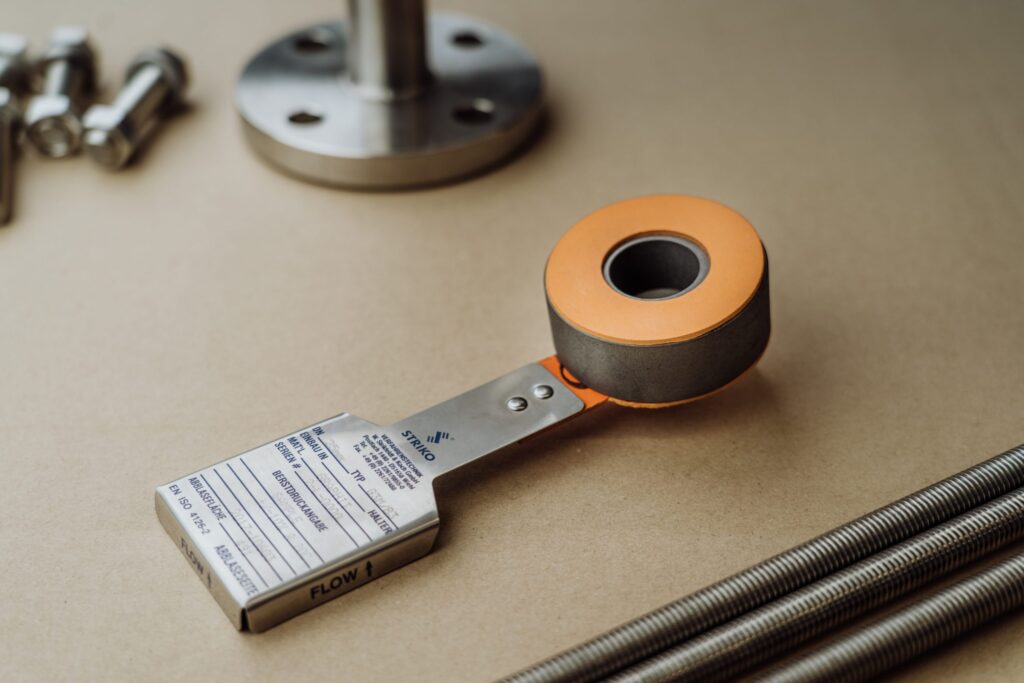
Choosing the rupture disc burst pressure between operating pressure and MAWP
Think of three pressures stacked on top of one another. At the bottom is the maximum operating pressure, including the peaks the process produces during start-up, switching or normal fluctuations. At the top is the maximum allowable working pressure, the MAWP, of the vessel or pipe the disc protects. Somewhere between them lies the rupture disc burst pressure, with its tolerance band around it.
In most designs the burst pressure is placed at or below the MAWP, so that even the highest possible burst pressure within the tolerance keeps the equipment within its code limits. During the relief itself, pressure vessel codes allow the pressure to rise above MAWP by a permitted overpressure while the medium flows out. That overpressure belongs to the flow calculation, not to the choice of burst pressure. Using it to justify a higher burst pressure is a mistake that eats into the margin the flow needs.
Below the burst pressure, the gap to the operating pressure is governed by the operating ratio, which we discuss in the next section. In a process that runs far below its MAWP, there is plenty of room and the choice is easy. In a process that runs close to MAWP, the space becomes tight, and the disc type and tolerance start to dictate what is possible. Selecting only on design pressure, without looking at peaks and temperature, is one of the most common errors in practice.
A practical example makes this concrete. An engineer specifying a disc for a storage vessel with a steady pressure and a comfortable MAWP can pick a burst pressure with generous margins on both sides. A colleague specifying a disc for a reactor that runs close to its MAWP and sees pressure swings during every batch faces a very different task. The same catalogue, the same equations, yet a completely different answer.
Operating ratio: how close the process may run to the burst pressure
The operating ratio describes the relation between the maximum operating pressure and the burst pressure. That relation largely decides how long a disc lasts and how predictably it behaves. A disc that is loaded close to its burst pressure day after day is worked harder than one with a comfortable margin, and over time that can lead to an opening below the marked value.
Disc type determines how much ratio is acceptable. Forward acting discs, with the pressure on the concave side, are loaded in tension and generally need a larger margin between operating pressure and rupture disc burst pressure. Reverse acting or reverse buckling discs, with the pressure on the convex side, are loaded in compression and tolerate a higher operating ratio. Holders for reverse buckling discs are known for higher resistance to pressure cycles and a lower risk of fatigue, which is why they are often chosen when the process has to run close to its limits. STRIKO positions its reverse acting metal discs on durability and efficiency for exactly this reason.
Flat and multi-layer discs, domed discs with X or C scored domes and graphite discs each have their own behaviour, and the manufacturer’s guidance on operating ratio for each type is part of the selection. When the ratio becomes the limiting factor, there are two routes. Either the disc type changes to one that tolerates a higher ratio, or the process conditions are reconsidered. We prefer to have that conversation before the disc is installed.
Tolerance set by material and manufacturing
Temperature can lower the effective burst pressure
Reverse buckling holders resist pressure cycling
STRIKO philosophy: test, evaluate, recalibrate
Temperature and the rupture disc burst pressure
Temperature is where many burst pressure problems begin. The rupture disc burst pressure is specified at a temperature, and the disc will behave differently when the actual temperature is much higher or lower. Heat weakens most disc materials, so a hot disc tends to open below its ambient rating, by an amount that depends on material and design. At lower temperatures a metal disc can become stronger, so it may open later than expected.
The critical temperature is not always the normal operating temperature. It is the temperature of the disc at the moment it has to open. In a fire case the vessel and the disc heat up far beyond normal conditions. In a runaway reaction the temperature climbs together with the pressure. In an insulated line with heat tracing, the disc may be warmer than the process fluid suggests, while a disc on an uninsulated nozzle on a cold day may be cooler. Our selection guidance for STRIKO burst plugs makes the same point very clearly: selection must be based on the temperature during the critical scenario, not only on the nominal operating temperature.
For that reason we always ask for two temperatures, one for normal operation and one for the relief scenario. With both values the burst pressure can be specified at the right temperature, and the material can be chosen accordingly. Our standard metal disc is made of 316 stainless steel, with Hastelloy and titanium as options, and for strongly corrosive media graphite discs are available from DN25 to DN400.
Cyclic loads, pulsation and vacuum
A static pressure is the easiest load a disc can face. Most processes are not static. Batch reactors are pressurised and vented, pumps and compressors introduce pulsation, and control valves can create pressure swings downstream. Each cycle loads the disc material a little, and over thousands of cycles that can lead to fatigue.
Picture an operator on a batch plant who finds that a disc has opened during an ordinary production run, at a pressure clearly below its marking. There was no upset and no alarm. The cause, in cases like this, is often fatigue from years of cycling close to the burst pressure. The disc did not fail. It was simply asked to carry a load pattern it was not selected for.
The remedy lies in selection. Reverse buckling designs cope better with pressure cycling. A dedicated holder, rather than clamping directly between flanges, provides reproducible loading and is the preferred route for pulsating pressure and cyclic loading. Engineering support such as optimisation for cyclic loading and FEM analyses on request can help in demanding cases.
Vacuum is a special form of cyclic load. A vessel that cools down after steam cleaning or is emptied quickly can pull a vacuum on the process side, and a disc that is not designed for it can be pulled the wrong way. Vacuum support, vacuum suitable discs or double discs, and vacuum support holders, keep the disc from flipping over or being damaged. The rupture disc burst pressure only means something if the disc is still in its original shape when overpressure occurs.
When the process changes, review the burst pressure
A burst pressure that was right on the day of commissioning is not necessarily right years later. Throughput increases, a new product, a changed cleaning cycle or a different heating medium can all shift the operating pressure, the peaks or the temperature. When that happens, the margin between operating pressure and burst pressure changes too, sometimes without anyone noticing.
Failing to reassess the relief device after process changes is a known source of trouble. A production manager who raises throughput by a modest amount may push the operating pressure closer to the disc than the original design intended. Nothing happens for a while, until a disc opens during normal production. A short review of the burst pressure, the operating ratio and the temperature basis should be part of every management of change procedure that touches pressure or temperature.
How Dutch Valve Vision helps choose the right burst pressure
Dutch Valve Vision, based in Monster in the Netherlands, is the exclusive agent of STRIKO Verfahrenstechnik GmbH for the Netherlands, Belgium and Luxembourg. We supply STRIKO rupture discs and holders and advise on the choice of burst pressure, tolerance and disc type.
To do that well we need the medium and its composition, the operating pressure including peaks, the MAWP, the required burst pressure, the temperature in normal operation and in the relief scenario, the pressure profile including cycling and vacuum, the connection and the installation space. Our holders are designed in line with ASME Section VIII, EN ISO 4126 and PED 2014/68/EU, and ATEX where applicable, and come with material certificates to EN 10204 3.1, pressure calculations, inspection reports and traceability. Our own quality management system is ISO 9001 certified by KIWA.
Send your data to sales@dutchvalvevision.com or call +31 (0)70-2210560, Monday to Friday from 09:00 to 17:00, and we will help you set a rupture disc burst pressure that protects your equipment and keeps your process running.
Specification ready? We will prepare a targeted quote.
Send us medium, pressure, temperature and connection. Our specialists come back with a matching proposal.
Frequently asked questions about rupture disc burst pressure
Question not listed? Our specialists are happy to help.
Is the rupture disc burst pressure the same as a set pressure on a safety valve?
Not quite, even though the two are often compared. A safety valve set pressure is adjusted on the valve and can be checked and reset. A rupture disc burst pressure is built into the disc by its material, geometry and manufacturing. It is specified at a temperature and comes with a tolerance. The disc reacts to the pressure difference across it, not to the absolute pressure in the vessel. Once the disc has opened, it cannot be reset and must be replaced. A safety valve can reclose after relief. Understanding these differences helps avoid wrong assumptions when both devices appear in one design.
What determines the tolerance on a burst pressure?
Its width is set by material properties and by the manufacturing process. Small variations in sheet thickness, material strength, forming and scoring all contribute. The manufacturer controls these variations and confirms the burst behaviour by testing discs from each batch. STRIKO works to a philosophy of testing, evaluating and recalibrating for this purpose. The tolerance applies around the specified burst pressure at the specified temperature. Both the upper and lower edge of the band have to be checked in the design. A wide tolerance leaves less room between operating pressure and MAWP. We discuss the applicable tolerance with you when proposing a disc.
How far below MAWP should the burst pressure be?
There is no single answer, because it depends on the tolerance and the operating ratio. The burst pressure is usually placed at or below the MAWP. The highest possible burst pressure within the tolerance must keep the equipment within its code limits. At the same time, the lowest possible burst pressure must stay clear of the operating pressure and its peaks. The disc type determines how close the operating pressure may be. Reverse buckling discs generally allow a tighter margin than forward acting discs. The permitted overpressure during relief belongs to the flow calculation, not to the burst pressure choice. We help you find the value that satisfies both edges.
Why does temperature change the burst pressure?
The strength of the disc material depends on temperature. At higher temperatures the effective burst pressure can drop, depending on material and design. At lower temperatures a metal disc can become stronger and may open later. That is why every burst pressure is specified together with a temperature. The relevant temperature is that of the disc at the moment it has to open. In a fire case or runaway reaction, that temperature can be far above normal operation. Selecting only on normal operating temperature is a common mistake. We always ask for both the normal and the scenario temperature.
What is a good operating ratio for a rupture disc?
The acceptable operating ratio depends mainly on the disc type. Forward acting discs are loaded in tension and generally need more margin below the burst pressure. Reverse acting discs are loaded in compression and tolerate a higher ratio. Pressure cycling and pulsation reduce the ratio that can be used safely. The manufacturer’s guidance for each disc type is the reference. A ratio that is too high shortens service life and can lead to an opening below the marked value. A ratio that is too low may push the burst pressure too close to MAWP. We check the ratio for every disc we propose.
Can a disc open below its marked burst pressure?
Yes, and it usually points to a selection or installation issue rather than a manufacturing fault. Fatigue from pressure cycling close to the burst pressure is a frequent cause. Corrosion can thin the disc material over time. A higher temperature than specified lowers the effective burst pressure. Damage during handling or installation can also weaken the disc. Even small defects can change the burst pressure, so a damaged disc must never be installed. When a disc opens unexpectedly, the cause should be investigated before a replacement is fitted. We can help review the burst pressure, disc type and conditions.
How does back pressure affect the burst pressure?
A rupture disc responds to the pressure difference across the membrane. Back pressure on the outlet side reduces that difference. The process side therefore has to reach a higher pressure before the disc opens. For a disc discharging into a shared header, this effect can be significant. Vacuum on the process side works the other way, loading the disc in the opposite direction. Vacuum support or a vacuum suitable disc prevents damage in that case. Always state the expected back pressure and any vacuum conditions in your request. We take both into account when specifying the burst pressure.
When should the burst pressure be reviewed?
A review is needed whenever the process changes in a way that affects pressure or temperature. Higher throughput, a new product or a different cleaning cycle are typical triggers. Such changes can move the operating pressure closer to the burst pressure. They can also change the temperature the disc sees in the relief scenario. An unexpected opening during normal production is a clear signal to review. Many plants include the relief devices in their management of change procedure. That is good practice for any change touching pressure or temperature. We can support the review with product data and advice.
Get your burst pressure checked
Send us the operating pressure including peaks, the MAWP, the temperatures in normal operation and in the relief scenario, the medium and the pressure profile. We advise on burst pressure, tolerance and disc type.
- +31 (0)70-2210560
- sales@dutchvalvevision.com
- Vlotlaan 641, 2681 TZ Monster, the Netherlands
- Mon-Fri 09:00-17:00