

ARC valve
How an ARC valve combines a check valve and a minimum flow bypass, and which Schroeder series suits your pump.
- Exclusive Schroeder Valves agent Benelux
- Original spare parts
- ISO 9001 · KIWA
Exclusive agent for Schroeder Valves
Official spare parts distributor
Quality system, KIWA certified
Service and advice from the Netherlands
How an automatic recirculation valve works
One valve that adjusts itself to process demand.
Full load
The disc is open in the main flow. The bypass stays closed, no energy is lost.
Part load
As demand drops the disc moves down and the mechanically linked bypass opens.
Zero load
The minimum flow returns through the bypass. The pump stays protected, without external energy.
What an ARC valve is and why pump engineers rely on it
An ARC valve is a self-actuated valve that sits on the discharge of a centrifugal pump and makes sure the pump never runs without enough liquid passing through it. ARC stands for automatic recirculation control, and the name describes the job quite precisely. The valve senses how much flow the process takes, and when that flow becomes too small it sends a controlled portion back to the suction side, a tank or a deaerator. The pump keeps turning over a safe amount of liquid, even when the plant downstream hardly asks for anything.
At Dutch Valve Vision we work with this product as the official and exclusive agent of Schroeder Valves in the Benelux. Schroeder has been building these valves for more than 70 years, and in the field you will hear them called by many names: automatic recirculation valve, minimum flow valve, ARC check valve, combined check and bypass valve, or in Dutch simply nullastklep. They all refer to the same idea. One valve body, no power supply, no transmitter, and a pump that is protected from the moment it starts until the moment it stops.
Why does that matter so much? A centrifugal pump that runs against a nearly closed system converts its drive energy into heat instead of flow. The liquid in the casing warms up and can start to vaporise, and cavitation, vibration and damage to bearings and seals follow. An ARC valve takes that scenario off the table, automatically and without anyone in the control room having to intervene.

Inside the ARC valve: main check, coupling and bypass
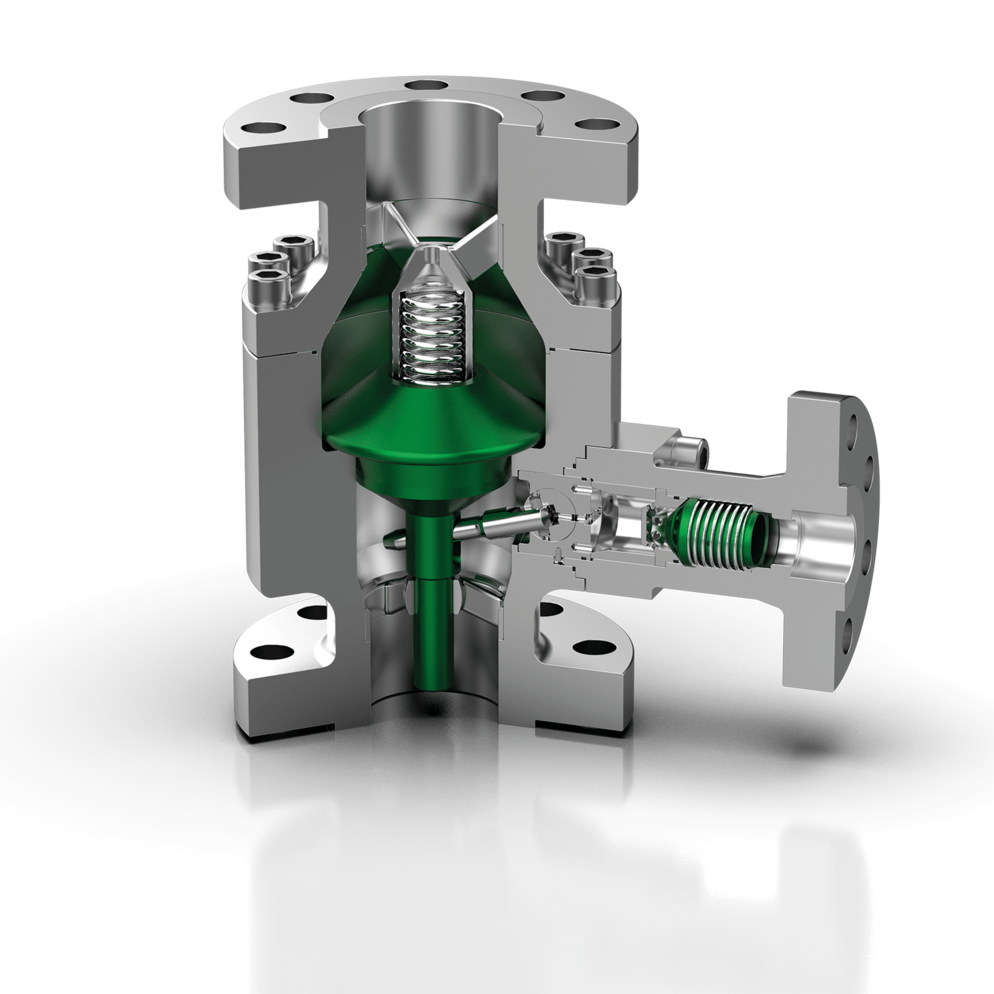
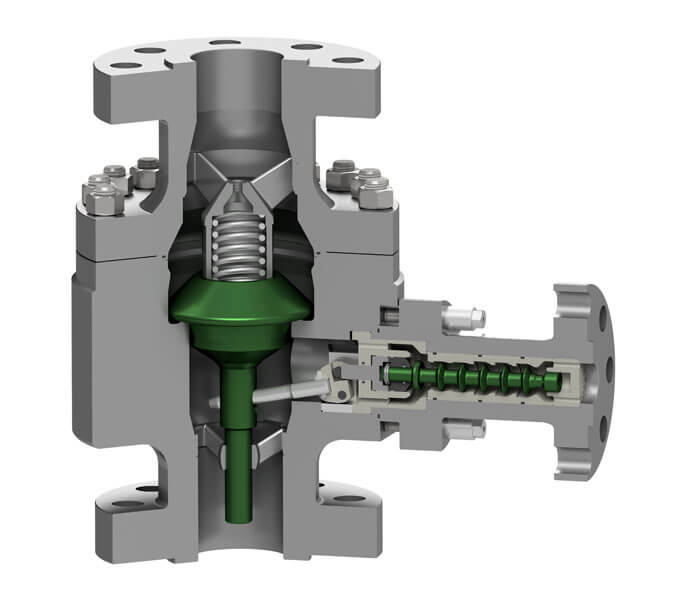
To understand what an ARC valve does, it helps to look at it the way a maintenance technician does when the valve lies open on the workbench. There are three functional parts, and each has a clear task.
The check valve in the main line
The heart of the valve is a check disc in the main flow path. Liquid from the pump lifts the disc off its seat, and the amount of lift depends on the amount of flow. At full process demand the disc is wide open. When demand drops, the disc moves back towards its seat, and when the pump stops it closes completely and prevents reverse flow through the pump. That last function alone replaces the separate check valve that would otherwise sit in the discharge line.
The mechanical coupling
The check disc is not only a check valve, it is also the sensor. Its position is transferred mechanically to the bypass element. There is no electrical signal, no pneumatic line and no controller in between. The flow moves the disc, and the disc moves the bypass. This is what makes an ARC valve self-actuated, and it is also why it keeps working during a power failure.
The bypass with pressure reduction
The bypass, also called the recirculation or leak-off branch, leads a controlled flow back to a point of lower pressure. Because the pressure difference between the pump discharge and that return point can be large, the bypass has to reduce the pressure in a controlled way. In high pressure services this is often done in several stages to limit erosion and noise. For situations where the pressure drop in the return line is especially high, Schroeder even offers separate multi-stage throttle valves in the SSD series.
Schroeder ARC series at a glance
A dedicated series for every pressure class and application.
An ARC valve, short for automatic recirculation control valve, is a self-actuated valve on the discharge side of a centrifugal pump. In the main line it works as a check valve, and when process demand falls it opens a mechanically coupled bypass so the pump always keeps its minimum flow. It needs no external energy, sensors or control system.

Schroeder SSV
Standard, compact all-in-one design.
Schroeder SIP
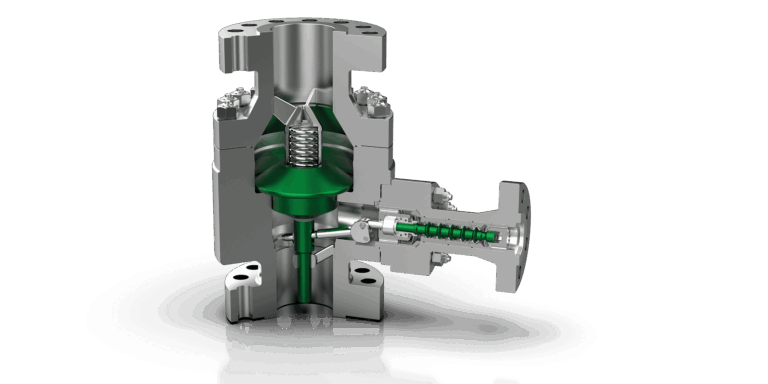
Medium pressure, up to about 250 bar.
Schroeder SHP
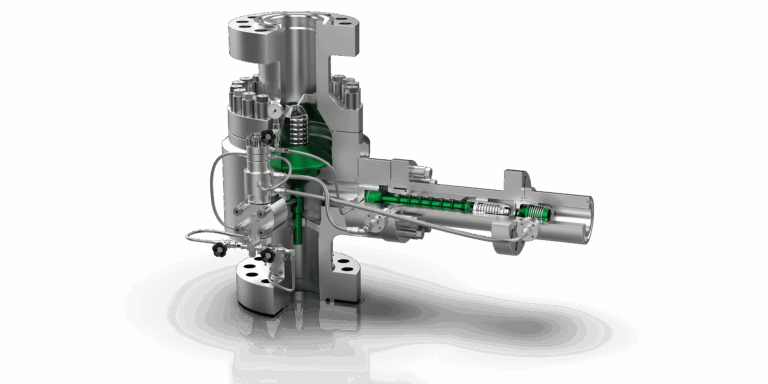
High and very high pressure.

Schroeder SMA
ON/OFF, pilot operated.
Schroeder SDV
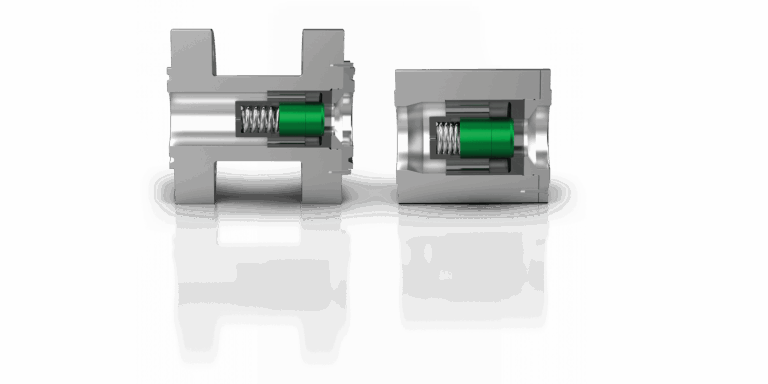
Back pressure device with check function.

Schroeder SSD
Multi-stage throttle for high differential pressure.
How an ARC valve behaves from start-up to full load
Let us follow a boiler feed water pump through a normal day, because that is where an ARC valve shows its value best. Before start-up the process valves downstream are closed or nearly closed, the pump is at standstill and the check disc rests on its seat. The bypass is open and ready.
The operator starts the pump. At that moment there is practically no demand from the boiler, so the check disc stays close to its seat and the minimum flow goes through the bypass back to the feed water tank. The pump is running, but it is running safely. As the boiler starts to take water, the flow in the main line increases, the check disc lifts further and the bypass gradually closes. Above a certain process flow the bypass is fully shut and all the liquid goes where it is needed.
Then the load changes. In the evening the steam demand falls, the feed water control valve throttles and the flow through the main line decreases. The check disc drops back, the coupling opens the bypass again, and the total flow through the pump never falls below the minimum. The ARC valve reacts directly to the change in flow, without oscillation or instability in the system, because it responds to the hydraulics and not to a signal that first has to be measured, processed and sent to an actuator.
Finally the pump trips or is switched off. The check disc closes, the column of water in the discharge line cannot flow back through the pump and the impeller is not driven in reverse. The next start follows the same sequence, without anyone having to reset anything.
Schroeder ARC valve series and where each one fits
Within the Schroeder range, several ARC valve series cover different pressure levels and minimum flow requirements. We describe them in full on our Schroeder ARC valve page, so here we give the short version to help you place your application.
The SSV series is the standard, compact all-in-one design for general industrial applications, power plants and process installations. When a pump needs a high minimum flow, the SSV with control disc handles minimum flows up to about 70 percent of the main flow, which suits sensitive or heavily loaded pumps. The SIP series is designed for pressures up to about 250 bar and is widely used in boiler feed water and utility systems. For high and very high pressures, and for loads that fluctuate strongly, there is the SHP series. The SMA series is an ON/OFF system with pilot operated automatic minimum flow control, built for fast and reliable operation at very high pressure.
Around those series Schroeder offers two supporting product lines. SDV back pressure devices keep a constant minimum upstream pressure, protect against cavitation and phase transitions and include a check function. SSD multi-stage throttle valves take care of controlled pressure and flow reduction where pressure differences are high and erosion is a concern.
Service and overhaul
OEM
Only original Schroeder parts.
Test bench
Flow calibration and pressure test after overhaul.
Warranty
Full Schroeder factory warranty.
Four media where an ARC valve earns its place
Schroeder minimum flow valves can be supplied for boiler feed water, ammonia and nitric acid, LNG and hydrocarbons, seawater and fire fighting systems, and other special media. Each of these services puts different demands on the valve, and that is why we never treat an ARC valve as a catalogue item.
Boiler feed water is the classic application. Feed water pumps run at high pressure and high temperature, and the demand from the boiler varies with the steam load. The liquid comes from a deaerator close to its boiling point, which makes the pump sensitive to heating at low flow. That explains why the SIP series, with its range up to about 250 bar, is so common in feed water and utility systems.
Ammonia and nitric acid (HNO3) are aggressive and hazardous media. Here the reliability of the check function counts just as heavily as the pump protection, because reverse flow of such a medium is the last thing an operator wants. Material selection is matched to the medium and the process conditions, with executions in carbon steel and stainless steel among the options.
LNG and hydrocarbons are volatile. A pump that heats up its own contents at low flow can quickly create vapour, so keeping the minimum flow is directly linked to preventing cavitation. In those services an SDV back pressure device can be a useful companion, because it holds enough upstream pressure to prevent phase transitions.
Seawater and fire fighting systems tell a different story. Fire pumps spend most of their life waiting. They are started for tests with little or no water leaving the system, and when they are really needed they must deliver immediately. An ARC valve lets the pump run a test against a closed network without overheating, and in a real emergency the bypass closes as soon as the demand rises.
Sizing an ARC valve on flow, not on pipe size
A mistake that is easy to make in existing plants is a valve that was chosen to match the pipe diameter instead of the pump. It looks tidy on the drawing, but it can work against you in operation. A check disc that is sized far too generously for the actual flow never lifts properly. It hovers close to its seat, it can start to flutter, and the bypass keeps modulating around a point where it was never meant to sit for hours. The result is wear on the internals and a pump that is protected less smoothly than it should be.
That is why we size on the hydraulics. Three flow values set the frame: the minimum flow the pump needs, the normal flow at which the process usually runs, and the maximum flow at the far end of the pump curve. The bypass has to deliver the minimum flow at the pressure difference between pump discharge and return point. The main line has to pass the normal and maximum flow with an acceptable pressure loss, and the check disc has to be in a stable position over the range where the pump spends most of its time.
A practical example makes this concrete. Picture a process pump that was selected with plenty of margin during the design phase, because nobody knew exactly how the plant would be operated. Years later it runs most of the day at a fraction of its rated flow. In that situation the pump itself is the real issue, and the ARC valve becomes the component that keeps it alive. Knowing the actual operating profile, and not only the design figures, makes a real difference to the selection. We therefore always ask how the pump is operated in practice, how often it starts and stops, and whether there are parallel pumps that can push each other back towards low flow.
Specification ready? We will prepare a targeted quote.
Send us medium, pressure, temperature and connection. Our specialists come back with a matching proposal.
Why an ARC valve beats a loose collection of components
Many older installations protect their pumps with a separate check valve, a flow meter, a controller and a control valve in the recirculation line. It works, but it means more components that can fail, more cabling, more calibration and more spare parts on the shelf. An ARC valve integrates the check function and the recirculation function in one body. That saves space, simplifies the piping and removes the dependency on electrical power, instrument air and control software.
The difference shows up in the total cost of ownership. Fewer components mean fewer failure points and lower investment and maintenance costs, and less wear on the pump means fewer repairs and less unplanned downtime. We work out that comparison in detail on our automatic recirculation valve page, but for many plant owners this is already the argument that tips the balance.
Specifying an ARC valve with Dutch Valve Vision
A good ARC valve selection starts with the pump and the process, not with the catalogue. We ask for the pump data, the minimum flow specified by the pump manufacturer, the normal and maximum process flow, the medium and its temperature, the pressure at the pump discharge and at the point where the bypass returns, and the connection standard. With that information we can determine which series fits, how the bypass has to reduce the pressure and which materials make sense.
Dutch Valve Vision works with an ISO 9001 certified quality management system, certified by KIWA, and supplies valves to DIN and ANSI standards. As exclusive agent for Schroeder Valves in Belgium, the Netherlands and Luxembourg we handle advice, technical support and supply chain management for new installations and replacements. When an existing valve needs attention, we supply original Schroeder spare parts and organise repairs with OEM parts, a flow calibration test and a pressure test on the Schroeder test bench, followed by a full factory warranty.
Do you have a pump that runs at part load more often than anyone would like, or a new project still on the drawing board? Contact us at +31 (0)70-2210560 or sales@dutchvalvevision.com, Monday to Friday from 09:00 to 17:00. We will help you find the ARC valve that matches your pump and your process.
Frequently asked questions about arc valve
Question not listed? Our specialists are happy to help.
- +31 (0)70-2210560
- sales@dutchvalvevision.com
- Vlotlaan 641, 2681 TZ Monster, the Netherlands
- Mon-Fri 09:00-17:00
What does ARC stand for in ARC valve?
ARC stands for automatic recirculation control. The term describes a valve that automatically recirculates part of the pump flow when the process demand becomes too low. Other names for the same product are automatic recirculation valve, minimum flow valve and pump protection valve. In Dutch plants you will often hear the word nullastklep or nullast afsluiter. Some specifications also use combined check and bypass valve or self-actuated recirculation valve. The principle behind all these names is identical. A check valve in the main line is mechanically linked to a bypass that guarantees minimum flow. We supply these valves as the exclusive Schroeder Valves agent for the Benelux.
Does an ARC valve need electrical power or instrument air?
No, an ARC valve works without any external energy. The flow of the pumped liquid lifts the check disc, and the position of that disc operates the bypass. There are no transmitters, no controllers and no actuators that need power or air. That makes the valve insensitive to failures in the surrounding instrumentation. During a power dip the pump protection simply keeps working. It also means there is no loop to tune and no software to maintain. The SMA series uses pilot operation for ON/OFF minimum flow control, but it remains an automatic system. For most applications the purely mechanical principle is the main reason customers choose this solution.
Can an ARC valve replace a separate check valve?
Yes, the check function is an integral part of every ARC valve. The main check disc closes when the pump stops and prevents liquid from flowing back through the pump. That means you do not need an additional check valve in the discharge line directly after the pump. This saves a component, a set of flanges and installation space. It also removes one more item from the maintenance list. In existing plants we always check how the current check valve and recirculation line are arranged before advising a replacement. Sometimes the old bypass line can be reused, sometimes it needs to be modified. We look at that together with your piping engineer.
Where is an ARC valve installed?
An ARC valve is installed on the discharge side of the centrifugal pump, as close to the pump as practical. The main outlet continues to the process, and the bypass outlet is connected to a return line. That return line usually leads to the suction vessel, a tank or a deaerator rather than straight into the pump suction. Returning to a vessel gives the recirculated liquid time to lose the heat it picked up in the pump. The bypass must be able to reduce the pressure from the discharge level to the return level. With high pressure differences a multi-stage design or an SSD throttle valve is used. The return line itself also has to be sized for the recirculated flow. We help you define the return point during the design phase.
How do I determine the minimum flow for my ARC valve?
The minimum flow comes from the pump manufacturer and is usually stated in the pump data sheet or curve. It depends on the pump design, the impeller, the speed and the liquid being pumped. We use that value, together with the normal and maximum process flow, to size the bypass of the valve. For most pumps the standard SSV series covers the required recirculation. Some pumps need a high minimum flow compared to their duty point. For those cases the SSV with control disc handles minimum flows up to about 70 percent of the main flow. If you are unsure about the value, we can review the pump data with you before selection. Guessing this figure is never a good idea, because it defines the whole bypass.
Which Schroeder ARC valve series handles high pressure?
Schroeder offers several series for demanding pressure levels. The SIP series is designed for pressures up to about 250 bar and is common in boiler feed water and utility systems. The SHP series covers high and very high pressure and is built for strongly fluctuating loads. The SMA series is an ON/OFF system with pilot operated minimum flow control for fast operation at very high pressure. For high pressure differences in the return line, SSD multi-stage throttle valves limit erosion and noise. SDV back pressure devices help keep enough upstream pressure to avoid cavitation. The right choice depends on your pressure, flow profile and medium. We compare the options for you based on your process data.
Is an ARC valve suitable for fire fighting pumps?
Yes, fire fighting and seawater systems are among the standard applications for Schroeder minimum flow valves. Fire pumps are started regularly for testing while hardly any water leaves the network. Without protection the pump would then run against a closed system and heat up. An ARC valve sends the minimum flow back during those tests. As soon as a real demand occurs, the bypass closes and the full flow goes to the fire water network. The valve does this without power, which matters in an emergency scenario. Material choice is important with seawater and is matched to the medium. We advise on the execution that fits your system.
Can Dutch Valve Vision service existing ARC valves?
Yes, we support existing Schroeder valves as well as new projects. We supply original Schroeder spare parts, such as gaskets, springs, housing parts, seats and valve components. For older models upgrade kits are available. Valves can be repaired through us with original OEM parts only. After revision each valve gets a flow calibration test and a pressure test on the Schroeder test bench. If deviations are measured, the valve is readjusted until it reaches its original settings. Repaired valves come with a full Schroeder factory warranty. Send us the tag or nameplate details and we will tell you what is possible.
Select the right ARC valve for your pump
Send us the pump data, the required minimum flow, the medium and temperature, and the pressures on the discharge and bypass side. We will propose the matching Schroeder series.
- +31 (0)70-2210560
- sales@dutchvalvevision.com
- Vlotlaan 641, 2681 TZ Monster, the Netherlands
- Mon-Fri 09:00-17:00