
Safety valve rupture disc
What a rupture disc in front of your safety valve means for daily monitoring, pressure in the interspace, burst alarms and valve maintenance.

In a safety valve rupture disc set-up the disc protects the valve from the medium, but the owner has to watch two things: the pressure in the space between disc and valve, and whether the disc has burst. Trapped pressure in that space makes the disc open later than intended, and a burst disc leaves the valve exposed. Interspace monitoring and a burst indicator cover both risks.
- A safety valve rupture disc arrangement seen from the valve owner's side
- What changes for your safety valve when a disc sits in front of it
- Pressure build-up between disc and valve: the risk you cannot see
- Interspace monitoring options in practice
- The burst indicator: knowing when your safety valve is exposed
- Maintaining the safety valve in a safety valve rupture disc set-up
- After the disc has burst
- How Dutch Valve Vision supports safety valve rupture disc owners
Unsure about the right choice?
Share your process data with our specialists. We check the numbers with you and give reasoned advice.
A safety valve rupture disc arrangement seen from the valve owner's side
A safety valve rupture disc arrangement usually lands on the desk of someone who did not design it. The plant was built years ago, the valve carries a tag you know by heart, and somewhere below it sits a disc in a holder with a small gauge or a cable attached. You are responsible for keeping that relief branch working. What exactly do you need to watch, and what changes in your maintenance routine because the disc is there?
Those are the questions this page answers. The reasons for putting a disc in front of a valve, and the design of the combination, are covered on our page about the rupture disc relief valve combination. Here we take the perspective of the operations and maintenance people who live with the arrangement every day. At Dutch Valve Vision we supply the disc side of such installations, as exclusive agent of STRIKO Verfahrenstechnik GmbH for the Netherlands, Belgium and Luxembourg, and we look at the arrangement the same way you do: as a system that has to keep working between turnarounds.
The short version is this. The disc does a great job for your valve, keeping the process medium away from its seat and internals and making the relief branch leak tight. In return, it adds two things that need attention: the pressure in the small space between disc and valve, and the state of the disc itself. If you have both under control, a safety valve rupture disc arrangement is one of the most reliable relief set-ups you can have. If you do not, it can hide problems that a bare valve would have shown you.
What changes for your safety valve when a disc sits in front of it
Without a disc, your safety valve is wetted by the process all the time. Its seat and internals see the medium, the temperature and whatever deposits or corrosion come with them. Every turnaround you find out how much damage that has done. With a disc in front of it, the valve lives in a clean, dry space at or near atmospheric pressure. Corrosion and fouling of the valve internals largely disappear from the picture, because the medium only reaches the valve once the disc has opened.
That is a real gain for the valve owner. A valve that never sees the process medium is spared the very conditions that make valve overhauls unpredictable. There is a flip side, though. The valve now depends on the disc for its protection, and the disc depends on the interspace staying at the right pressure. In a safety valve rupture disc set-up you are no longer looking after one device, but after a small system of three parts: the disc, the space behind it and the valve.
Leak tightness changes as well. A safety valve on its own may leak slightly at the seat before it opens, especially when the plant runs close to the set pressure. An intact rupture disc is 100% leak tight until it bursts. With the disc in place, any emission through the valve seat during normal operation is ruled out, which matters for toxic, expensive or environmentally harmful media.
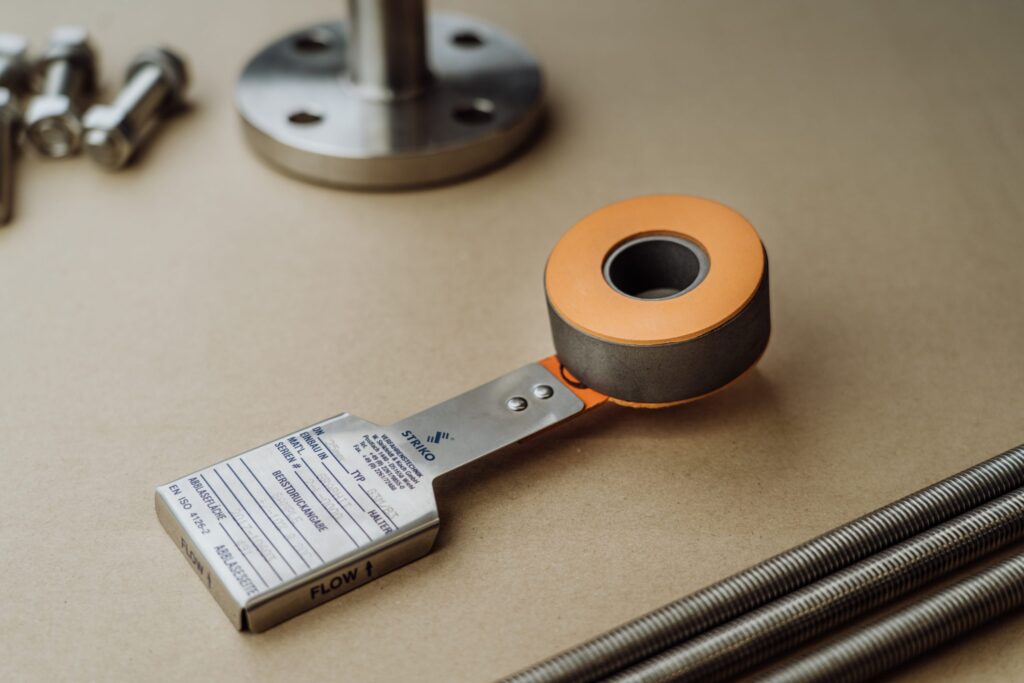
Pressure build-up between disc and valve: the risk you cannot see
Here is the part that every owner of a safety valve rupture disc arrangement should understand thoroughly. A rupture disc does not respond to the process pressure alone. It responds to the difference between the pressure on its process side and the pressure behind it. As long as the interspace is at atmospheric pressure, that difference equals the process pressure and the disc bursts where it should. Once pressure builds up in the interspace, the disc needs a correspondingly higher process pressure before it bursts.
How does pressure get into that space? The most common cause is a small leak through the disc itself, a pinhole from corrosion or a crack from fatigue, which lets medium seep into the interspace without the disc opening. A leaking gasket or seal in the holder can do the same. Temperature can also play a role: gas trapped in a closed cavity expands when the assembly warms up in the sun or from nearby process heat. In each case the pressure behind the disc rises slowly, often without any visible sign on the outside.
The consequence is serious. Suppose the interspace has quietly filled to a fraction of the burst pressure. The vessel now has to reach the burst pressure plus that fraction before the disc opens, and the valve behind it will only get the chance to relieve at that higher pressure. The protected equipment may exceed the pressure it was supposed to be protected at, while everything on the control room screen looks normal. A disc that leaks has also stopped doing its job of isolating the valve, because medium is now reaching the valve inlet. That is why interspace monitoring is not an optional extra in a safety valve rupture disc set-up but a basic requirement.
Interspace monitoring options in practice
There are several ways to keep an eye on the interspace, and the right one depends on the medium, the location and the monitoring philosophy of your site. The applicable code and your company standards usually set the minimum.
A local pressure gauge
The simplest option is a pressure gauge on the interspace. It shows at a glance whether the space is at atmospheric pressure, and it costs little to install. Its weakness is that someone has to look at it. A gauge on top of a column or in a corner of a tank farm only helps if it is part of a regular inspection round and if the people doing that round know what a reading above zero means.
A pressure switch or transmitter with alarm
A pressure switch or transmitter on the interspace, connected to the control system, removes the dependence on inspection rounds. A rise in interspace pressure produces an alarm in the control room, where it can be handled like any other process alarm. For remote positions or hazardous media, this is often the preferred solution.
A vent through an excess flow valve
Another approach vents the interspace through an excess flow valve. Small leakage is allowed to escape, so pressure cannot build up behind the disc. When the disc bursts, the large flow closes the excess flow valve, so the medium is directed to the safety valve rather than out through the vent. This option only makes sense where the leaking medium can be vented safely, so it is not suitable for every service.
Whichever option you choose, it needs a clean connection to the interspace. Our holders can be supplied with leak detection ports where required, which provides that connection point without improvised fittings between disc and valve.
Burst indicator with fail-safe principle
Signal to PLC, SCADA or DCS
Holders with leak detection ports available
Never install a damaged disc
The burst indicator: knowing when your safety valve is exposed
Interspace monitoring tells you that something is wrong before the disc opens. A burst indicator tells you that the disc has opened. For the valve owner that is a crucial piece of information, because from that moment the safety valve is in direct contact with the process medium and the leak tight barrier is gone.
A burst detection sensor watches the disc continuously. With electrical detection, a loop across the disc is broken the moment the disc opens. Magnetic detection reads a field that changes when the disc moves. Fail-safe designs also generate a safe notification when the sensor itself fails, so a false negative is avoided. The signal can be connected to PLC, SCADA or DCS, which allows an automatic shutdown and a warning to personnel, and detection can be applied in ATEX zones.
What should happen when the alarm comes in? At the very least, the operators need to know that the relief branch has acted and that the valve is now exposed. The cause of the overpressure has to be investigated, the process brought to a safe state and the disc replaced before the arrangement can be relied upon again. A clear alarm text and a short instruction per tag make that response quick and consistent. Without detection, a burst disc is sometimes only discovered during a routine check, long after the valve has been exposed to the medium.
Maintaining the safety valve in a safety valve rupture disc set-up
The disc does not remove the need to maintain the safety valve. Your inspection regime for the valve still applies, and the valve still has to be tested and overhauled at the intervals your site and the regulations require. What changes is the condition in which you usually find the valve, and the extra steps needed around the disc.
When the valve is removed for testing, the disc and holder are usually exposed as well. That is the moment to inspect the holder, its sealing faces and its leak detection port, and to check the interspace connection and the monitoring instrument. Holders are designed for long-term reuse, and maintenance of the holder is normally limited to visual inspection. The disc itself is a different story. We advise against reinstalling a disc that has been removed from its holder, because handling can damage it, and a damaged disc must never be installed since even small defects can change the burst pressure. Plan a new disc for every opening of the assembly and keep spares in stock for critical positions.
During reassembly, the usual installation rules apply. Check the diameter and burst pressure of the new disc against the tag, make sure the flanges are clean and aligned, centre the gaskets, respect the flow direction arrow and tighten the bolts evenly to the recommended torque. Holders with clear flow and installation markings and a consistent bolt load help to get the disc in the right way, every time. Finally, bring the interspace back to atmospheric pressure, check the gauge or transmitter and test the burst indicator loop before the unit starts up.
After the disc has burst
A burst disc in front of a safety valve calls for a short, fixed sequence. Bring the process to a safe state and find out why the pressure rose. Treat the safety valve as having been exposed to the medium, because it has, and decide whether it needs inspection before it goes back into service. Replace the disc with a new one of the correct specification, check the holder and its seals and reset the interspace monitoring and the burst indicator. Only then is the safety valve rupture disc arrangement complete again.
Keeping the right spare discs on the shelf makes all the difference at that moment. A disc that has to be ordered after the event extends the downtime, while a spare disc with the correct burst pressure, material and size lets you restart as soon as the cause is understood. Burst plugs follow the same logic where they are used as secondary protection alongside a safety valve: they are always replaced after activation.
How Dutch Valve Vision supports safety valve rupture disc owners
Dutch Valve Vision, based in Monster in the Netherlands, supplies the disc side of your arrangement: STRIKO rupture discs, holders with optional leak detection ports and burst detection. STRIKO, active in rupture discs since 1974, builds on a philosophy of testing, evaluating and recalibrating. Our holders are designed in line with ASME Section VIII, EN ISO 4126 and PED 2014/68/EU, and ATEX where applicable, and come with material certificates to EN 10204 3.1, pressure calculations, inspection reports and traceability per component. We work with an ISO 9001 certified quality management system, certified by KIWA.
For a replacement disc or an upgrade of an existing safety valve rupture disc position, send us the tag, the existing disc data if available, the medium, the operating pressure including peaks, the set pressure of the valve, the temperature in normal operation and in the relief scenario and the connection. Tell us how the interspace is monitored today and whether burst detection is installed. Mail sales@dutchvalvevision.com or call +31 (0)70-2210560, Monday to Friday from 09:00 to 17:00.
Specification ready? We will prepare a targeted quote.
Send us medium, pressure, temperature and connection. Our specialists come back with a matching proposal.
Frequently asked questions about safety valve rupture disc
Question not listed? Our specialists are happy to help.
What is a safety valve rupture disc arrangement?
It is a relief set-up in which a rupture disc is installed directly upstream of a safety valve. The disc seals the relief branch during normal operation and keeps the process medium away from the valve. When the pressure reaches the burst pressure, the disc opens and the safety valve lifts to relieve the excess. Once the pressure has dropped, the valve closes again and limits the loss of medium. The disc then has to be replaced before the arrangement is complete again. The small space between disc and valve must be monitored for pressure. A burst indicator tells you when the disc has opened. Together these parts form one relief system that needs to be looked after as a whole.
What does a rising pressure between disc and valve mean?
A rising pressure in the interspace usually means that medium is getting past the disc without the disc having burst. The most common causes are a pinhole from corrosion, a crack from fatigue or a leaking seal in the holder. Temperature effects on trapped gas can also raise the pressure. Because a disc responds to the pressure difference across it, the disc will now open at a higher process pressure than intended. The protected equipment could exceed its intended relief pressure before anything opens. The valve is also no longer fully isolated from the medium. Treat such a reading as a reason to investigate promptly and to plan a disc replacement. Do not simply vent it and carry on without finding the cause.
What is an excess flow valve used for in the interspace?
An excess flow valve lets small leakage escape from the space between disc and valve. That prevents pressure from building up behind the disc. When the disc bursts, the large flow closes the excess flow valve. The medium is then directed to the safety valve rather than out through the vent. This keeps the interspace at atmospheric pressure without constant manual attention. It is only suitable where the leaking medium can be vented safely. For toxic or hazardous media, a pressure switch or transmitter with an alarm is often preferred. Our holders can be supplied with leak detection ports as the connection point for such devices.
Do I still need to maintain my safety valve if a disc protects it?
Yes, the safety valve still needs inspection, testing and overhaul according to your site regime and the regulations. The disc does not replace that maintenance. What changes is the condition of the valve, because it is no longer wetted by the process medium. Corrosion and deposits on the seat and internals are therefore much less of a problem. When the valve is removed, the disc and holder should be checked at the same time. We advise fitting a new disc whenever the assembly has been opened. The holder is designed for reuse and usually only needs visual inspection. The interspace monitoring and burst indicator should be tested before start-up.
What should operators do when the burst indicator alarms?
A burst alarm means that the disc has opened and the safety valve is now exposed to the medium. The first step is to bring the process to a safe state. Next, the cause of the overpressure has to be found. The safety valve should be treated as exposed and checked before it goes back into service. The disc is then replaced with a new one of the correct specification. The holder, seals, interspace monitoring and burst indicator are checked and reset. A short instruction per tag in the control room helps operators respond quickly and consistently. Keeping spare discs in stock keeps the downtime as short as possible.
Can I reuse the rupture disc after removing it for valve maintenance?
We advise against reinstalling a disc that has been removed from its holder. Handling during removal and storage can damage the disc. A damaged disc must never be installed, because even small defects can change the burst pressure. Such damage is not always visible to the eye. Fitting a new disc is a small effort compared to the consequences of a disc that opens at the wrong pressure. That is why we recommend planning a new disc for every opening of the assembly. Keep spare discs with the correct burst pressure, material and size in stock. The holder itself can be reused after inspection.
How do I know if the rupture disc under my safety valve is leaking?
The clearest sign is pressure in the interspace between disc and valve. A gauge that reads above zero, or a pressure switch or transmitter that alarms, points to a leak. Without interspace monitoring, a leaking disc can remain unnoticed for a long time. Signs of process medium at the valve inlet during maintenance also indicate that the disc has not been tight. A burst indicator will not always detect a small leak, because the disc has not opened. That is why interspace monitoring and burst detection complement each other. If you suspect a leak, plan a disc replacement and check the holder seals. Tell us what you found so we can check whether the disc selection still fits the process.
What can Dutch Valve Vision supply for an existing safety valve?
We supply the disc side of the arrangement as exclusive STRIKO agent for the Benelux. That includes replacement rupture discs matched to your tag, medium, temperature and burst pressure. We also supply holders, which can be fitted with leak detection ports for interspace monitoring. Burst detection with electrical or magnetic sensing and fail-safe design can be added to the disc or holder. Holders come with material certificates, pressure calculations, inspection reports and traceability. For a quick answer, send us the valve tag, the existing disc data, the medium and the operating conditions. Tell us as well how the interspace is monitored today. Mail your data to sales@dutchvalvevision.com or call +31 (0)70-2210560.
A disc in front of your safety valve?
Send us the valve tag, set pressure, medium, temperatures and connection, and tell us how the interspace is monitored today. We advise on the matching disc, holder and detection.
- +31 (0)70-2210560
- sales@dutchvalvevision.com
- Vlotlaan 641, 2681 TZ Monster, the Netherlands
- Mon-Fri 09:00-17:00