
Rupture disc price
The factors behind every rupture disc price, and the data that gets you an accurate quotation from us without endless back and forth.

A rupture disc price is set by the specification, not by a catalogue: material, nominal diameter, burst pressure and tolerance, disc type, holder, quantity, documentation and burst detection all play a part. That is why Dutch Valve Vision quotes per application instead of publishing prices. Send us the medium, pressures, temperatures and connection and we prepare a no-obligation quotation for the matching STRIKO disc.
- Why a rupture disc price starts with your process
- Material: the first lever on the rupture disc price
- Size, burst pressure and tolerance
- Disc type and holder: design choices that shape the rupture disc price
- Quantity, documentation and detection
- Installation and handling: the cost that is not on the quotation
- Where you can influence the rupture disc price yourself
- How to get an accurate rupture disc price quickly
Unsure about the right choice?
Share your process data with our specialists. We check the numbers with you and give reasoned advice.
Why a rupture disc price starts with your process
A rupture disc price is one of the most searched questions in pressure relief, and one of the hardest to answer with a single figure. The reason is simple. Two discs that look almost identical in a photograph can be completely different products. One is a flat stainless steel disc for a low pressure utility line. The other is a reverse acting disc in a special alloy for a reactor with an aggressive medium, supplied in a holder with burst detection and a full certificate package.
At Dutch Valve Vision we therefore do not publish prices. We are the exclusive agent of STRIKO Verfahrenstechnik GmbH for the Netherlands, Belgium and Luxembourg, and every STRIKO disc we supply is selected for a specific application. What we can do is explain which factors move a rupture disc price up or down, so you understand a quotation when it lands on your desk and can send the right data from the start.
Think of it the way an engineer thinks about a pressure vessel. Nobody asks what a vessel costs without saying what it has to hold, at what pressure and temperature, and to which code. A rupture disc is much smaller, but the logic is identical. Material, diameter, burst pressure and tolerance, disc type, holder, quantity, documentation and detection each add a variable. Together they explain almost every difference between two quotations.
Material: the first lever on the rupture disc price
The material has to survive the medium, the temperature and the mechanical load for years, and still burst at the right pressure when it matters. That makes it the first and often the heaviest lever.
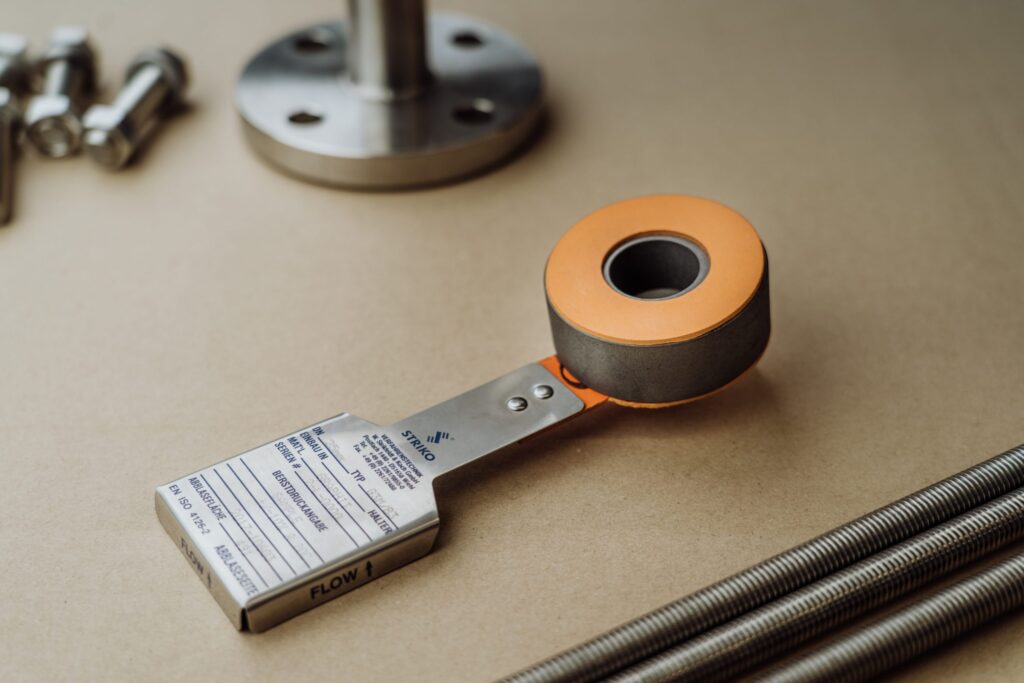
Our standard metal rupture disc is made of 316 stainless steel, a material known for good corrosion resistance and structural integrity. For many process applications it is the sensible default. When the medium is more aggressive or the temperature higher, Hastelloy or titanium can be required. High performance alloys like these are more costly to buy and more demanding to process than stainless steel, and that shows in the rupture disc price. The choice is never made on price alone, though. It follows from chemical compatibility with the medium, the working temperature and the mechanical load.
Graphite is a different route altogether. A graphite rupture disc is naturally resistant to many acids, bases and aggressive media without an extra coating, and we supply it from DN25 to DN400. In corrosive service it can be the economically attractive option compared with an exotic metal, not least because many graphite discs can be mounted directly between standard flanges without a separate holder. An optional TFE coating adds another variable to weigh.
The holder brings its own material question. Holders are available in carbon steel, 316/316L stainless steel, duplex and super duplex, and Inconel or Hastelloy. A carbon steel holder for a controlled medium and a super duplex holder for chloride-rich service are not in the same league, and the price of a complete assembly reflects that.
Size, burst pressure and tolerance
Nominal diameter
The nominal diameter follows from the relief capacity the system needs. A larger opening means a larger disc, more material, a larger holder and bigger flanges to match. Diameter also interacts with pressure. For a given burst pressure the material thickness and construction change with size, so the rupture disc price does not rise in a straight line with DN. Undersizing to save money is never an option, because the disc must be able to relieve the scenario it is there for. Sizing comes first, and the price follows from it.
Burst pressure and tolerance
Every disc is designed for an exact burst pressure matched to the safe working pressure of the system, with a tolerance determined by material properties and the manufacturing process. Very low burst pressures are technically demanding, because the membrane has to be extremely thin or specially constructed and still stay stable in service. High pressures call for sturdier designs, such as the forward acting metal discs STRIKO builds for high pressure environments, or a multi-layer construction for extra strength.
A tight tolerance is another driver. The closer the burst pressure has to sit to its target, the more manufacturing and verification effort it takes. That is no reason to accept a loose tolerance, because the tolerance also determines how close to the burst pressure you can run your process. It is simply a factor to discuss openly. The same goes for temperature. The effective burst pressure can fall at higher temperatures, depending on material and design, and a disc specified for a hot relief scenario has to be designed and verified for that scenario.
Disc type and holder: design choices that shape the rupture disc price
Flat, forward acting, reverse acting or special
The STRIKO programme runs from flat metal discs for standard applications to forward acting discs for high pressure, reverse acting discs chosen for durability and efficiency, aseptic discs for pharma and food, extruder discs, discs for tank containers and compact burst plugs. A flat disc for a standard application is the most straightforward design. A reverse acting disc is a more elaborate design, but it offers higher resistance to pressure cycles and a lower risk of fatigue. An aseptic disc adds polished surfaces that support cleaning and CIP routines. Each step up in complexity shows in the rupture disc price, and each step also solves a specific problem that a simpler disc would not.
Domed discs with an X or C scored dome, vacuum suitable discs and double discs for systems that see both overpressure and underpressure bring their own engineering as well. If your vessel can be pulled into vacuum during emptying or cooling, that requirement belongs in the specification from day one, not as a change after the order.
The holder
Metal discs can be clamped directly between flanges in systems with straight pipe sections, which keeps the purchase simple. For pulsating pressure, cyclic loading or wherever process integrity matters most, a dedicated holder is the better route. We supply forward acting holders, reverse buckling holders and vacuum support holders, with sealing faces of controlled roughness, clear installation markings and, where needed, leak detection ports. A holder is designed for long-term reuse, and only the disc is replaced after an event. When you compare a rupture disc price with and without holder, look at that difference across the life of the installation rather than at the first order alone.
Standard disc material: 316 stainless steel
Hastelloy and titanium available as options
Graphite discs from DN25 to DN400
Holder documents to EN 10204 3.1
Quantity, documentation and detection
Quantity has a stronger effect on the rupture disc price than many buyers expect. Burst pressure is verified by destructive testing of discs from the same production batch, and preparing production for a specific design takes effort whatever the batch size. Ordering one replacement disc per position means those fixed efforts are spread over very few discs. Ordering the replacements for several identical positions together, or adding spare discs for critical points to the same order, spreads them more widely. Spares bring a second benefit: the fastest restart after an event is the one where the new disc is already in the store.
Documentation is the next variable. For holders we supply material certificates to EN 10204 3.1, pressure calculations, inspection reports and traceability per component. For graphite discs the emphasis is on traceable material quality and burst pressures tested in advance. Projects that require more, such as a PED dossier, FEM analyses or support in HAZOP and other safety studies, add engineering hours. That is real work, and it belongs in the quotation, so it is better to mention these requirements up front than to discover them after the order.
Burst detection completes the list. A sensor based on an electrical loop or magnetic detection, with a fail-safe design and a connection to a PLC, SCADA or DCS, adds hardware and, in explosive atmospheres, ATEX requirements. For toxic, valuable or environmentally harmful media it is often well worth it, because it shortens the time between a burst and a response. Without detection, a burst disc is sometimes only noticed during a routine inspection.
Installation and handling: the cost that is not on the quotation
One factor never appears as a line on a quotation, yet it can mean paying twice for the same position. A rupture disc is a precision part. Even small defects can change the burst pressure, which means a disc that is dented during handling or mounted incorrectly must not be used. That is a second purchase, and often a delay as well.
The basics are well known. Check the diameter and burst pressure against the specification before mounting. Make sure the flanges are clean and aligned, centre the gaskets, respect the flow direction arrow and tighten the bolts evenly to the recommended torque. Our holders help here with clear flow and installation markings, correct positioning of the disc and a consistent bolt load. Store spare discs in their packaging until they are needed. None of this changes the rupture disc price on paper, but all of it changes what the disc really costs you.
Where you can influence the rupture disc price yourself
Most of the factors above follow from the process and are not open to negotiation. A burst pressure is what the vessel needs, and the material is what the medium allows. Still, a plant has more influence on the rupture disc price than it may think, mainly through the way it organises its relief devices.
The first lever is standardisation. Over the years, many sites collect a wide variety of disc designs, often because each project specified its own. Where several positions see the same medium and similar conditions, it can make sense to review whether they can share one design, one material and one holder type. Fewer variants mean larger batches per design, simpler spare part management and less chance of fitting the wrong disc in a hurry. The review must always start from the process data, never from the wish to reduce variety, but where it is technically sound it pays off.
The second lever is planning. Replacements ordered in a rush after an unexpected opening leave little room for bundling or for checking whether a better design is available. Replacements planned around a turnaround or maintenance stop can be combined, checked against current process conditions and delivered in time. The same applies to spare discs for critical positions: a planned spare is ordered with other discs, an emergency one is ordered alone.
The third lever is design choice over the life of the installation. A reverse acting disc on a position with heavy pressure cycling may carry a higher rupture disc price than a simple flat disc, yet it can last considerably longer because of its lower risk of fatigue. A holder that is reused for years reduces what each later replacement involves. Looking at the position over its lifetime, rather than at the next order, often changes which option is actually the economical one.
How to get an accurate rupture disc price quickly
Two requests arrive in an inbox on the same morning. The first reads: we need a rupture disc for a reactor, DN80, please send a price. The second lists the medium and its composition, the operating pressure including peaks, the required burst pressure, the temperature in normal operation and in the relief scenario, the flange standard and rating, the available installation space, whether vacuum can occur, the number of positions, the required documents and whether burst detection is wanted.
The first request starts a conversation. The second starts a quotation. Neither buyer is doing anything wrong, but the second will have an accurate rupture disc price much sooner, because almost every variable on this page has already been answered.
For a replacement, the existing tag data and the current specification are often enough to start. For a new installation, a copy of the relevant P&ID section or datasheet helps us understand the context. If you are unsure about one of the values, say so. We would rather ask one question than guess, because a disc that is cheaper on paper but wrong for the process is the most expensive choice of all.
Send your data to sales@dutchvalvevision.com or call +31 (0)70-2210560, Monday to Friday from 09:00 to 17:00. We prepare a no-obligation quotation for the matching STRIKO disc, holder and options, and on request we explain which choices drive the cost in your case.
Specification ready? We will prepare a targeted quote.
Send us medium, pressure, temperature and connection. Our specialists come back with a matching proposal.
Frequently asked questions about rupture disc price
Question not listed? Our specialists are happy to help.
What has the biggest influence on a rupture disc price?
In most cases the material and the design type carry the most weight. A flat 316 stainless steel disc for a standard application is the most straightforward option. Hastelloy, titanium or a reverse acting design add material and manufacturing effort. Diameter and burst pressure follow closely, because they determine thickness and construction. A holder, extra documentation and burst detection add further items to the quotation. Quantity influences how fixed efforts such as batch testing are spread. Which factor dominates differs from one application to the next. When you ask, we explain which choices drive the cost in your case.
Is a graphite rupture disc cheaper than a metal one?
That depends on the medium and on the alternative you compare it with. Against a standard 316 stainless steel disc in mild service, graphite is not automatically the cheaper option. Against a disc in an exotic alloy for aggressive chemistry, graphite can be economically attractive. Graphite resists many acids, bases and aggressive media without a coating. Many graphite discs can be mounted directly between standard flanges without a separate holder. That can simplify the installation and reduce the scope of the order. Options such as TFE coating, burst detection or vacuum support add to the specification. We compare both routes for your medium so you can decide on facts.
Does a holder make a rupture disc more expensive?
A holder adds a component to the first order, so the initial scope is larger. In return you get correct positioning, reproducible clamping and a proper seal. A poorly designed or missing holder can lead to premature failure, leakage or a wrong burst pressure in demanding services. Holders are designed for long-term reuse, so only the disc is replaced after an event. For pulsating pressure or cyclic loading we almost always advise a holder. In systems with straight pipe sections and steady conditions, direct flange mounting can be suitable. The comparison should therefore cover the whole life of the installation, not just the first purchase. We tell you honestly when a holder adds value and when it does not.
How does burst pressure affect the rupture disc price?
Burst pressure determines how the disc is constructed. Very low burst pressures require very thin or specially built membranes, which are technically demanding. High pressures call for sturdier designs such as forward acting or multi-layer metal discs. The required tolerance matters too, because a tighter tolerance means more manufacturing and verification effort. Temperature at the moment of bursting is part of the same equation. A hotter disc can open at a lower pressure than a cold one, to an extent that depends on material and design. A disc must be designed and verified for the scenario it protects against. Give us the burst pressure, the tolerance you need and both temperatures so we can quote precisely.
Do I pay less per disc if I order more discs at once?
Ordering several identical discs together usually spreads fixed efforts over more pieces. Burst pressure is verified by destructive testing of discs from the same batch. Preparing production for a specific design also takes effort regardless of the batch size. Bundling replacements for identical positions is therefore often sensible. Adding spare discs for critical positions to the same order is another smart move. A rupture disc is single use, so a spare on the shelf shortens downtime after an event. Spare discs should be stored and handled carefully, because a damaged disc must never be installed. Tell us how many positions share the same specification and we will take that into account.
What does burst detection add to a rupture disc quotation?
Burst detection adds a sensor, cabling and the connection to your control system. Detection can work with an electrical loop that breaks or a magnetic field that changes when the disc opens. Fail-safe designs also report a defect in the sensor itself. In explosive atmospheres the sensor needs suitable ATEX certification. The signal can go to a PLC, SCADA or DCS to stop the process and warn personnel. For toxic, valuable or environmentally harmful media, that speed of response is often decisive. Detection can be integrated into the disc or the holder, and it is also available as an option on our graphite discs. We advise where detection adds value, so you do not specify it where it is not needed.
Which documents can influence the quotation?
Standard documentation for our holders includes material certificates to EN 10204 3.1. Pressure calculations, inspection reports and traceability per component are part of that package. Some projects need more, such as a PED dossier for the holder. FEM analyses are available on request for demanding applications. Support in HAZOP and other safety studies is another engineering service we can provide. Each of these involves engineering time, so it belongs in the quotation. Mention your documentation requirements at the enquiry stage to avoid surprises later. That way the quotation you receive matches what your quality department will ask for.
How can I speed up my rupture disc quotation?
The most effective step is sending complete data from the start. Start with the medium and its composition, then the operating pressure including peaks and the required burst pressure. Add the temperature in normal operation and in the relief scenario. The connection, nominal diameter, flange standard and installation space complete the technical picture. Mention the number of positions, the required documents and whether burst detection or a holder is wanted. For replacements, the existing tag data and specification are often enough. If a value is unknown, say so, and we will help you determine it. Send everything to sales@dutchvalvevision.com and we will get back to you as soon as possible.
Get an accurate rupture disc quotation
Send the medium, operating pressure with peaks, required burst pressure, temperatures, connection, quantity and required documents. We prepare a no-obligation quotation for the matching STRIKO solution.
- +31 (0)70-2210560
- sales@dutchvalvevision.com
- Vlotlaan 641, 2681 TZ Monster, the Netherlands
- Mon-Fri 09:00-17:00