
Bursting disc manufacturers
Bursting disc or rupture disc, EN ISO 4126 and the PED: what a UK or European buyer should expect from a bursting disc manufacturer.

Bursting disc manufacturers make the same device that American specifications call a rupture disc: a non-reclosing membrane that opens at a set pressure. In Europe the key references are EN ISO 4126 and the Pressure Equipment Directive, so a manufacturer should supply a disc with a defined burst pressure, a matching holder and traceable documentation. Dutch Valve Vision supplies STRIKO bursting discs as exclusive agent for the Netherlands, Belgium and Luxembourg.
- Bursting disc manufacturers and the question of names
- What EN ISO 4126 means for bursting disc manufacturers
- What bursting disc manufacturers should supply with every order
- DIN or ANSI, PN or Class: two flange worlds in one plant
- Bursting disc and safety valve: the combination EN ISO 4126 anticipates
- Choosing between bursting disc manufacturers: a buyer's view
- STRIKO bursting discs through Dutch Valve Vision
Unsure about the right choice?
Share your process data with our specialists. We check the numbers with you and give reasoned advice.
Bursting disc manufacturers and the question of names
Anyone searching for bursting disc manufacturers soon discovers that the same product travels under several names. In British and European usage, and in the EN ISO 4126 standards, it is a bursting disc. American codes and many US datasheets say rupture disc. Engineers also write burst disc, German specifications say Berstscheibe, and on a Dutch drawing it becomes a breekplaat. It is one and the same device: a thin, calibrated membrane that stays leak tight in normal service and opens at a set pressure to protect a vessel or pipe against overpressure, and in some designs against vacuum.
Why does the name matter at all? Because it hints at the rulebook behind a specification. A datasheet that says bursting disc safety device and refers to EN ISO 4126 has been written with European pressure equipment rules in mind. One that says rupture disc and refers to ASME Section VIII comes from the American code world. Plenty of European plants mix both, especially where a licensor or an EPC contractor works in American standards on a European site. Good bursting disc manufacturers are comfortable in either language, and so are we.
We are Dutch Valve Vision, based in Monster in the Netherlands, and we supply bursting discs made by STRIKO Verfahrenstechnik GmbH as STRIKO’s exclusive agent for the Netherlands, Belgium and Luxembourg. This page looks at choosing between bursting disc manufacturers from the viewpoint of a UK or European buyer: which standards frame the choice, what a manufacturer should put in the box besides the disc, and how to compare offers on substance.
What EN ISO 4126 means for bursting disc manufacturers
EN ISO 4126 is the European and international series on safety devices for protection against excessive pressure. Several parts touch bursting discs directly. Part 2 deals with bursting disc safety devices themselves. Part 3 looks at the situation where a safety valve and a bursting disc safety device work together. Part 6 is about the application, selection and installation of bursting disc safety devices. In the United Kingdom the same documents are published as BS EN ISO 4126, so a British specification usually points to the same technical content as a continental one.
One detail in the terminology deserves attention. The standard speaks of a bursting disc safety device, meaning the disc together with its holder. That is a useful reminder when you compare bursting disc manufacturers. A disc never bursts in isolation. It bursts in a holder or between flanges, under a particular clamping load, at a particular temperature. The burst pressure on the certificate only means something if the disc is installed the way it was designed and tested.
The Pressure Equipment Directive 2014/68/EU sits alongside the standard. Under the PED a bursting disc is treated as a safety accessory, and it carries CE marking when placed on the European market. For metal bursting discs the relevant framework therefore includes the PED, ISO 4126, CE marking and, where explosion protection is concerned, EN 14491. For holders, we design in line with ASME Section VIII, EN ISO 4126 and PED 2014/68/EU, with ATEX where applicable.
What does all this mean for the buyer in practice? It means you can ask bursting disc manufacturers very concrete questions. Which part of the standard does the disc conform to? How is the burst pressure verified for the production batch? At what temperature is the burst pressure specified? What marking will appear on the disc and on the holder? A manufacturer that answers those without searching for the right person is usually a safe pair of hands.
What bursting disc manufacturers should supply with every order
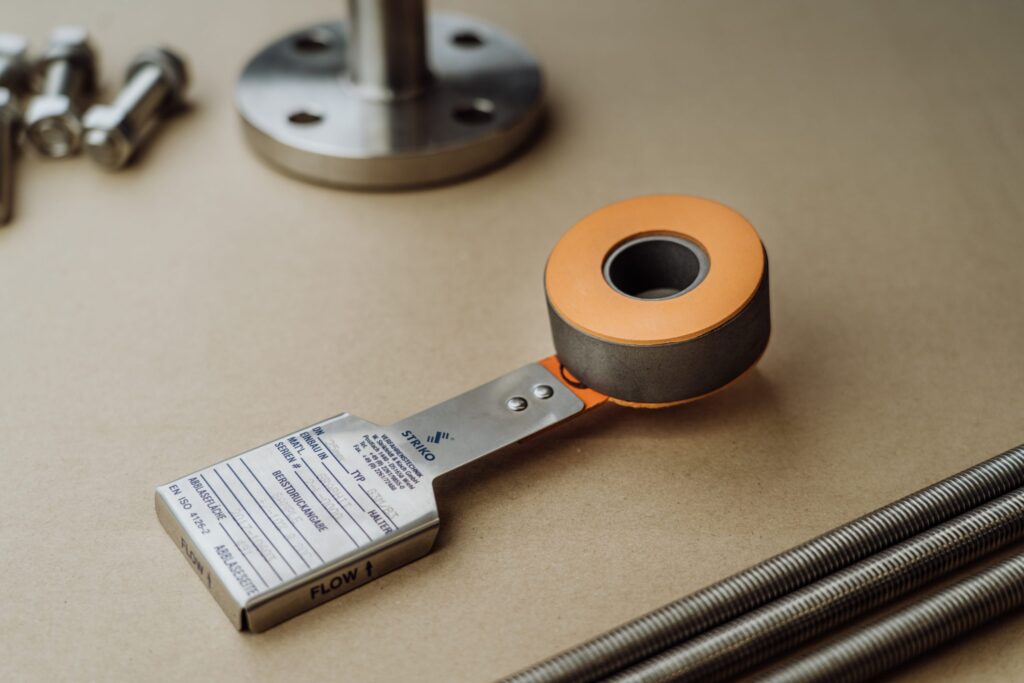
A bursting disc arrives as a small, light component. The package around it should be far more substantial, at least on paper.
Start with the disc itself. Every disc is designed for an exact burst pressure matched to the safe working pressure of the system, with a tolerance that follows from material properties and the manufacturing process. The burst pressure should be stated for a defined temperature, because the effective burst pressure can fall at higher temperatures depending on material and design. Our standard metal disc is made of 316 stainless steel, with Hastelloy and titanium as options, in flat and multi-layer designs or domed with an X or C scored dome for a controlled bursting pattern.
Next, the holder. The best disc in the world still depends on how it is held: correct positioning, a reproducible clamping load and a proper seal. Our holders are built with tight tolerances to avoid stress concentrations, with sealing faces of controlled roughness, clear flow and installation markings and a consistent bolt load. Where required, leak detection ports can be integrated. The choice between forward acting holders, reverse buckling holders and vacuum support holders follows the disc and the process. Holders are designed for long-term reuse, so after an event only the disc is replaced.
Then the documents. For holders we supply material certificates to EN 10204 3.1, pressure calculations, inspection reports and traceability per component, and a PED dossier is available as an option. For graphite bursting discs the focus is on traceable material quality, burst pressures tested in advance and documentation fit for audits and compliance. A buyer in a regulated plant should request this set as part of the enquiry, not as an afterthought when the goods arrive at the gate.
Finally, the options that turn a disc into a system. Burst detection sensors signal an opening straight to a PLC, SCADA or DCS, using either an electrical loop that breaks or a magnetic field that changes when the disc moves. In a fail-safe design, a fault in the sensor itself also triggers a signal, which rules out a false negative. For zones with an explosive atmosphere, ATEX suitability of sensor and cabling matters. Vacuum support and double discs cover vessels that see both overpressure and underpressure, for example during emptying or cooling after steam cleaning.
DIN or ANSI, PN or Class: two flange worlds in one plant
European plants rarely speak a single engineering language. A site in the Netherlands or Belgium may have one unit built with PN flanges and DN sizes, and a newer unit designed by an international contractor in ASME classes and NPS sizes. A plant that has grown over the decades may have both side by side. For bursting disc manufacturers, that means the same disc type may have to fit two completely different flange families on one site.
We supply according to DIN and ANSI/ASME. Metal discs can be clamped directly between flanges in systems with straight pipe sections, or mounted in a dedicated holder where pressure pulsates, loading is cyclic or process integrity matters most. Graphite bursting discs, available from DN25 to DN400, fit directly between ANSI or DIN flanges or in a holder. That flexibility is less glamorous than a new disc design, but for a maintenance team it is often what decides whether a replacement goes in smoothly during a tight shutdown window.
Material choice follows the same practical logic. Holders are available in carbon steel for standard applications with controlled media, 316/316L stainless steel as a corrosion resistant all-rounder, duplex and super duplex for high strength and chloride resistance, and Inconel or Hastelloy for high temperatures and aggressive media. Which one is right depends on the process data and on the disc that sits inside it.
Installation practice completes the picture, whatever the flange family. Check the diameter and burst pressure against the specification, make sure the flanges are clean and aligned, centre the gaskets, respect the flow direction arrow and tighten the bolts evenly to the recommended torque. Never fit a disc that has been dented or scratched, since even minor damage can shift its burst pressure.
Bursting disc and rupture disc: same device
Holders designed to EN ISO 4126
Material certificates to EN 10204 3.1
Supplied to DIN and ANSI/ASME
Bursting disc and safety valve: the combination EN ISO 4126 anticipates
The fact that EN ISO 4126 devotes a separate part to combinations says a lot about European practice. In many plants the bursting disc does not work alone but sits directly upstream of a spring loaded safety valve. The reasoning is straightforward. An intact bursting disc is 100% leak tight up to the moment it bursts, while a safety valve relies on a disc pressed onto a seat that can wear, corrode or collect deposits. Put the bursting disc in front, and the valve stays isolated from a corrosive or sticky medium during normal operation. When overpressure occurs, the disc opens first and the valve then limits how much medium escapes, reclosing once the pressure has dropped.
That arrangement puts specific demands on the manufacturer. The space between disc and valve has to be monitored, because pressure trapped there changes the differential across the disc and therefore the pressure at which it opens. Holders with leak detection ports and burst detection sensors are the practical answer. The disc must also open cleanly, so that fragments do not interfere with the valve downstream. When you compare bursting disc manufacturers for this duty, ask how their holder handles interspace monitoring and how the bursting pattern of the proposed disc suits a valve downstream. We look at both the disc and the holder for such combinations, working from the valve data and the process conditions you give us.
Choosing between bursting disc manufacturers: a buyer's view
Picture a process engineer at a chemicals site preparing a turnaround. She has a list of bursting discs to replace, a few new relief points from a recent HAZOP and three bursting disc manufacturers to choose from. How does she decide?
The first filter is technical conformity. Does each manufacturer offer a disc that suits the medium, the pressure and the temperature, and does it conform to the standards her plant works to? The second is design reasoning. For a vessel with frequent pressure cycling, a reverse acting disc offers higher resistance to cycles and a lower risk of fatigue. For a steady high pressure gas service, a forward acting disc with its high burst pressure accuracy may be the logical choice. For a corrosive acid, a graphite disc resists attack without a coating. A manufacturer that proposes a design and explains why is worth more than one that simply repeats the part number from the old datasheet.
The third filter is documentation, as described above. The fourth is support after delivery: who helps when a disc opens, who holds the tag data, how quickly a replacement can be arranged and whether spare discs for critical positions can be planned in advance. The fifth is breadth. If one manufacturer can cover reactor discs, sterile process lines, extruders and corrosive service, the plant ends up with one documentation format and one point of contact.
None of these filters requires a supplier to be the biggest name in the market. They require it to be precise, transparent and reachable.
STRIKO bursting discs through Dutch Valve Vision
STRIKO Verfahrenstechnik GmbH is a German manufacturer of bursting discs and of static mixers for (highly) viscous media. It has been active in the bursting disc market since 1974 and works to a philosophy of testing, evaluating and recalibrating, which underpins the track record it has built across very different applications. Its programme includes flat metal discs for standard applications, forward acting metal discs for high pressure, reverse acting metal discs for durability, aseptic metal discs for pharmaceutical and food processes, extruder discs, discs for tank containers and compact burst plugs.
Among bursting disc manufacturers, STRIKO combines German engineering with a range that covers most of the process situations a European plant will meet. Dutch Valve Vision is its exclusive agent for the Netherlands, Belgium and Luxembourg. We give technical advice on design, selection and application, deliver quickly and support maintenance and replacement. We work with an ISO 9001 certified quality management system, certified by KIWA, and offer engineering support that includes FEM analyses on request and help with HAZOP and other safety studies.
Buying for a UK company with sites or projects in the Benelux? Then we are your route to STRIKO for those locations. For other locations, get in touch anyway and we will discuss what is possible. Send your data to sales@dutchvalvevision.com or call +31 (0)70-2210560, Monday to Friday from 09:00 to 17:00 Dutch time.
Specification ready? We will prepare a targeted quote.
Send us medium, pressure, temperature and connection. Our specialists come back with a matching proposal.
Frequently asked questions about bursting disc manufacturers
Question not listed? Our specialists are happy to help.
Is a bursting disc the same as a rupture disc?
Yes, both terms describe the same device. Bursting disc is the usual term in British English and in the EN ISO 4126 standards. Rupture disc is common in American usage and in ASME based specifications. Burst disc is a third variant that you will see on drawings and datasheets. In German the device is called a Berstscheibe and in Dutch a breekplaat. The function is identical in every language: a calibrated membrane that opens at a set pressure. What can differ is the standard a specification refers to and the documents that go with it. We work with both terms and both code worlds every day.
Which parts of EN ISO 4126 apply to bursting discs?
Three parts are especially relevant. Part 2 covers bursting disc safety devices as such. Part 3 deals with safety valves and bursting disc safety devices installed in combination. Part 6 covers the application, selection and installation of bursting disc safety devices. In the United Kingdom these are published as BS EN ISO 4126. The standard treats the disc and its holder together as one safety device. That is a good reason to select disc and holder as a combination rather than separately. Our holders are designed in line with EN ISO 4126, ASME Section VIII and PED 2014/68/EU.
Does a bursting disc need CE marking?
A bursting disc placed on the European market as a safety accessory falls under the Pressure Equipment Directive. In that case CE marking applies. Metal bursting discs are covered by the PED, ISO 4126 and CE marking, with EN 14491 relevant for explosion safety. Our holders are designed to PED 2014/68/EU as well. The exact requirements can depend on the application and on how the disc is used within the installation. For zones with an explosive atmosphere, ATEX requirements come on top. We check the applicable requirements when we prepare a proposal. If your project has specific marking or documentation requirements, include them with your enquiry.
What should a bursting disc manufacturer supply besides the disc?
A disc alone is rarely enough for a regulated plant. You should expect a burst pressure stated for a defined temperature, with a clear tolerance. A matching holder, or confirmation that direct flange mounting is suitable, belongs in the proposal. For holders we supply material certificates to EN 10204 3.1, pressure calculations and inspection reports. Traceability per component lets you follow every part back to its origin. Holders carry clear flow and installation markings to prevent mistakes during mounting. Options such as burst detection, vacuum support or double discs should be offered where the process calls for them. Ask for a sample documentation set up front so your quality department can review it in time.
Can bursting discs be mounted between DIN and ANSI flanges?
Yes, depending on the type and the installation. We supply according to both DIN and ANSI/ASME. Metal discs can be clamped directly between flanges in systems with straight pipe sections. For pulsating pressure, cyclic loading or critical process integrity, a dedicated holder is usually the better choice. Graphite bursting discs from DN25 to DN400 can be installed directly between ANSI or DIN flanges or in a holder. Clean, aligned flanges and centred gaskets are essential in every case. Bolts must be tightened evenly to the recommended torque. Tell us which flange standard and rating your line uses and we will match the disc and holder to it.
When is a graphite bursting disc the better choice?
Graphite is worth considering when the medium attacks stainless steel or other metals. It resists many acids, bases and aggressive media without needing a coating. When a graphite disc bursts, it opens across its full diameter for fast pressure relief. We supply graphite discs from DN25 to DN400. Optional TFE coating, burst detection and vacuum support are available. An intact graphite disc is 100% leak tight until the moment it bursts. Many graphite discs can be mounted directly between standard flanges without a separate holder, which keeps installation simple. We compare graphite and metal options for you based on medium, temperature and pressure.
Does Dutch Valve Vision supply STRIKO bursting discs to UK companies?
Our agency for STRIKO covers the Netherlands, Belgium and Luxembourg. For installations in those three countries we are the exclusive route to STRIKO bursting discs. That applies equally when the plant owner or the engineering office is based in the UK. For installations outside the Benelux, contact us and we will discuss the options openly. Dutch Valve Vision itself supplies special valves to customers worldwide. Enquiries in English are welcome. You can reach us on +31 (0)70-2210560 or at sales@dutchvalvevision.com. Office hours are Monday to Friday from 09:00 to 17:00 Dutch time.
What data do bursting disc manufacturers need for an enquiry?
The core data set is much the same for every manufacturer. We need the medium and its composition, the operating pressure including peaks and the required burst pressure. Temperatures during normal operation and during the relief scenario are both essential. Add the connection, flange standard, nominal diameter, back pressure and available installation space. Mention whether the vessel can see vacuum and whether burst detection is required. List the standards and documents your project calls for, such as EN ISO 4126 or ASME Section VIII. For replacements, the existing tag data and specification often let us start straight away. With a complete set, we can propose a STRIKO disc and holder quickly and accurately.
Request a STRIKO bursting disc proposal
Send the medium, operating pressure and peaks, required burst pressure, both temperatures, flange standard and the codes your project follows. We reply with a matching STRIKO disc, holder and document package.
- +31 (0)70-2210560
- sales@dutchvalvevision.com
- Vlotlaan 641, 2681 TZ Monster, the Netherlands
- Mon-Fri 09:00-17:00