
Kenics static mixer
What people mean by a Kenics static mixer, how the helical principle works and what to compare before you choose a supplier.
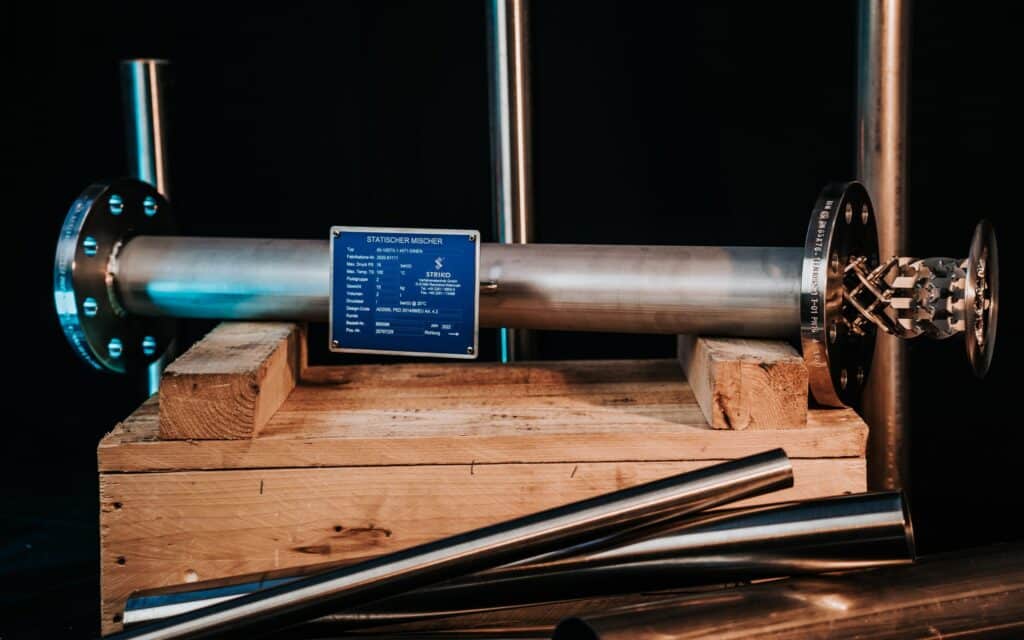
Kenics is one of the best-known brand names in static mixing, and many engineers use it as shorthand for a static mixer with helical elements. The principle itself is generic: twisted elements in a pipe split, turn and recombine the flow without any moving parts. Dutch Valve Vision offers the STRIKO Helical, the universal mixer in the STRIKO range, as an alternative for customers in the Benelux.
- What people mean by a Kenics static mixer
- The helical principle behind the Kenics static mixer name
- Laminar and turbulent: where helical elements do their work
- What to compare when a specification says Kenics static mixer or equal
- Placement in the line matters as much as the name on the drawing
- The STRIKO Helical as an alternative
- When a helical element is not the best answer
- From datasheet to replacement: a practical route
Unsure about the right choice?
Share your process data with our specialists. We check the numbers with you and give reasoned advice.
What people mean by a Kenics static mixer
When an engineer asks for a Kenics static mixer, they are usually asking for something broader than one brand. Kenics is one of the best-known names in static mixing, and over the years it has become shorthand for a particular design: a pipe section with a row of twisted, helical elements inside. The same thing happens in many markets, where the leading brand ends up naming the whole product category. On P&IDs, in older datasheets and in maintenance conversations, Kenics static mixer often simply means helical static mixer.
Let us be clear from the start. Kenics is a trademark of its owner, and Dutch Valve Vision has no connection with it. We do not sell Kenics products, and we will not make claims about their specifications or prices. What we can do is explain the helical principle the name has come to stand for, show what to compare when you choose a supplier, and introduce the alternative we offer: the STRIKO Helical, supplied through us as the exclusive agent of STRIKO Verfahrenstechnik GmbH for the Netherlands, Belgium and Luxembourg.
This page is written for the process engineer who finds Kenics static mixer on an existing drawing, the buyer who receives a request to replace one, and anyone who wants to understand what they are actually specifying when they use the name.
The helical principle behind the Kenics static mixer name
A static mixer mixes without moving parts. The energy comes from the flow itself, drawn from the pressure drop over the mixer. Inside the pipe, a series of geometrically designed elements forces the stream to split, change direction and recombine, again and again, until the components are evenly distributed. There is no drive, no shaft seal and no bearing, which is exactly why static mixers are so low in maintenance.
The helical design does this in a particularly elegant way. In the classic arrangement, each element is a flat strip twisted into a helix. Consecutive elements twist in opposite directions, left and then right, and each one is turned relative to the previous element so that its leading edge cuts across the stream leaving the one before. At every element the flow is divided in two. The twist then carries fluid from the centre of the pipe towards the wall and back again, while the change of direction at the next element reverses the rotation and folds the layers over once more.
What that achieves is easiest to picture in laminar flow. Imagine two streams entering side by side, one clear and one coloured. After the first element there are two layers, after the second four, after the third eight. The number of layers doubles with every element, so after a modest number of elements the layers become so thin that diffusion finishes the job. Nothing spins, nothing wears, and the mixer keeps doing its work for as long as there is flow.
This is why the helical static mixer became so widespread that its best-known brand turned into a generic word. The design is open, it combines effective mixing with a relatively moderate pressure drop, and it can be applied across a very wide range of processes, from dosing chemicals into water to blending liquids in a chemical plant.

Laminar and turbulent: where helical elements do their work
Whether it is called a Kenics static mixer or a helical mixer, its behaviour depends on the flow regime. Laminar flow occurs with viscous media or low velocities. The streams move in orderly layers, and mixing happens through the repeated splitting and folding described above. Turbulent flow occurs with low viscosity media at higher velocities. There the elements generate additional vortices that distribute the components quickly.
The Reynolds number tells you which regime you are in. It combines density, velocity, pipe diameter and viscosity into one dimensionless figure. Low values mean laminar flow, high values turbulent flow, with a transition zone in between. For a static mixer, the regime determines how many elements you need, how long the mixer must be and how much pressure drop you have to accept. The right choice of elements and mixer length decides how intensively the stream is mixed.
That is also why two mixers that look alike on a drawing can perform quite differently. Element geometry, the number of elements and the pipe diameter all interact with viscosity, flow rate and the viscosity ratio between the components. A helical mixer that works perfectly on a water treatment line may need a different configuration when the same pipe size has to carry a viscous polymer solution, and a mixer sized for one additive may fall short when a thicker additive is introduced years later.
What to compare when a specification says Kenics static mixer or equal
Specifications often read Kenics static mixer or equal. That phrase invites alternatives, but it also places the burden on the buyer to show that the alternative really is equal. Here is what we would compare, for any supplier, including ourselves.
Start with process performance. Ask each supplier to size the mixer for your viscosities, flow rates, temperature and pressure, and for the mixing quality you need. The answer should include the type and number of elements, the mixer length and the expected pressure drop. If a supplier cannot explain how it arrives at those figures, the comparison stops there.
Then materials. Static mixers are made in stainless steel such as SS316, 1.4404 and 1.4571, in carbon steel, in plastics such as PVC, PE and PVDF, and with special coatings or linings for aggressive media. The material must suit the medium, the temperature and any corrosive conditions, for the elements as well as for the housing.
Next, mechanical design and connections. Is the mixer supplied as a flanged pipe section, and to which flange standard? Can the elements be removed for cleaning or inspection? Is inline sterilisation or steam cleaning possible for hygienic service? Where will the additive be injected, and does the supplier take that into account in the sizing?
Finally, validation and support. Can the supplier support pressure testing and leak detection, measuring points for mixing quality and simulations of flow and homogeneity? Who helps you when the process changes and the mixer has to be reviewed? For a Kenics static mixer replacement, these points decide whether the alternative is equal in practice and not just on paper.
STRIKO Helical: the universal static mixer
No moving parts, energy from pressure drop
Easy dismantling, inline sterilisation possible
Exclusive STRIKO agent for the Benelux
Placement in the line matters as much as the name on the drawing
Discussions about a Kenics static mixer or an alternative tend to focus on the mixer itself. In practice, a good part of the result is decided by what happens just before and just after it. A mixer can only work with what it is fed, and it can only be judged by what is measured downstream.
Take the injection point. When a small stream of additive enters a large main flow, it helps to introduce it close to the mixer inlet and in a way that brings it into the main stream rather than letting it creep along the pipe wall. The smaller the additive fraction, the more that matters, because a small fraction starts from a very uneven distribution and every element has more work to do. For viscous additives, the injection design and the viscosity difference between additive and main stream deserve particular attention during sizing.
Then the surroundings. A helical mixer needs to run full of liquid to do its job properly, so its position and orientation in the line should be chosen with that in mind. Leave room for removing the elements if cleaning or inspection is part of the maintenance routine. Plan a sampling or measuring point downstream so that the mixing quality can be checked once the line is in operation, instead of simply assumed. None of this is specific to one brand, yet it often explains why an identical mixer performs well in one plant and disappoints in another.
The STRIKO Helical as an alternative
STRIKO Verfahrenstechnik GmbH is a German manufacturer that specialises in rupture discs and in static mixers for (highly) viscous media. Its static mixer range has four series. The EREstat is designed for food and hygienic processes. The Helical is the universal mixer, providing uniform mixing across many industries. The STV is optimised for gases, and the STX is intended for viscous, thick and syrupy liquids.
For most enquiries that begin with Kenics static mixer, the STRIKO Helical is the logical counterpart. As the name says, it is built around helical elements, and STRIKO positions it as the mixer for the broadest field of applications. Like all STRIKO static mixers it has no moving parts, which means virtually no wear and low maintenance. The mixers can be dismantled easily for cleaning or inspection, inline sterilisation and steam cleaning are possible, and custom options are available for specific process requirements. Diameters, lengths and internal elements can be configured to the viscosity, flow rate and final quality the process calls for.
STRIKO mixers are used in food and beverage production, chemical and petrochemical processes, pharmaceutical production, water and waste water treatment, and cryogenic or viscous media streams. That breadth makes them a sound choice for integrators, OEM builders and end users who want high mixing quality with minimal maintenance.
We do not publish detailed element geometry or performance figures for the Helical on this page, because the right configuration depends on your process. What we do is size and select it with you, based on your data, and explain why the proposed configuration fits.
When a helical element is not the best answer
A good comparison is also honest about limits. The helical design is universal, but universal does not mean optimal for every duty. That is precisely why STRIKO offers more than one series.
For very viscous media, the STX is designed for thick and syrupy liquids, an area in which STRIKO has specialised. For gas mixing, the STV is optimised for gas processing. In food and other hygienic processes, the EREstat is built around hygienic design, cleaning and sterilisation. If your existing Kenics static mixer sits in one of those duties, the best successor might not be a helical mixer at all.
We look at it the other way round: first the process, then the mixer. A dosing line in water treatment where coagulants or neutralising agents have to be spread evenly for good pH control, a petrochemical line where a representative sample is needed, a continuous chemical process where a homogeneous mixture stabilises the reaction, a food process with emulsions and additives: each asks for its own answer. Sometimes that answer is the Helical, sometimes another STRIKO series, and occasionally a custom configuration.
From datasheet to replacement: a practical route
A typical situation looks like this. A plant in the Benelux has a static mixer in a dosing line, installed long ago and marked on the P&ID as a Kenics static mixer. The process has changed, a different chemical is now being dosed, and maintenance wants to know whether the mixer is still adequate or should be replaced.
The route we follow is straightforward. First we collect the current process data: viscosities of the components, flow rates of main stream and additive, temperature, pressure, pipe size and connection, and the required mixing quality. If the datasheet of the existing mixer is available, it helps us understand the original design intent. Then we size a STRIKO solution, usually a Helical unless the medium calls for STX, STV or EREstat, and check the pressure drop against what the line and the pump can accept. Finally we look at materials, cleaning requirements and validation, including pressure testing and measuring points for mixing quality.
Integration is part of the job too. A static mixer rarely stands alone, and we can look at it together with the valves, the measuring instruments and the process automation around it. After installation we support validation and optimisation, so the mixer delivers in the plant what the sizing promised.
If you recognise that situation, send us the data at sales@dutchvalvevision.com or call +31 (0)70-2210560, Monday to Friday from 09:00 to 17:00. We work under an ISO 9001 certified quality management system, certified by KIWA, and we will give you an honest view of whether a STRIKO Helical is the right successor for your Kenics static mixer.
Specification ready? We will prepare a targeted quote.
Send us medium, pressure, temperature and connection. Our specialists come back with a matching proposal.
Frequently asked questions about kenics static mixer
Question not listed? Our specialists are happy to help.
Is Kenics a type of static mixer or a brand?
Kenics is a brand name and a trademark of its owner. Because it became so well known, many engineers use it as a generic term for helical static mixers. On drawings and datasheets you will therefore often see Kenics where the design intent is simply a helical element mixer. The helical principle itself is not tied to one brand. Several manufacturers build static mixers with helical elements. STRIKO’s version is the Helical, the universal mixer in its range. Dutch Valve Vision has no affiliation with the Kenics brand. We supply STRIKO static mixers as exclusive agent for the Netherlands, Belgium and Luxembourg.
How does a helical static mixer work?
A helical static mixer contains a series of twisted elements inside a pipe. In the classic design, consecutive elements twist in opposite directions. Each element divides the flow in two and moves fluid between the centre of the pipe and the wall. At the next element the direction of rotation reverses and the flow is divided again. In laminar flow the number of layers doubles with every element. After enough elements the layers are so thin that the mixture becomes homogeneous. The energy for mixing comes from the pressure drop over the mixer, not from a motor. There are no moving parts, so there is virtually no wear.
Can a STRIKO Helical replace an existing Kenics static mixer?
In many cases it can, but we always check it against the process first. The mixer has to match the viscosities, flow rates, temperature, pressure and required mixing quality. Pipe size, connection and the pressure drop the line can accept also play a part. STRIKO mixers can be configured in diameter, length and internal elements. That flexibility helps when a replacement has to fit an existing pipe run. If the datasheet of the current mixer is available, it helps us understand the original design. Sometimes the process has changed and a different series, such as the STX, fits better. We tell you openly which option we recommend and why.
What should I compare between static mixer suppliers?
Compare the sizing first: type and number of elements, mixer length and expected pressure drop for your process. Ask how the supplier arrives at those figures. Check the materials of elements and housing against the medium and temperature. Look at the connections and at whether the mixer is supplied as a complete flanged section. Ask whether the elements can be removed for cleaning or inspection. For hygienic processes, check whether inline sterilisation and steam cleaning are possible. Validation support, such as pressure testing and measuring points for mixing quality, is worth asking about too. Finally, consider who will support you locally when the process changes.
Which materials are available for the static mixers you supply?
The material depends on the media, the temperature, corrosive conditions and process requirements. Stainless steel is widely used, for example SS316, 1.4404 and 1.4571. Carbon steel is another option. Plastics such as PVC, PE and PVDF are used where their chemical resistance is an advantage. Special coatings or linings are available for aggressive media. Materials can be adapted to project-specific requirements. The aim is a long service life with full chemical compatibility. Send us your medium and conditions and we will propose the right material.
Is a helical mixer suitable for viscous liquids?
Helical mixers are used across a wide range of viscosities, including in laminar flow. In laminar flow they mix by repeatedly splitting and folding the stream. For very viscous, thick and syrupy liquids, STRIKO offers a dedicated series, the STX. Viscous media are one of STRIKO’s specialities. The choice between Helical and STX depends on the viscosities, the viscosity ratio and the allowable pressure drop. Mixer length and the number of elements are part of that decision as well. We make the comparison for you on the basis of your process data. That way you get the series that fits, not simply the one that sounds familiar.
How much pressure drop does a helical static mixer cause?
That depends on the flow regime, the viscosity, the flow rate, the pipe diameter and the number of elements. The mixing energy is taken from the pressure drop, so some pressure loss is always part of the design. In laminar flow with viscous media, pressure drop tends to be the limiting factor. In turbulent flow with thin liquids, it is usually easier to manage. Helical designs are known for combining effective mixing with a relatively open cross section. Every supplier should state the expected pressure drop for your specific duty. We calculate it for the STRIKO solution we propose and check it against what your line can accept. Without process data, any single figure would be a guess.
What data do you need to propose a STRIKO Helical?
We start with the viscosities of all components and the flow rates of main stream and additives. Temperature and pressure come next. Pipe size and connection tell us how the mixer has to fit into the line. The required mixing quality defines what the mixer has to achieve. Tell us about cleaning, sterilisation or hygienic requirements if they apply. If you are replacing an existing mixer, include its datasheet or drawing if available. Send everything to sales@dutchvalvevision.com or call +31 (0)70-2210560. We will size the solution and explain our choice.
Related topics
Compare the STRIKO Helical with your current mixer
Send us the viscosities, flow rates, temperature, pressure, pipe size and required mixing quality, plus the datasheet of your current mixer if you have one.
- +31 (0)70-2210560
- sales@dutchvalvevision.com
- Vlotlaan 641, 2681 TZ Monster, the Netherlands
- Mon-Fri 09:00-17:00