
Bursting disc sizing
How bursting disc sizing works under EN ISO 4126 and the PED, which data you need and what the manufacturer brings to the table.

Bursting disc sizing under European practice follows EN ISO 4126, which covers bursting disc safety devices and their application, selection and installation, within the framework of the Pressure Equipment Directive. It combines a required discharge capacity with a specified bursting pressure at a specified temperature, a performance tolerance and a flow characteristic that the manufacturer establishes by testing. Dutch Valve Vision supports this work as exclusive STRIKO agent for the Benelux.
- Bursting disc sizing through a European lens
- Where EN ISO 4126 fits into bursting disc sizing
- The data sheet behind every bursting disc sizing
- Specified bursting pressure, tolerance and temperature in bursting disc sizing
- The manufacturer's part: tested, marked and traceable
- Bursting discs in combination with a safety valve
- Holder, material and detection choices that follow from the sizing
- Bursting disc sizing with STRIKO and Dutch Valve Vision
Unsure about the right choice?
Share your process data with our specialists. We check the numbers with you and give reasoned advice.
Bursting disc sizing through a European lens
Bursting disc sizing is the same engineering problem on both sides of the Atlantic, yet the language, the standards and the paperwork differ enough to trip people up. In the United Kingdom and much of Europe the device is called a bursting disc, the governing family of standards is EN ISO 4126 and the legal framework is the Pressure Equipment Directive. An engineer who moves from an American licensor package to a European site soon notices that the questions are familiar but the vocabulary is not.
Take a maintenance engineer at a chemical site in Belgium who needs to replace a disc on an older vessel. The original documentation refers to a burst pressure and a nominal size, and the rest has faded along with the tag plate. The vessel was built and certified under European rules, and the replacement has to fit that basis. This is where bursting disc sizing becomes more than choosing a diameter. It means reconstructing the design intent, checking it against current requirements and specifying a disc that a manufacturer can produce, test and mark accordingly.
At Dutch Valve Vision these are the requests we handle for engineers in the Netherlands, Belgium and Luxembourg. We supply STRIKO bursting discs and holders as the exclusive STRIKO agent for the Benelux. On this page we explain how bursting disc sizing fits into the European framework, what data we need and what the manufacturer contributes. We keep to general principles and do not reproduce the equations from the standards.
Where EN ISO 4126 fits into bursting disc sizing
EN ISO 4126 is a multi-part standard for safety devices that protect against excessive pressure. Several parts are directly relevant to bursting discs. Part 2 deals with bursting disc safety devices themselves, meaning the disc and its holder as a combination. Part 3 covers safety valves and bursting disc safety devices used in combination. Part 6 gives guidance on the application, selection and installation of bursting disc safety devices, and that is where most of the practical questions about bursting disc sizing are answered. Part 7 contains common data used across the series.
The standard sits inside the Pressure Equipment Directive, PED 2014/68/EU. Under the PED, a bursting disc safety device is a safety accessory that protects pressure equipment against exceeding its allowable limits. That has consequences for design, manufacture, conformity assessment and marking. CE marking is part of that picture, and metal discs fall under PED, ISO 4126 and, for explosion venting of dust, EN 14491. The plant owner or the equipment manufacturer carries responsibility for the overall protection concept, while the bursting disc manufacturer is responsible for delivering a device that performs as specified.
For bursting disc sizing this means two things. First, the calculation has to use the terms and data that EN ISO 4126 defines. Second, the disc that comes out of the calculation must be one that the manufacturer can certify and mark for those exact conditions. A theoretical diameter that no manufacturer supports with test data is of little use on a European site. It also creates friction later in the project. Inspection bodies, notified bodies and the owner’s own safety department all expect a clear line from calculation to certified device, and a gap in that line tends to surface at the least convenient moment, usually just before commissioning.
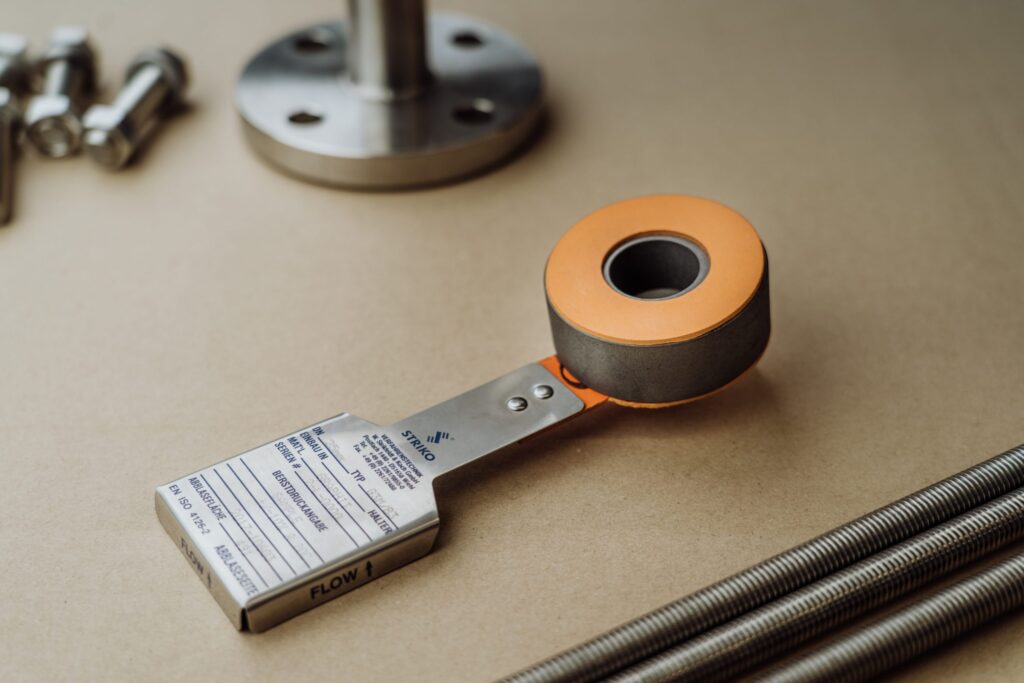
The data sheet behind every bursting disc sizing
A good bursting disc sizing starts with a complete data sheet. We ask for the medium and its composition, because the phase, the corrosiveness and the physical properties all affect both the flow calculation and the choice of material. We ask for the normal operating pressure and any pressure peaks, because the relation between those peaks and the bursting pressure decides how long the disc will last. We ask for the specified bursting pressure the design calls for and for the maximum allowable pressure of the protected equipment.
Temperature comes next, and we ask for it twice. We need the normal operating temperature and the temperature of the disc in the relief scenario. Those two can be far apart, for instance in a fire case or during a runaway reaction. We also need the required discharge capacity from the relief study, any back pressure from the outlet system, the connection standard and nominal size, and the installation space between the flanges.
In a retrofit the story often has gaps. A design team working on a brownfield project in the Netherlands may inherit a vessel with a known allowable pressure but no recorded relief study. In that case the honest answer is that bursting disc sizing cannot be completed on the old nominal size alone. The relief scenarios need to be defined first, and we can support that with product data and our experience in HAZOP and safety studies.
Specified bursting pressure, tolerance and temperature in bursting disc sizing
European terminology is precise here, and it pays to use it. The specified bursting pressure is the pressure at which the disc is designed to burst, and it is always tied to a specified temperature. Around that value lies the performance tolerance, the band within which the actual bursting pressure of the discs from a production batch will fall. The tolerance depends on material properties and on the manufacturing process.
In bursting disc sizing the upper end of that tolerance band is checked against the allowable limits of the equipment, while the lower end is checked against the operating pressure. The relation between the maximum operating pressure and the minimum bursting pressure is often called the operating ratio. A tight ratio shortens service life, especially with pressure cycling. A generous ratio gives the disc room to breathe but may push the upper tolerance too close to the allowable pressure. The designer has to find the balance. Disc type helps here. Reverse buckling designs generally tolerate a tighter operating ratio than forward acting designs, which gives the designer more freedom when the operating pressure sits close to the allowable pressure. The choice of type is therefore part of the sizing discussion, not a separate step that follows it.
Temperature ties everything together. A metal disc that bursts at the specified pressure at one temperature will not do so at a much higher temperature, because the strength of the material changes. At higher temperatures the effective bursting pressure can drop, depending on material and design. That is why a data sheet with a pressure but no temperature is incomplete, and why we always ask for the temperature in the relief scenario as well as the normal one.
Holders designed to EN ISO 4126
PED 2014/68/EU compliant holder design
EN 10204 3.1 material certificates supplied
STRIKO: test, evaluate, recalibrate since 1974
The manufacturer's part: tested, marked and traceable
Here the European approach makes something explicit that is easy to overlook. Bursting disc sizing depends on data that only the manufacturer can provide. The flow characteristic of a disc and holder combination, whether expressed as a coefficient of discharge or as a flow resistance, is determined by testing. The actual bursting pressure of a batch is confirmed by testing discs from that batch. Without that test basis, a calculation has nothing solid to stand on.
STRIKO Verfahrenstechnik GmbH has been active in bursting discs since 1974. Its working philosophy is to test, evaluate and recalibrate, and that is exactly what a sizing engineer relies on without always realising it. When a disc is marked with a specified bursting pressure and temperature, that marking represents the outcome of the manufacturer’s test and calibration process. The engineer builds the calculation on it, and the operator trusts it every day the plant runs.
Traceability completes the chain. Our holders come with material certificates to EN 10204 3.1, pressure calculations, inspection reports and traceability per component. They are designed in line with ASME Section VIII, EN ISO 4126 and PED 2014/68/EU, and ATEX where applicable. When an auditor asks how a particular bursting disc sizing was verified, the documentation should lead straight back to tested and certified data. Picture a plant where the calculation is sound but the certificates are missing from the file, so the replacement discs cannot be accepted until the paperwork has been reconstructed. It is a small detail during design and a large one during an audit.
Bursting discs in combination with a safety valve
A frequent European arrangement places a bursting disc directly upstream of a spring loaded safety valve. EN ISO 4126 Part 3 covers this combination. The reasons are practical. The disc keeps a corrosive or sticky medium away from the valve internals, and it stops the small seat leakage that a spring loaded valve can show before it opens. For toxic or costly media that alone can justify the arrangement.
The sizing logic shifts in this case. The safety valve usually determines the discharge capacity, and the disc must open fully without restricting the flow to the valve. The combination is therefore assessed as a unit, with a factor that reflects how the pair behaves together. The space between disc and valve needs attention as well. If pressure builds up there through a pinhole or a slow leak, the disc no longer sees the full process pressure difference and will burst later than intended. A pressure indicator, a tell-tale or a burst detection sensor in that space is the usual answer.
For the operator, the benefit is clear. When the disc bursts, the safety valve limits the loss of medium and can reclose once the pressure falls. When the disc stays intact, the valve remains clean and dry. We supply the disc and the holder for such combinations and can advise on detection in the interspace.
Holder, material and detection choices that follow from the sizing
Once the flow area, the specified bursting pressure and the temperature are fixed, several choices follow. The disc type is one of them. Forward acting discs carry the pressure on the concave side and are known for accurate bursting pressures in gas and liquid service. Reverse buckling discs carry it on the convex side and cope better with pressure cycles and high temperatures. Flat and multi-layer discs, domed discs with X or C scored domes and vacuum or double discs complete the metal range.
Material follows the medium and the temperature. Our standard metal disc is made of 316 stainless steel, with Hastelloy and titanium available where the process demands it. For strongly corrosive chemistry, graphite discs resist many acids and alkalis without a coating, in sizes from DN25 to DN400, clamped directly between ANSI or DIN flanges or in a holder, with optional TFE coating and vacuum support.
The holder deserves as much attention as the disc. It positions the disc, applies a reproducible load and seals it. Holders are available in carbon steel, 316/316L stainless steel, duplex and super duplex, and Inconel or Hastelloy, as forward acting holders, reverse buckling holders or vacuum support holders. Burst detection, using an electrical loop or magnetic detection with a fail-safe design, can signal an opening directly to a PLC, SCADA or DCS system. None of these choices change the physics of the calculation, but each one affects whether the disc performs in the plant as it did on paper.
Bursting disc sizing with STRIKO and Dutch Valve Vision
Dutch Valve Vision is based in Monster in the Netherlands and specialises in special valves for special services. For bursting discs, static mixers and related products, we are the exclusive STRIKO agent for the Netherlands, Belgium and Luxembourg. Our quality management system is ISO 9001 certified by KIWA.
Our role in bursting disc sizing is practical. We review your data sheet, point out what is missing, discuss the operating ratio and the temperature basis and propose a STRIKO disc and holder combination that fits the calculation. Where a project needs more depth, we can arrange FEM analyses on request, optimise for cyclic loading and support HAZOP and safety studies. The relief scenario and the final sign-off remain with the plant owner and its engineers, as the PED intends.
Send your data to sales@dutchvalvevision.com or call +31 (0)70-2210560, Monday to Friday from 09:00 to 17:00. Whether it is a new vessel or a disc that has to be replaced during the next shutdown, we will help you close the gap between the calculation and the device.
Specification ready? We will prepare a targeted quote.
Send us medium, pressure, temperature and connection. Our specialists come back with a matching proposal.
Frequently asked questions about bursting disc sizing
Question not listed? Our specialists are happy to help.
Is a bursting disc the same as a rupture disc?
Yes, the two terms describe the same device. Bursting disc is the usual term in the United Kingdom and in European standards such as EN ISO 4126. Rupture disc is the common term in American practice and in documents such as API 520. The underlying engineering is the same, but the vocabulary around it differs. European documents speak of a specified bursting pressure and a performance tolerance. American documents speak of a marked burst pressure and a burst tolerance. On a project it helps to agree early which set of terms will be used. We work with both and translate between them when needed.
Which parts of EN ISO 4126 matter for bursting disc sizing?
Part 2 covers bursting disc safety devices, meaning the disc and holder together. Part 6 gives guidance on application, selection and installation, and it is the part engineers consult most for sizing questions. Part 3 becomes relevant when a bursting disc is combined with a safety valve. Part 7 contains common data used across the series. The standard is applied within the framework of the Pressure Equipment Directive. Your project specification should state which parts and editions apply. If it does not, it is worth clarifying before the calculation starts. We can advise on how our STRIKO products are documented against these parts.
What does the Pressure Equipment Directive mean for a bursting disc?
Under PED 2014/68/EU, a bursting disc safety device is a safety accessory. It protects pressure equipment against exceeding its allowable limits. That status affects how the device is designed, manufactured, assessed and marked. CE marking is part of the requirements. The plant owner or equipment manufacturer is responsible for the overall protection concept. The disc manufacturer is responsible for supplying a device that performs as specified. Our holders are designed in line with PED 2014/68/EU and supplied with full documentation. That documentation supports your own conformity file.
Why does bursting disc sizing need a specified temperature?
The bursting pressure of a disc depends on the temperature of the disc material. At higher temperatures the effective bursting pressure can drop, depending on material and design. A specified bursting pressure without a temperature is therefore incomplete. The temperature in the relief scenario can differ strongly from the normal operating temperature. A fire case or a runaway reaction are typical examples. The manufacturer tests and marks the disc for the specified temperature. We always ask for both temperatures in a request. That way the disc is sized and marked for the situation it actually has to handle.
What is the performance tolerance of a bursting disc?
The performance tolerance is the band within which the actual bursting pressure of a disc will fall. It sits around the specified bursting pressure at the specified temperature. The width of the band depends on material properties and the manufacturing process. In sizing, the upper end is compared with the allowable limits of the equipment. The lower end is compared with the maximum operating pressure. A wide tolerance leaves less room between those two limits. That is why tolerance is part of the selection and not an afterthought. We discuss the tolerance with you when we propose a disc.
What role does the manufacturer play in bursting disc sizing?
The manufacturer provides the data that the calculation depends on. The flow characteristic of the disc and holder is determined by testing. The bursting pressure of a production batch is confirmed by testing discs from that batch. Without that tested basis, a sizing calculation has nothing reliable to build on. STRIKO works to a philosophy of testing, evaluating and recalibrating. That approach is what gives the marked values their meaning. Documentation such as material certificates and inspection reports makes the chain traceable. As STRIKO agent, we bring that data into your project.
Can I reuse the old nominal size when replacing a bursting disc?
Only if the original sizing basis is still valid and known. In many older plants the relief study was never updated after process changes. A new product, a higher throughput or a different operating temperature can change the required discharge capacity. The old nominal size may then no longer be adequate. For a like-for-like replacement with a confirmed design basis, reuse is usually fine. Where the basis is unclear, the scenarios should be reviewed first. We can help identify which data are missing. That is quicker than discovering the gap after the disc has been installed.
How do I start a bursting disc sizing request with Dutch Valve Vision?
Begin with the medium and its composition. Add the operating pressure including peaks, the specified bursting pressure and the allowable pressure of the equipment. Include the temperature in normal operation and in the relief scenario. State the required discharge capacity, any back pressure, the connection standard, the nominal size and the installation space. For a replacement, the existing tag data and specification are a good starting point. A short description of the relief scenario helps us to check the basis. Send it all to sales@dutchvalvevision.com or call +31 (0)70-2210560. We will review the data with you and propose a matching STRIKO disc and holder.
Bursting disc sizing support for your plant
Send us your medium, operating pressure including peaks, specified bursting pressure, temperatures and connection. Together with STRIKO we turn it into a disc and holder that fit your EN ISO 4126 basis.
- +31 (0)70-2210560
- sales@dutchvalvevision.com
- Vlotlaan 641, 2681 TZ Monster, the Netherlands
- Mon-Fri 09:00-17:00