
What is a rupture disc
A plain definition of the rupture disc: what it is, what it consists of, where you find it and why plants rely on it.

A rupture disc is a thin, calibrated membrane that seals a vessel or pipe and bursts open at a predetermined pressure, relieving overpressure before equipment is damaged. It has no moving parts, needs no external energy and is 100% leak tight until it bursts. After opening it cannot reclose and must be replaced.
- What is a rupture disc? The short answer
- The parts behind the answer: disc, holder and detection
- What a rupture disc protects against
- What is a rupture disc used for? Industries and typical positions
- Why plants choose a rupture disc, and where its limits are
- Terms and standards that belong to the definition
- The main designs in brief
- From what is a rupture disc to the right one for your plant
Unsure about the right choice?
Share your process data with our specialists. We check the numbers with you and give reasoned advice.
What is a rupture disc? The short answer
What is a rupture disc, put as plainly as we can? It is a thin, calibrated membrane that seals a vessel or a pipe and bursts open at a predetermined pressure, so that overpressure escapes before the equipment is damaged. No spring, no actuator, no power supply and no control loop are involved. It is a component designed to give way at exactly the right moment and in exactly the right manner, and to stay completely tight until then. You will also come across the terms bursting disc and burst disc, while Dutch engineers say breekplaat and German colleagues speak of a Berstscheibe. All of these names describe the same device.
We hear the question what is a rupture disc from buyers, maintenance planners and engineers who are new to pressure safety, and it deserves more than a dictionary line. A rupture disc is often called the last line of defence. Control systems, alarms and operators come first, and each of them can fail. When everything else has failed, the disc is still there, responding to nothing but the pressure acting on it. That is why you find it on reactors, storage tanks, pipelines and machines throughout the process industry.
This is a definition page. It explains what the device is, what it consists of, where it is used and why plants choose it. If you want to follow step by step how a disc opens, our page on the rupture disc working principle covers that in detail. If you already know you need one and want to compare designs, our overview of rupture disc types is the better next stop.
The parts behind the answer: disc, holder and detection
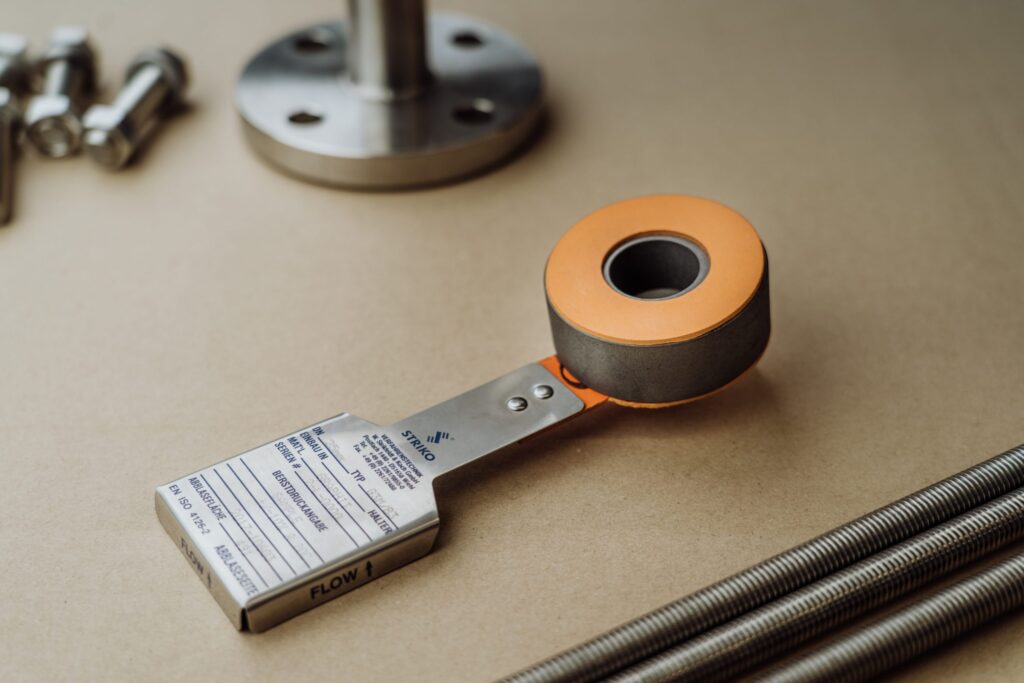
Ask what is a rupture disc and most people picture a single metal plate. In practice it is usually a small assembly of parts that work together, and each part has a job of its own.
The disc itself
The disc is the membrane that actually bursts. Most discs are metal, and our standard metal disc is made of 316 stainless steel, with Hastelloy and titanium as options for more demanding media. Graphite is the main alternative, chosen for its natural resistance to acids, bases and aggressive media. Discs come flat, multi-layer or domed, and a domed disc can have an X or C scored dome that defines how it opens. Every disc is made for one specific burst pressure, matched to the safe working pressure of the system it protects.
The holder
A disc can be clamped directly between flanges, but in many positions it sits in a dedicated holder. The holder is the mechanical housing that positions the disc correctly, seals it under operating pressure, loads it in a controlled way and lets it relieve safely once the set pressure is exceeded. We treat the holder as a safety component in its own right and not as an accessory, because a poorly designed holder can cause premature failure, leakage or a wrong burst pressure. Holders are reusable and are designed for long service without loss of performance.
The burst detection sensor
The third part is optional, and more and more plants specify it for safety critical positions. A burst detection sensor watches the disc and sends a signal the moment it opens, either through an electrical loop that is interrupted or through a magnetic field that changes when the disc moves. That signal can go to a PLC, SCADA or DCS system, so the process can be shut down and personnel warned without waiting for a routine inspection round. Detection can be integrated into the disc or the holder, and fail-safe designs also report a defect in the sensor itself, so a broken sensor is never mistaken for an intact disc. For safety critical positions we recommend specifying it from the start rather than adding it later.
What a rupture disc protects against
Overpressure rarely appears from nowhere, and the triggers differ per sector. In chemical and petrochemical plants, discs protect reactors, storage vessels and process lines against pressure from exothermic reactions or blocked processes. In power plants they guard steam boilers and vapour circuits during rapid load changes. In cryogenic storage of liquefied gases such as LNG, they relieve pressure peaks caused by temperature changes. In an extruder, a blockage or a sudden change in viscosity can push the pressure up within moments.
Underpressure is the other half of the story. A vessel that is emptied or that cools down can end up under vacuum, and not every vessel is built to withstand that. Vacuum suitable discs and double discs exist for systems that must cope with both overpressure and underpressure, and vacuum support holders keep a disc from flipping or being damaged when the pressure reverses. So when someone asks what is a rupture disc for, the honest answer covers both directions: protection against too much pressure and, where needed, against too little.
What is a rupture disc used for? Industries and typical positions
The list of places where rupture discs do their work is long. The chemical and petrochemical industry uses them on reactors, columns and piping systems, including protection against runaway reactions. Oil and gas installations, offshore and onshore, rely on them where high pressures, corrosive media and strict regulation meet. In energy and hydrogen, they provide pressure relief at electrolysers, compressors and storage modules.
Pharma, biotech and food plants use hygienic discs with highly polished surfaces that support cleaning and CIP procedures. Aerospace, defence and high tech applications use them where precision under pressure matters, such as fuel systems and hydraulic circuits. Tank containers carry their own discs as safety solutions for transport tanks. Skid builders and OEMs integrate discs and holders into their own equipment, from custom units to series production.
Picture a maintenance planner preparing a turnaround at a chemical site. On the list are several reactors, each with a disc on a top nozzle and a holder that has been in service for years. The discs are replaced, the holders are inspected and reused, and the burst detection wiring is checked before start-up. That quiet routine is what rupture discs look like in everyday plant life, far from the dramatic moment they are designed for.
How to recognise one in the field
On a walk through a plant, a rupture disc is easy to overlook. It is usually a flat assembly between two flanges or a compact holder on a nozzle, often on top of a vessel, with a discharge line leading away to a safe location. Holders carry clear flow and installation markings so the disc cannot be fitted the wrong way round, and discs themselves carry an arrow that shows the flow direction. Where burst detection is fitted, you will see a cable running from the holder to a junction box. On a combined arrangement, a safety valve sits directly downstream of the disc. Once you know what to look for, you start seeing these assemblies on reactors, tanks and skids everywhere.
Leak tight until the moment of bursting
No moving parts, no external energy
Single use, replaced after activation
Supplied via DVV as STRIKO agent
Why plants choose a rupture disc, and where its limits are
The reasons come down to a handful of properties. An intact rupture disc is 100% leak tight until the moment it bursts, because there is no seat that can wear and no gap that can open. For toxic, expensive or environmentally harmful media, that alone can decide the design. It reacts almost instantly, because there are no moving parts to set in motion. It needs no external energy, so a power failure does not affect it. It is light and compact compared to many valves, and it requires no mechanical maintenance.
Part of the answer to what is a rupture disc is also what it is not, and we would rather state the limits than hide them. A rupture disc works once. After it has opened it must be replaced, and it cannot reclose like a valve, so the process often has to stop for a while. A damaged disc must never be installed, because even small defects can change the burst pressure. The burst pressure is also not independent of temperature, since at higher temperatures the effective burst pressure can fall, depending on material and design. Those are reasons to select carefully, not reasons to avoid the device.
Many plants combine a disc with a safety valve for exactly this reason. The disc keeps the valve isolated from the medium and prevents leakage through the valve seat, while the valve can reclose once the pressure has dropped. Our pages comparing the rupture disc with the pressure relief valve, and on the combination of both, explain those choices further.
Terms and standards that belong to the definition
Five terms on every data sheet
A definition is only useful if the words around it are clear as well, so here are the terms you will meet on every data sheet. The burst pressure is the pressure at which the disc is designed to open, always stated together with the temperature it applies to. The tolerance is the permitted variation around that burst pressure, and it is determined by material properties and the manufacturing process. The operating ratio is the relation between the maximum operating pressure and the burst pressure, and it has a direct effect on the service life and reliability of the disc. Non-reclosing means that the opening stays open once the disc has burst, until someone replaces it. Finally, the maximum allowable working pressure of the protected equipment is the upper limit the whole selection is built around.
These five terms explain why two discs that look identical on a shelf can behave very differently in a plant. A disc with the right burst pressure but the wrong operating ratio may fatigue early on a cycling process. A disc selected at room temperature may open lower than expected on a hot reactor. When we review a request, these are the numbers we check first.
The standards and documents that come with it
So what is a rupture disc in the eyes of an inspector or a notified body? A piece of pressure equipment, and it is treated that way. Metal discs fall under recognised European and international rules, including the Pressure Equipment Directive, ISO 4126, EN 14491 for explosion safety and CE marking. Our holders are designed in line with ASME Section VIII, EN ISO 4126, PED 2014/68/EU and ATEX where applicable. They are supplied with material certificates to EN 10204 3.1, pressure calculations, inspection reports and traceability per component. For an auditor or a safety engineer, that paper trail is as much part of the product as the disc itself.
The main designs in brief
Once you know what is a rupture disc in general terms, the next question is which one. The STRIKO programme we supply covers flat metal discs for standard applications, forward acting metal discs designed for high pressure, reverse acting metal discs built for durability, aseptic metal discs for pharma and food, extruder discs, discs for tank containers and compact burst plugs. Alongside that we supply graphite discs from DN25 to DN400 for corrosive service. Forward acting discs have the process pressure on the concave side of the dome, reverse acting discs on the convex side. That difference affects how well a disc copes with pressure cycles and high temperatures, which is why it matters in selection. Our overview of types walks through each family in more depth.
From what is a rupture disc to the right one for your plant
Dutch Valve Vision is based in Monster in the Netherlands and specialises in special valves for special services. For rupture discs we are the exclusive agent of STRIKO Verfahrenstechnik GmbH in the Netherlands, Belgium and Luxembourg. STRIKO has been active in rupture discs since 1974 and works to a philosophy of testing, evaluating and recalibrating. We ourselves work with an ISO 9001 certified quality management system, certified by KIWA.
When the definition turns into a real requirement, we need a few facts: the medium and its composition, the operating pressure including peaks, the required burst pressure, the temperature in normal operation and in the relief scenario, and the connection and installation space. With that we select the disc, the material, the holder and, where it adds value, burst detection. We also offer engineering support such as FEM analyses on request and support in HAZOP and other safety studies. Send your question to sales@dutchvalvevision.com or call +31 (0)70-2210560, Monday to Friday from 09:00 to 17:00.
Specification ready? We will prepare a targeted quote.
Send us medium, pressure, temperature and connection. Our specialists come back with a matching proposal.
Frequently asked questions about what is a rupture disc
Question not listed? Our specialists are happy to help.
What is a rupture disc in simple terms?
A rupture disc is a thin, calibrated membrane that protects a vessel or pipe against excessive pressure. It stays closed and leak tight during normal operation. When the pressure reaches the set burst pressure, the disc opens and lets the medium escape. That relieves the system before the equipment is damaged. It works without springs, actuators or external energy. After opening, the disc cannot close again and has to be replaced. It is often described as the last line of defence in a pressure safety concept. Think of it as a deliberate weak point that fails in a controlled way, at a known pressure.
Is a bursting disc the same as a rupture disc?
Yes, both terms describe the same device. Rupture disc is the term most used in American English and in many international specifications. Bursting disc is common in British English and in European documents. Burst disc is a third variant that appears on data sheets and websites. In Dutch the device is called a breekplaat and in German a Berstscheibe. The function, the standards and the selection process are the same whichever word is used. What matters is that the specification clearly states the burst pressure, the temperature, the medium and the connection. We handle requests in any of these terms.
What is a rupture disc made of?
Most rupture discs are made of metal, and our standard metal disc is 316 stainless steel. For more demanding media, Hastelloy and titanium are available as options. Graphite is the main non-metal alternative and is naturally resistant to many acids, bases and aggressive media. Graphite discs can also be given an optional TFE coating. The holder is a separate choice, with materials ranging from carbon steel and 316/316L stainless steel to duplex, super duplex, Inconel and Hastelloy. The material is always chosen together with the process data. Chemical compatibility, working temperature and mechanical load are the main criteria. A wrong material choice can shift the burst pressure or shorten the service life.
Where is a rupture disc installed?
A rupture disc is installed on the equipment it protects, typically on a vessel nozzle or in a pipe section. Common examples are reactors, columns, storage vessels, steam boilers and process lines. It can be clamped directly between flanges or mounted in a dedicated holder. In an extruder or another compact system, a threaded burst plug is often used instead. Some discs are placed upstream of a safety valve to isolate the valve from the medium. The discharge side has to lead the released medium to a safe location. The flow direction arrow must be respected during installation. We can advise on placement as part of the selection.
Does a rupture disc need maintenance?
A rupture disc has no moving parts, so it needs no mechanical maintenance in the usual sense. That does not mean it can be forgotten after installation. Periodic visual inspections and checks of the installation conditions are good practice. After activation, the disc must always be replaced. Keeping spare discs in stock for critical positions shortens downtime after an event. The holder usually needs only visual inspection and is designed for long-term reuse. Documenting inspections and replacements helps with audits and planning. If burst detection is installed, you are warned immediately when a disc has opened.
Can a rupture disc protect against vacuum?
Yes, provided the right design is chosen. A vessel that is emptied or that cools down, for example after steam cleaning, can end up under vacuum. A disc designed only for overpressure could then be pulled the wrong way and damaged. For systems that must handle both overpressure and underpressure, vacuum suitable discs and double discs are available. Vacuum support holders prevent the disc from flipping over or being damaged. They are essential in batch processes and cleaning cycles. Graphite discs can also be supplied with vacuum support as an option. Let us know in your request whether vacuum can occur, so we can take it into account.
Why use a rupture disc instead of only a safety valve?
A rupture disc offers properties that a spring loaded safety valve cannot always match. It is 100% leak tight until it bursts, while a safety valve can show small leaks before it opens. It reacts faster because there are no moving parts. It needs no maintenance and is lighter and more compact. The drawback is that a disc works only once and does not reclose, so the process often stops after an event. That is why the choice depends on the process and the risks involved. In many plants the two are combined, with the disc upstream of the valve. We help you weigh these options for your specific installation.
How do I order a rupture disc from Dutch Valve Vision?
Start by sending us the key process data. We need the medium and its composition, the operating pressure including peaks and the required burst pressure. Add the temperature in normal operation and in the relief scenario. The connection and the available installation space complete the request. For a replacement, the existing tag data or specification is usually enough to get started. As exclusive STRIKO agent for the Benelux, we then select the disc, holder and optional detection. You can reach us at sales@dutchvalvevision.com or on +31 (0)70-2210560. Our office in Monster is open Monday to Friday from 09:00 to 17:00.
From definition to the right disc
Tell us the medium, operating pressure including peaks, required burst pressure, temperature and connection. We will propose a matching STRIKO disc and holder.
- +31 (0)70-2210560
- sales@dutchvalvevision.com
- Vlotlaan 641, 2681 TZ Monster, the Netherlands
- Mon-Fri 09:00-17:00