
Helical static mixer
How alternating left and right twisted elements mix a flow, why the helical design is so universal and when STRIKO Helical is the right pick.
- Exclusive STRIKO agent Benelux
- ISO 9001 · KIWA
- Engineering support from Monster (NL)
Four steps that repeat in every mixing element.
Split
Mixing elements divide the flow into smaller partial streams.
Redirect
The partial streams are redirected, creating shear.
Recombine
The streams merge again, element after element.
Homogeneous
No moving parts, energy taken from the pressure drop.
A helical static mixer contains a series of twisted elements with alternating left and right hand rotation, which divide the flow, rotate it and reverse it at every element transition. The result is uniform mixing across a wide range of liquids and flow conditions without moving parts. STRIKO Helical is the universal mixer in the STRIKO range, supplied in the Benelux by Dutch Valve Vision.
- STRIKO Helical is the universal mixer
- Uniform mixing in diverse industries
- No moving parts, energy from flow
- Easy dismantling for cleaning or inspection
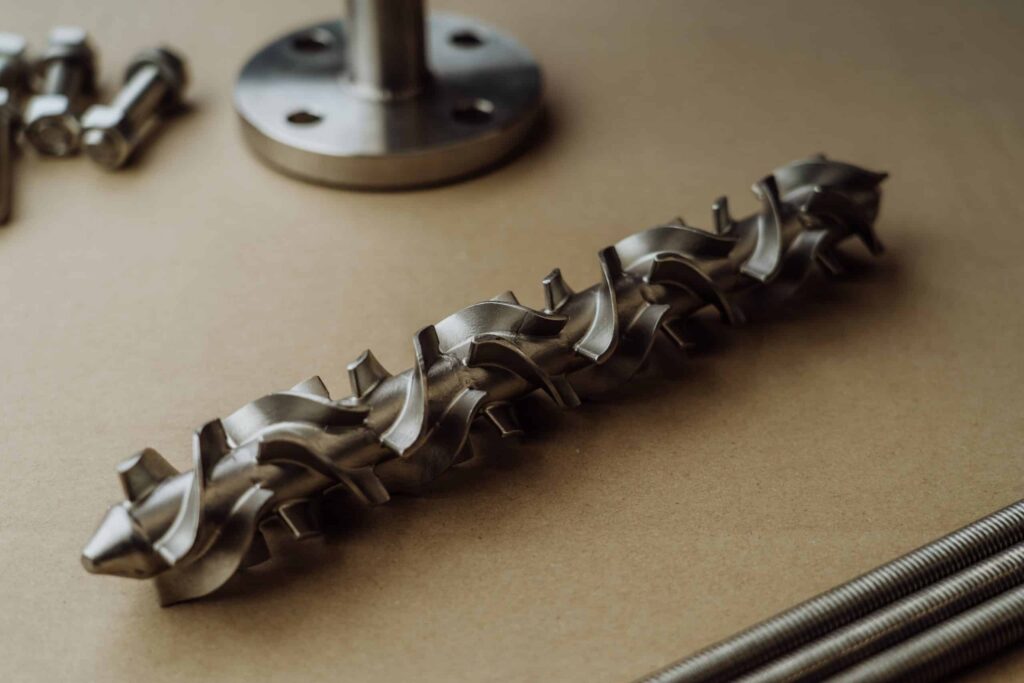
The helical static mixer in one picture
A helical static mixer is easiest to understand if you imagine a flat strip of metal, clamped at both ends and twisted through half a turn. Place a series of those twisted strips in a pipe, alternate the direction of the twist from one strip to the next, and turn each strip so its leading edge meets the trailing edge of the previous one at a right angle. That, in essence, is the classic helical design. It looks almost too simple to be effective, and yet it is one of the most widely used mixing geometries in the process industry.
The reason lies in what happens to the flow at every element. The fluid is divided, rotated in one direction, divided again and rotated in the opposite direction, over and over along the length of the pipe. There is no motor and no moving part. The energy for this repeated folding comes from the pressure drop of the flow, supplied by the pump that already moves the product through the line.
Dutch Valve Vision represents STRIKO Verfahrenstechnik GmbH as exclusive agent for the Netherlands, Belgium and Luxembourg. In the STRIKO range, Helical is the universal mixer, designed to provide uniform mixing across a wide variety of industries. This article looks at the helical static mixer from the inside: how the element geometry works, why it performs in so many different processes, how it compares with the other STRIKO series and what we need to know to configure one for your line.
The choice of element geometry is not a detail. Two mixers with the same diameter and the same length can behave very differently depending on what sits inside the pipe, and the right geometry depends first of all on the medium. A helical design is the logical starting point for many duties, but not for all of them. Understanding how it works, and where its strengths end, helps you make the right call before the order is placed rather than after the first samples come back from the lab.
Left, right, left: why alternating twists mix
The mixing action of a helical static mixer comes from three effects that occur at every element and at every transition between elements.
The first effect is division. The leading edge of each element cuts the incoming flow in two. Because each element is turned at a right angle to the previous one, it cuts across the layers created by the element before it. Every new element therefore doubles the number of layers in the flow.
The second effect is rotation. As the fluid follows the twisted surface, it is carried around the axis of the pipe. Fluid near the wall is moved towards the centre and fluid in the centre is moved towards the wall. This radial exchange is what distinguishes a mixing element from a simple flow divider.
The third effect is reversal. Because the next element twists in the opposite direction, the rotation is reversed abruptly at each transition. That reversal adds shear and disrupts any pattern the flow might otherwise settle into.
In laminar flow, the effect of division is easy to quantify. If each element doubles the number of layers, then after two elements there are four, after five there are thirty-two and after ten there are more than a thousand. A thick additive that entered as a single stripe ends up as a stack of layers so thin that the product is homogeneous for practical purposes. This is the same principle as folding dough, carried out by the geometry of the pipe instead of by hand.
In turbulent flow, the division still happens, but it is joined by vortices generated at the element edges. Those vortices spread the components across the cross section quickly. A turbulent helical static mixer can therefore reach homogeneity in fewer elements than a laminar one for the same task.
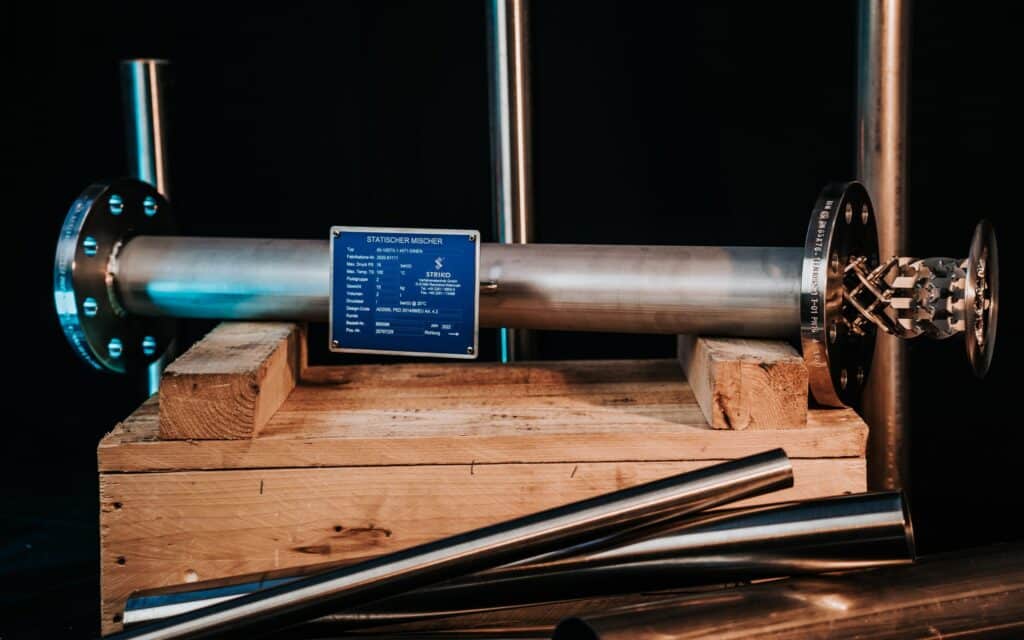
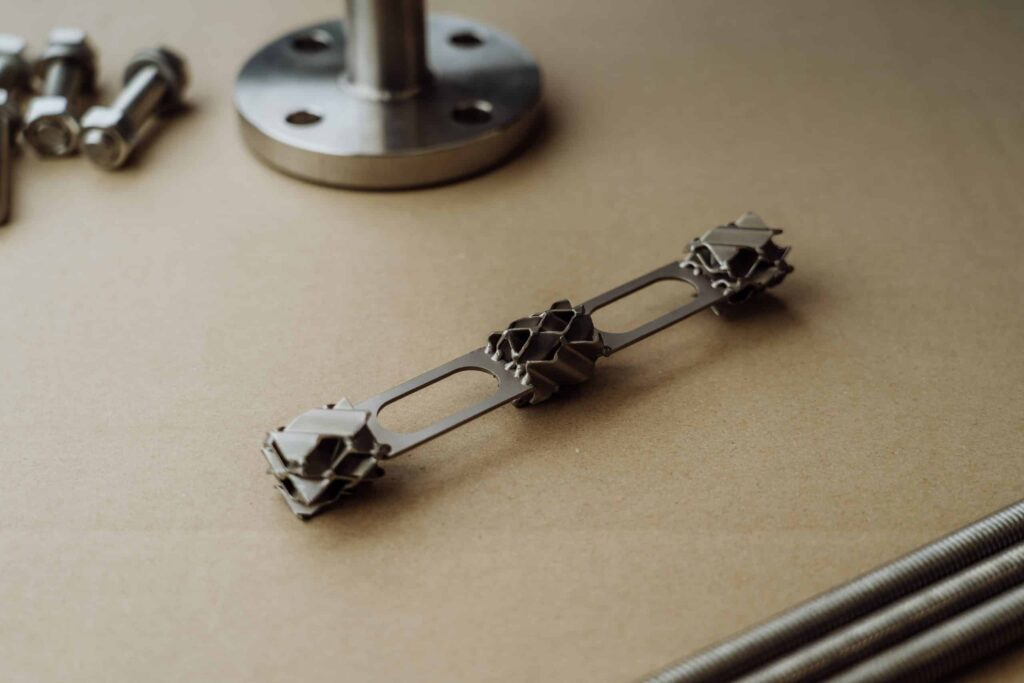
Laminar and turbulent behaviour of a helical static mixer
The flow regime in a helical static mixer is usually described with the Reynolds number, the ratio of inertial to viscous forces. Viscous products such as polymers, resins, syrups or creams tend to flow laminar. Thin liquids such as water and many chemicals tend to flow turbulent, particularly at higher velocities.
The helical geometry works in both regimes, which is part of why it is considered universal. In laminar flow, the number of elements determines how finely the product is divided, and the designer chooses enough elements to reach the required mixing quality. In turbulent flow, velocity and element edges do much of the work, and the question shifts towards pressure drop and the location of dosing points.
A practical advantage of the helical design is its relatively open flow path. Each element divides the pipe into two channels rather than into many small passages. That tends to keep pressure drop moderate compared with more intricate geometries, and it gives deposits fewer places to settle. For many general mixing tasks, that balance between mixing performance and hydraulic resistance is exactly what makes a helical static mixer attractive.
The flip side is that some tasks call for a different balance. With very high viscosity ratios, or with components that are extremely difficult to blend, a geometry designed specifically for viscous media can reach the required result in a shorter length. With gases, the low density and different flow behaviour justify a dedicated design. That is why STRIKO offers more than one series.
Selection starts with four data points
With these we choose series, diameter and number of elements.
Viscosity
Of the main stream and of the added component.
Flow rates
Main flow and dosing, also at part load.
Temperature and pressure
Determine material and allowable pressure drop.
Mixing quality
How homogeneous the product must be downstream.
Why the helical static mixer is called universal
The word universal is used for STRIKO Helical, and it fits. The helical geometry performs across a wide range of viscosities, flow rates and mixing tasks without needing to be redesigned for each one. It blends miscible liquids, distributes dosed chemicals, evens out concentration differences and supports temperature equalisation where a warm and a cold stream meet or where a product must reach a uniform temperature before the next step.
Temperature equalisation is a good example of a less obvious duty. Picture a product that leaves a heat exchanger with a warmer core and cooler layers near the wall, or two streams at different temperatures that must enter a filling machine at one uniform temperature. The radial exchange in a helical static mixer, moving fluid from wall to centre and back at every element, evens out those differences in a short length of pipe. The same mechanism that blends two liquids also blends two temperatures. That versatility is valuable in practice. A plant engineer who needs a mixing step for a new product line does not always know in advance exactly how the process will evolve. A universal design gives room to adjust flows and recipes within a reasonable range without immediately outgrowing the mixer. For OEM builders and integrators who supply skids to several industries, a single well understood geometry also simplifies engineering.
STRIKO designs are configurable in diameter, length and internal elements, so a Helical unit can be matched to the viscosity, flow velocity and end quality a process demands. The number of elements is the most important lever. A short unit suits an easy task, while a longer unit handles more demanding blends.
Specification ready? We will prepare a targeted quote.
Send us medium, pressure, temperature and connection. Our specialists come back with a matching proposal.
STRIKO Helical and the other STRIKO series
STRIKO offers four static mixer series, and Helical is the logical starting point for most general duties. The other three exist because some media ask for something more specific.
EREstat is the STRIKO mixer for food processing and hygienic processes. When hygiene, cleaning and sterilisation drive the design, EREstat is the first series to look at.
STV is optimised for gas processing. Gases behave very differently from liquids in a pipe, and a dedicated design makes sense there.
STX is the mixer for viscous liquids, ideal for thick and syrupy media. STRIKO specialises in static mixers for (highly) viscous media, and STX is where that specialism is most concentrated.
In practice we often start a selection with Helical and then ask whether the medium pushes us towards one of the other series. A thin chemical dosed into water points to Helical. A thick additive blended into a viscous base product points to STX. A food product in a hygienic line points to EREstat. A gas stream points to STV. When the medium sits between categories, the process data decide.
What a helical static mixer cannot do
Being universal does not mean being unlimited, and an honest selection starts with the limits. A helical static mixer mixes only while product flows. When the line stops, mixing stops. It cannot keep solids in suspension in a stationary pipe, and it does not provide residence time for a reaction that needs minutes rather than seconds. If a process depends on either of those, a vessel or a buffer still has a role, with the static mixer taking care of blending before or after it.
A static mixer also cannot correct a wrong ratio. If a dosing pump delivers too little additive, the mixer produces a perfectly homogeneous mixture that is still off specification. Stable dosing and reliable flow measurement are therefore as important as the mixer itself. We advise on the integration of static mixers with valves, measuring instrumentation and process automation for exactly that reason.
Then there are the media that simply ask for a different geometry. Extremely viscous products, or blends where one component is far thicker than the other, can be mixed in a helical unit but may require a long section with a high pressure drop. A geometry built specifically for viscous media, such as STRIKO STX, can then be the more efficient answer. Gas streams have their own behaviour and point towards STV. Strictly hygienic food duties point towards EREstat. Recognising those cases early saves time and avoids a mixer that works, but not as well as it could.
Applications for a helical static mixer
In water and waste water treatment, static mixers distribute neutralising agents, coagulants or air evenly for effective treatment and pH control. A helical static mixer is a natural fit for these relatively thin, turbulent flows.
In continuous chemical processes, a homogeneous mixture accelerates and stabilises reactions and supports consistent quality. In petrochemistry and oil and gas, mixing upstream of a sampling point provides representative samples and reliable homogeneity. STRIKO mixers are also used in cosmetics production, in food and pharma, and in cryogenic or viscous media flows.
Across these sectors the pattern is similar. Where the task is general blending or dosing and the medium is not extreme, the helical design usually delivers the required result with a sensible pressure drop.
Materials, cleaning and maintenance
The material of a Helical unit follows the medium, the temperature, corrosive conditions and hygiene requirements. Options include stainless steel in grades such as SS316, 1.4404 and 1.4571, carbon steel, plastics such as PVC, PE and PVDF, and special coatings or linings for aggressive media. Materials can be adapted to project-specific requirements.
Because the mixer has no moving parts, wear is virtually ruled out and regular mechanical maintenance is unnecessary. STRIKO designs are easy to dismantle for cleaning or inspection and are suitable for inline sterilisation and steam cleaning. The relatively open helical geometry also makes visual inspection of the elements straightforward.
Selecting a helical static mixer with Dutch Valve Vision
To configure a helical static mixer, we need the viscosity of each component, the volume flows at minimum and maximum load, temperature and pressure, and the mixing quality required at the outlet. Chemical compatibility determines the material, and the available pressure drop and pipe size define the hydraulic and mechanical boundaries. With those data we confirm whether Helical is the right series, or whether EREstat, STV or STX suits your process better, and we configure diameter, length and number of elements.
From our office in Monster in the Netherlands we work under an ISO 9001 quality management system, certified by KIWA. Send your viscosities and flows to sales@dutchvalvevision.com or call us on +31 (0)70-2210560 between 09:00 and 17:00 on weekdays.
Frequently asked questions about helical static mixer
What is a helical static mixer?
A helical static mixer is a static mixer with twisted elements inside a pipe. In the classic design each element is twisted through half a turn. The direction of twist alternates from one element to the next. Each element is also turned at a right angle to the previous one. As the flow passes, it is divided, rotated and reversed at every element. There are no moving parts, and the mixing energy comes from the pressure drop of the flow. STRIKO Helical is the universal mixer in the STRIKO range. Dutch Valve Vision supplies it as exclusive STRIKO agent for the Benelux.
Why do the elements alternate between left and right twist?
The alternation is what turns a flow divider into a mixer. Each element rotates the flow around the pipe axis in one direction. At the transition to the next element, the rotation is reversed abruptly. That reversal adds shear and prevents the flow from settling into a stable pattern. Because each element is also set at a right angle to the previous one, it cuts across the layers already formed. The number of layers doubles with every element in laminar flow. After ten elements there are more than a thousand layers. That repeated folding is what produces a homogeneous mixture.
How many elements does a helical static mixer need?
The number depends on the mixing task and the flow regime. In laminar flow, more elements mean finer division and a more homogeneous result. Large viscosity differences or small dosing ratios require more elements. In turbulent flow, vortices help, so fewer elements may be sufficient for the same task. More elements also mean more pressure drop. The design therefore balances mixing quality against the available pressure. We determine the number of elements on the basis of your process data. Please include the required mixing quality at the outlet in your request.
Is a helical static mixer suitable for viscous products?
A helical design works in laminar flow, which is typical for viscous products. Each element divides the flow further, so a thick product can be blended with enough elements. For very high viscosities or extreme viscosity ratios, a dedicated geometry may reach the result in a shorter length. STRIKO offers the STX series specifically for viscous liquids, ideal for thick and syrupy media. STRIKO specialises in mixers for (highly) viscous media. We compare Helical and STX for your specific product. The decision depends on viscosities, flow rates and the available pressure drop. Send us the data and we will advise which series fits.
How does the pressure drop of a helical static mixer compare with other types?
The helical geometry has a relatively open flow path, with each element dividing the pipe into two channels. That tends to keep pressure drop moderate compared with more intricate geometries. The actual value depends on flow rate, viscosity, diameter and the number of elements. In laminar flow, pressure drop rises roughly in proportion to velocity. Under turbulent conditions the increase is steeper, roughly with velocity squared. A more intricate geometry may mix a difficult blend in a shorter length at a higher pressure drop. The right balance depends on the task. We calculate the expected pressure drop as part of our advice.
When should I choose STX, STV or EREstat instead of Helical?
Helical is the universal starting point for general blending and dosing. STX is the better choice for thick and syrupy liquids, where STRIKO’s viscous media specialism counts most. STV is optimised for gases, which behave very differently from liquids. EREstat is designed for food processing and hygienic processes. When a medium clearly belongs to one of those categories, the dedicated series is usually the better fit. When it sits between categories, the process data decide. We often start with Helical and check whether the medium pushes the selection elsewhere. You receive a clear recommendation with the reasoning behind it.
How is a helical static mixer cleaned and maintained?
A helical static mixer has no moving parts, so wear is virtually ruled out. Regular mechanical maintenance is therefore unnecessary. For cleaning or inspection, a STRIKO unit can be taken apart without difficulty. They also support inline sterilisation and steam cleaning. The relatively open geometry makes visual inspection of the elements straightforward. Some products leave deposits over time, so an inspection interval matched to the medium is sensible. A rising pressure drop across the mixer can indicate that inspection is due. We advise on a practical interval for your process.
What information does Dutch Valve Vision need to configure a helical static mixer?
We need the viscosity of each component and the volume flows at minimum and maximum load. Temperature and operating pressure come next. The required mixing quality at the outlet determines the number of elements. Chemical compatibility decides the material. The available pressure drop and the pipe size define the hydraulic and mechanical limits. With these data we confirm whether Helical is right or whether another STRIKO series fits better. We then configure diameter, length and elements. Mail your request to sales@dutchvalvevision.com and you will hear from us shortly.
Check if Helical fits your duty
Send us viscosities, flow rates, temperature, pressure and the mixing quality you need. We will tell you whether STRIKO Helical suits your process or another series fits better.
- +31 (0)70-2210560
- sales@dutchvalvevision.com
- Vlotlaan 641, 2681 TZ Monster, the Netherlands
- Mon-Fri 09:00-17:00