
Rupture disc manufacturers
What separates one rupture disc manufacturer from another, and how STRIKO and Dutch Valve Vision measure up on each point.

When comparing rupture disc manufacturers, look beyond the disc itself: check how burst pressures are tested and calibrated, which standards and documents come with every disc, how broad the range is and who supports you locally. STRIKO Verfahrenstechnik has been active in rupture discs since 1974 and works to a philosophy of testing, evaluating and recalibrating. Dutch Valve Vision is the exclusive STRIKO agent for the Netherlands, Belgium and Luxembourg.
- What rupture disc manufacturers are really selling you
- Testing and calibration: the first question for rupture disc manufacturers
- Standards and documentation to expect from rupture disc manufacturers
- Range: can one manufacturer cover the whole plant?
- Why local support matters as much as the factory
- Where STRIKO and Dutch Valve Vision fit among rupture disc manufacturers
- A practical way to shortlist rupture disc manufacturers
Unsure about the right choice?
Share your process data with our specialists. We check the numbers with you and give reasoned advice.
What rupture disc manufacturers are really selling you
Most rupture disc manufacturers can show you a thin domed membrane of stainless steel and a datasheet that says it will burst at a given pressure. On paper, that makes one disc look much like another. In practice the disc is only the visible part of something bigger: a manufacturing process that has to hit a burst pressure within a tight tolerance, a test regime that proves it, a set of documents that stands up in an audit, and people who can tell you which design suits your process. When a disc protects a reactor and every alarm and control loop before it has already failed, those invisible parts are what you are paying for.
We are Dutch Valve Vision, based in Monster in the Netherlands, and we are the exclusive agent of STRIKO Verfahrenstechnik GmbH for the Netherlands, Belgium and Luxembourg. So yes, we have a view on this. Still, the questions on this page are the ones we would ask of any manufacturer, including the one we represent. A buyer who asks them gets a better disc, whoever makes it.
This page is written for the engineer or buyer who has a requirement on the desk and a handful of rupture disc manufacturers on the long list. It covers what to check, why each point matters and how to turn that long list into a shortlist you can defend to your safety department.
Testing and calibration: the first question for rupture disc manufacturers
A rupture disc has one number that matters above all others: the pressure at which it opens. Everything else supports that number. Ask rupture disc manufacturers how they arrive at it and how they prove it, and you learn a great deal about them within a single conversation.
The burst pressure of a metal disc depends on the material, its thickness, the geometry of the dome and any score lines, and on the way the disc is clamped. Small variations in any of those shift the result. That is why every disc is designed for an exact burst pressure matched to the safe working pressure of the system, with a tolerance determined by material properties and the manufacturing process. A manufacturer who talks confidently about tolerance and can explain where it comes from usually has a firm grip on production. One who treats burst pressure as a catalogue value deserves a second look.
Recognised standards require burst pressure to be verified by testing discs from the same production batch, so the question is rarely whether a manufacturer tests. The better question is what happens with the results. STRIKO has built its approach around a simple philosophy: test, evaluate and recalibrate. Testing shows where the discs actually burst. Evaluating compares that with the design. Recalibrating feeds what was learned back into production, so the next batch lands closer to target. STRIKO has worked this way since it entered the rupture disc market in 1974, and it is the basis of the track record it has built in very different applications since then.
Temperature belongs in the same conversation. The burst pressure is not a number that exists apart from its environment, and at higher temperatures the effective burst pressure can fall, depending on material and design. Ask how the manufacturer accounts for the temperature in the relief scenario, not just the normal operating temperature, and how that is reflected in the design and the paperwork.
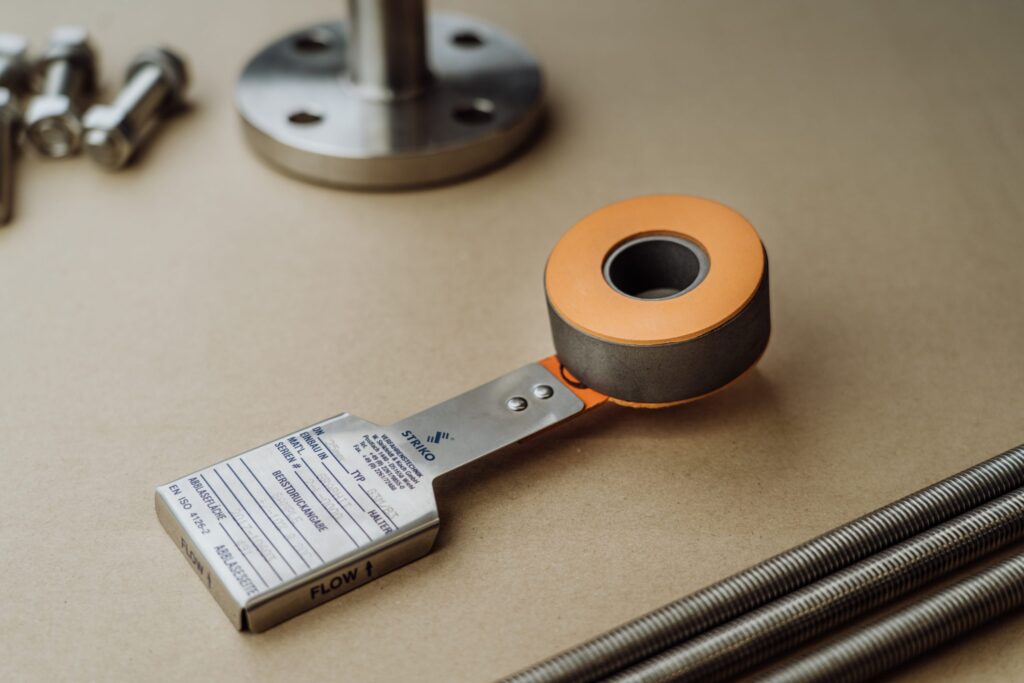
Finally, ask what the manufacturer tells you about handling and installation, because calibration in the factory is only half the story. A disc that is dented during unpacking or mounted against the flow direction will not burst where its certificate says it should. Even small defects can change the burst pressure, so a damaged disc must never be installed. Good manufacturers make mistakes hard to make: clear flow and installation markings on the holder, correct positioning of the disc and a consistent bolt load. When those details are designed in, the burst pressure measured on the test bench is also the burst pressure you get on your vessel.
Standards and documentation to expect from rupture disc manufacturers
The second test is paperwork, and it is less dull than it sounds. A plant that cannot prove what is installed on a pressure vessel has a problem at its next inspection, however good the disc may be.
For metal rupture discs in Europe, the relevant framework includes the Pressure Equipment Directive, ISO 4126 for safety devices against excessive pressure, EN 14491 where explosion safety is concerned, and CE marking. Holders are a separate component with their own requirements. Ours are designed in line with ASME Section VIII, EN ISO 4126 and PED 2014/68/EU, and ATEX where applicable. That combination means a plant built to European rules and a skid engineered to American codes can both be served properly.
Then the documents themselves. For holders we supply material certificates to EN 10204 3.1, pressure calculations, inspection reports and traceability per component. For graphite discs the emphasis is on traceable material quality, burst pressures tested in advance and documentation suitable for audits and compliance. When you compare rupture disc manufacturers, ask for a sample document set for a disc like yours before you order, not after. A quality engineer can tell within minutes whether it will satisfy your inspector or your internal audit.
Quality systems count too. Dutch Valve Vision works with an ISO 9001 certified quality management system, certified by KIWA. For you that means controlled processes, full traceability and thorough documentation on our side of the chain as well as at the factory.
Range: can one manufacturer cover the whole plant?
A single site often needs very different discs. A reactor with a fast exothermic reaction, a storage tank holding a corrosive acid, a sterile line in a pharma suite and an extruder barrel all need pressure relief, but not the same device. If each application ends up with a different supplier, you end up with different document formats, different installation habits and different people to call when something opens.
So look at breadth. The STRIKO programme covers flat metal rupture discs for standard applications, forward acting metal discs designed for high pressure, reverse acting metal discs chosen for durability, aseptic metal discs for pharmaceutical and food processes, extruder discs for demanding polymer processing, rupture discs for tank containers and compact burst plugs. Through Dutch Valve Vision you can also source graphite rupture discs from DN25 to DN400, which resist many acids, bases and aggressive media without a coating, with optional TFE coating, burst detection and vacuum support.
Materials are part of the range as well. Our standard metal disc is made of 316 stainless steel, with Hastelloy and titanium as options. Holders are available in carbon steel, 316/316L stainless steel, duplex, super duplex, Inconel and Hastelloy. Vacuum and double discs cover systems that see both overpressure and underpressure. For the control room, burst detection sensors with an electrical loop or magnetic detection report an opening straight to a PLC, SCADA or DCS.
Range is not about having the thickest catalogue. It is about how often a manufacturer can answer with a design that fits and a reason why, instead of telling you that your application is not something they make.
STRIKO active in rupture discs since 1974
Philosophy: test, evaluate, recalibrate
Exclusive STRIKO agent for the Benelux
ISO 9001 quality system, KIWA certified
Why local support matters as much as the factory
Picture a Friday afternoon. A disc on a reactor has opened, the cause is understood, and production wants to restart. Nobody at that moment cares how impressive the factory is. They care whether someone answers the phone, understands the tag data and can get the right replacement moving.
That is the part of the comparison that rupture disc manufacturers cannot always solve from a distance. Local support means someone who knows the installations in your region and can help with selection, installation questions and replacement. It also means someone who looks at the process first, because the right disc starts with the medium, the operating pressure including peaks, the required burst pressure and the temperature in both normal operation and the relief scenario.
For customers in the Netherlands, Belgium and Luxembourg, that role is ours for STRIKO. We give technical advice on design, selection and application, and we deliver quickly, with support during maintenance or replacement. Engineering support goes further than the order: selecting the right combination of disc and holder, FEM analyses on request, optimisation for cyclic loading and support in HAZOP and other safety studies. We work with EPCs, end users and OEMs, and our office in Monster is reachable Monday to Friday from 09:00 to 17:00.
One practical tip, whichever supplier you choose. Keep spare discs for critical positions. A rupture disc is single use, so the fastest restart after an event is the one where the replacement is already on the shelf.
Where STRIKO and Dutch Valve Vision fit among rupture disc manufacturers
We are not going to tell you that other rupture disc manufacturers make poor products. The market has several experienced names, and many plants run safely on their discs. What we can do is describe honestly where STRIKO stands and what the combination with Dutch Valve Vision offers.
STRIKO is a German manufacturer that specialises in rupture discs and in static mixers for (highly) viscous media. It has been active in rupture discs since 1974, is known worldwide for solid German engineering and designs its products to withstand extreme conditions. Its discs are used in chemical processing, pharmaceutical production and the food industry, protecting installations against both overpressure and vacuum. Ongoing investment in research and development, together with close cooperation with customers, leads to tailor-made solutions when a standard product does not fit.
Dutch Valve Vision is the other half of that equation. We focus on special valves for special services, with most of our work in (petro)chemistry, energy, offshore and hydrogen. Our partners together have more than 60 years of experience in design and custom work. For rupture discs that means a single point of contact in the Benelux who looks at your process, specifies the disc and holder with you, and is still involved when a disc needs replacing years later.
A practical way to shortlist rupture disc manufacturers
Here is a way of working that we see succeed. An engineer drawing up a P&ID for a new reactor, or a maintenance lead preparing a turnaround, sends exactly the same data set to three rupture disc manufacturers. The data set is complete: medium and composition, operating pressure with peaks, required burst pressure, normal and scenario temperature, connection, nominal diameter, back pressure and available space.
The answers then become comparable. Does the manufacturer propose a disc type and explain the choice between forward and reverse acting? Does it ask about pressure cycling and the operating ratio, the relation between maximum operating pressure and burst pressure that governs service life? Does it propose a holder, or explain why direct flange mounting is acceptable? Does it mention the temperature at the moment of bursting? Does it state which documents come with the delivery? A supplier that asks good questions back is usually the one that stays useful long after the purchase order.
Weight the answers according to what matters in your plant. For a toxic medium, leak tightness and burst detection may dominate. For a batch reactor with frequent cycling, reverse acting designs and holder quality may carry the most weight. For a pharma line, aseptic design and documentation for validation come first. For a line carrying a strong acid or another aggressive medium, the question may be whether a graphite disc does the job better than an exotic alloy. There is no universal ranking of rupture disc manufacturers, only a ranking for your particular set of positions.
If STRIKO is on your list, send us the same data set and judge us on the same questions. Email sales@dutchvalvevision.com or call +31 (0)70-2210560. We would rather win on the quality of our answer than on a claim.
Specification ready? We will prepare a targeted quote.
Send us medium, pressure, temperature and connection. Our specialists come back with a matching proposal.
Frequently asked questions about rupture disc manufacturers
Question not listed? Our specialists are happy to help.
Is Dutch Valve Vision a rupture disc manufacturer?
No, and we prefer to be clear about that. The manufacturer of the rupture discs we supply is STRIKO Verfahrenstechnik GmbH. We are STRIKO’s exclusive agent for the Netherlands, Belgium and Luxembourg. That means we handle advice, selection, quotation, delivery and support for customers in those three countries. We also supply graphite rupture discs and rupture disc holders with the associated documentation. Our role is to translate your process data into the right disc and holder. STRIKO’s role is to manufacture, test and calibrate that disc. For you, the result is one local point of contact backed by a specialised factory.
What should I ask rupture disc manufacturers about burst pressure tolerance?
Start by asking how the tolerance is defined and what determines it. For every disc, the tolerance around the set burst pressure follows from material properties and the manufacturing process. A manufacturer should be able to explain that link without hesitation. Ask next how burst pressure is verified, because recognised standards require testing of discs from the production batch. Then ask how the test results are used, since that shows whether the process improves over time. STRIKO works to a philosophy of testing, evaluating and recalibrating for exactly this reason. Also ask how the temperature at the moment of bursting is taken into account, as the effective burst pressure can fall at higher temperatures. The answers tell you more about a manufacturer than any brochure.
Which standards apply to rupture discs in Europe?
Metal rupture discs fall under the Pressure Equipment Directive, ISO 4126 and CE marking, with EN 14491 relevant where explosion safety is involved. Rupture disc holders have their own framework. Ours are designed in line with ASME Section VIII, EN ISO 4126 and PED 2014/68/EU. Where a holder is installed in a potentially explosive atmosphere, ATEX applies as well. Burst detection sensors used in such zones need suitable ATEX certification too. Which requirements apply exactly depends on the installation, the medium and the country of use. That is why we check the applicable requirements as part of every selection. Tell us which codes your project is built to and we will match the disc, holder and documents to them.
What documents should come with a rupture disc delivery?
At minimum you want documents that prove what the disc is, what it is made of and at what pressure it is designed to burst. For our holders we supply material certificates to EN 10204 3.1. Pressure calculations and inspection reports are part of the package as well. Traceability is provided per component, so every part can be followed back to its origin. For graphite discs the emphasis is on traceable material quality and burst pressures tested in advance. Documentation should be fit for audits and compliance checks, not just for goods receipt. Ask for a sample document set before ordering so your quality department can review it in advance. That avoids discovering a gap only when the inspector is on site.
Which rupture disc types does STRIKO manufacture?
The STRIKO programme covers several families of rupture discs. Flat metal rupture discs are intended for standard applications. Forward acting metal discs are designed for high pressure environments. Reverse acting metal discs are chosen for durability and efficiency. Aseptic metal discs serve the pharmaceutical and food industries. Extruder discs are built for demanding polymer processing, and rupture discs for tank containers protect transport tanks. Compact burst plugs with a threaded connection complete the range. We help you choose the family and the exact design that suits your process conditions.
Why work with a local agent instead of ordering from a factory abroad?
A local agent adds knowledge of your region and often of your installations. For customers in the Benelux, we give technical advice on the design, selection and application of STRIKO products. We deliver quickly and support you during maintenance or replacement. When a disc opens unexpectedly, a short line to someone who knows your tag data saves valuable time. We also handle engineering questions, from disc and holder combinations to FEM analyses on request and HAZOP studies. Our office in Monster is open Monday to Friday from 09:00 to 17:00. The manufacturer remains responsible for production, testing and calibration. Together that gives you factory quality with support close to your plant.
Can I combine a disc from one manufacturer with a holder from another?
We generally advise against it. The burst pressure of a disc depends partly on how it is clamped, positioned and sealed in the holder. A holder designed for a different disc geometry can change that load and with it the burst behaviour. A poorly matched holder can cause premature failure, leakage or a wrong burst pressure. That is why we always select disc and holder as a combination. Holder material is also chosen together with the process data and the disc being used. If you have existing holders in the plant, send us the tag data and drawings so we can assess the situation. Safety should never depend on the assumption that two parts will fit together.
What information do rupture disc manufacturers need for a quotation?
Every serious manufacturer will ask for roughly the same data set. First comes the medium and its composition. Then the operating pressure including peaks and the required burst pressure. Temperature is needed twice, for normal operation and for the relief scenario. The connection, nominal diameter, back pressure and available installation space complete the technical picture. For replacements, the existing tag data and current specification are often enough to start. Mention also which standards and documents your project requires and whether burst detection is needed. Send that set to sales@dutchvalvevision.com and we will come back to you with a STRIKO proposal.
Put STRIKO to the test on your specification
Send us the medium, operating pressure including peaks, required burst pressure, temperatures and connection. We propose the matching STRIKO disc and holder, with the documents your project needs.
- +31 (0)70-2210560
- sales@dutchvalvevision.com
- Vlotlaan 641, 2681 TZ Monster, the Netherlands
- Mon-Fri 09:00-17:00